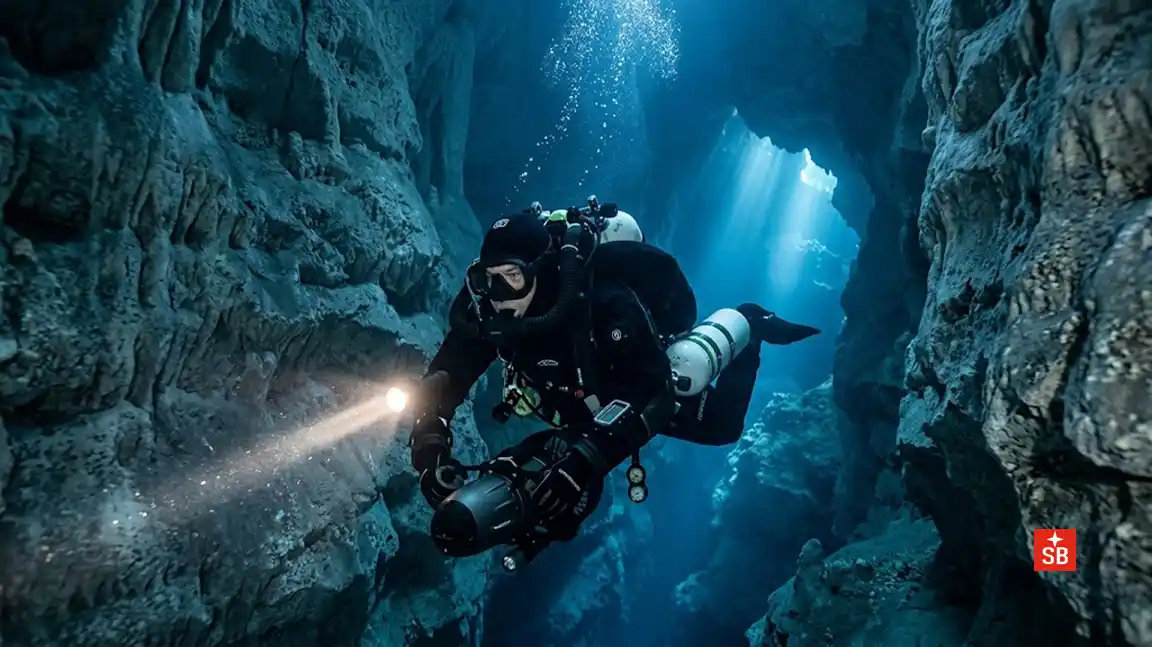
Far beneath Norway’s frozen mountains, crystal clear water hid one of nature’s deadliest traps. In February 2014, five highly trained Finnish cave divers entered the Plura cave system to complete an extraordinary underwater journey.
The water looked calm enough to fool the eye, but beneath its glass-like surface waited crushing pressure, freezing cold, and invisible chemical dangers. Two divers never returned. This was not simply an accident. It was a deadly conversation between physics, chemistry, and the human body. In Plura Cave, those deep waters guarded secrets that even experience could not completely overcome.
The cave is shaped like a giant rocky letter U. To cross it, the divers had to descend more than 130 metres below the surface, swim through narrow underwater tunnels, and then climb back towards daylight. Think of the water pressure like stacking many heavy trucks on your chest. At that depth, the pressure becomes nearly fourteen times greater than at sea level. “Welcome to my kingdom,” the pressure seemed to whisper. “Here, I make my own rules.” Under such enormous pressure, ordinary breathing becomes a scientific challenge rather than a natural act.
This is where chemistry begins to shape survival. According to Henry’s Law, gases dissolve more easily into liquids when pressure increases. Your blood behaves much like a bottle of soft drink sealed tightly under pressure.
The deeper a diver goes, the more nitrogen dissolves into the blood and body tissues. Everything appears normal while the pressure remains high, but hidden changes are quietly taking place inside the body. In scientific jargon, the tissues gradually become saturated with dissolved gases, preparing the stage for possible decompression illness if the ascent is not carefully controlled.
Disaster struck when diver Jari Huotarinen became trapped inside a narrow rocky passage nearly 110 metres below the surface. His underwater scooter became tangled, forcing him to struggle with great physical effort. Like a car engine pushed to its highest speed, his muscles demanded more oxygen while producing increasing amounts of carbon dioxide, or CO₂. Every second of struggle pushed his body further towards its biological limits. Sometimes, the strongest enemy is the one we create within ourselves.
The divers were using Closed Circuit Rebreathers, or CCRs, sophisticated breathing systems that recycle exhaled air instead of releasing bubbles into the water. Inside each rebreather is a chemical called soda lime, made mainly of calcium hydroxide and sodium hydroxide.
This chemical works like a faithful housekeeper, quietly sweeping away carbon dioxide from every breath. “Leave the cleaning to me,” the soda lime seems to say. But even the best worker cannot keep pace when work arrives faster than it can be handled. As Jari’s breathing became rapid because of panic and intense effort, the air passed too quickly through the chemical scrubber. Carbon dioxide escaped removal and returned with every breath.
Soon his blood began accumulating excessive carbon dioxide, a dangerous condition called hypercapnia. Ironically, the human brain often reacts more strongly to rising carbon dioxide than to falling oxygen. The brainstem sounded its ancient emergency alarm, creating an overwhelming feeling called air hunger. The harder he breathed, the less effective the rebreather became. It was like trying to extinguish a fire by adding more fuel. Rising carbon dioxide made his blood more acidic, causing confusion, blurred vision, poor judgement, and extreme panic. Within minutes, his body’s own chemistry became an invisible prison, and he lost consciousness beneath the icy water.

Another diver, Jari Saarinen, reached his trapped friend and tried desperately to rescue him. But the rescue effort placed enormous demands on his own body. The water temperature was only about 3 degrees Celsius. In such freezing conditions, the body performs peripheral vasoconstriction, narrowing blood vessels in the arms and legs to protect the heart and brain.
At the same time, the dense gas under extreme pressure became much harder to breathe, almost like trying to drink thick milkshake through a tiny straw. Exhaustion, cold stress, and rising carbon dioxide combined into a perfect physiological storm. Soon, he too became unconscious and passed away beside his companion.
The surviving divers now faced another terrible challenge. Their bodies had absorbed large amounts of nitrogen during the long dive. Normally, divers rise slowly and stop several times so dissolved nitrogen can safely leave the body through the lungs. But emergencies rarely allow perfect choices. Forced to escape quickly, they had to shorten important decompression stops. The result was similar to opening a shaken bottle of soda too quickly. As pressure suddenly dropped, dissolved nitrogen burst into countless tiny bubbles inside the blood and tissues. This dangerous condition is called decompression sickness, or the bends. These bubbles block blood vessels like tiny traffic jams, causing severe joint pain, nerve damage, paralysis, and even death. One survivor developed severe decompression sickness, while another endured an agonising eleven hour decompression ascent alone in complete darkness before reaching safety.
The Plura Cave disaster reminds us that nature never negotiates with scientific laws. Pressure, temperature, chemistry, and physiology worked together like four relentless judges, each delivering its own verdict. The rebreather did not simply fail mechanically, it was overwhelmed chemically. The brain did not simply panic emotionally, it responded biologically to rising carbon dioxide. The blood itself became a battlefield where invisible gases changed form as pressure fell. Every event followed well understood scientific principles, yet together they created a tragedy no one could reverse.
This heartbreaking incident continues to teach doctors, physiologists, chemists, and diving experts valuable lessons about the limits of the human body. Deep underwater, technology can assist, training can prepare, and courage can inspire, but nature always has the final word. The Plura Cave disaster remains a powerful reminder that science is not only found inside laboratories and textbooks. Sometimes, it writes its most unforgettable lessons in the silent darkness beneath the earth, where every breath becomes a delicate balance between life and death.