Space may look empty and peaceful from Earth, but for the human body, it is an extreme environment. Astronauts face microgravity, isolation, disrupted sleep, and perhaps most importantly, higher exposure to space radiation. Scientists have therefore been asking a fascinating question: What happens to our DNA when we leave Earth?
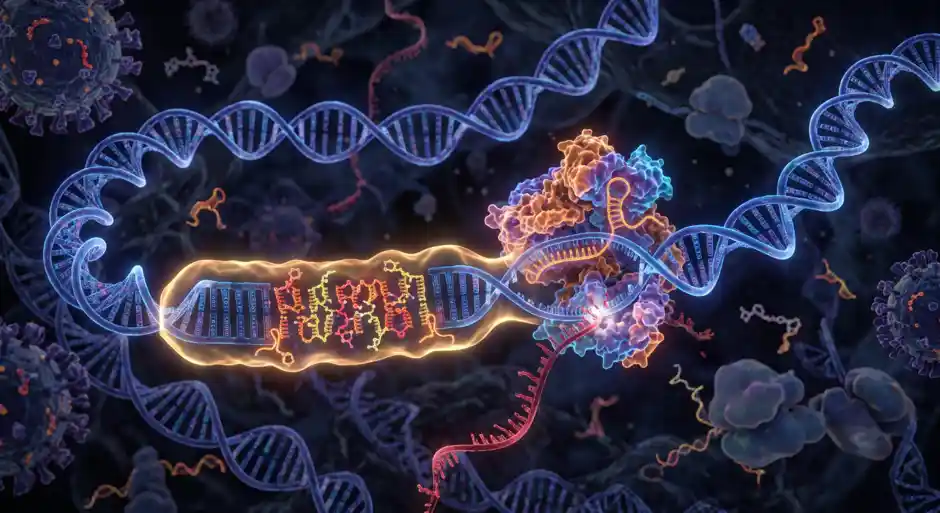
Our DNA is like a vast instruction manual, quietly guiding how our cells work. When we travel into space, this manual does not simply get rewritten, but the way some instructions are read can change. Space, in a way, acts like a strict examiner, testing how well the human body can cope with unfamiliar conditions.
The answer is more complicated than simply saying that space “changes your DNA.” The truth lies somewhere between damage, repair, adaptation, and regulation. In simple words, the genetic book may remain largely the same, while some pages are read differently.

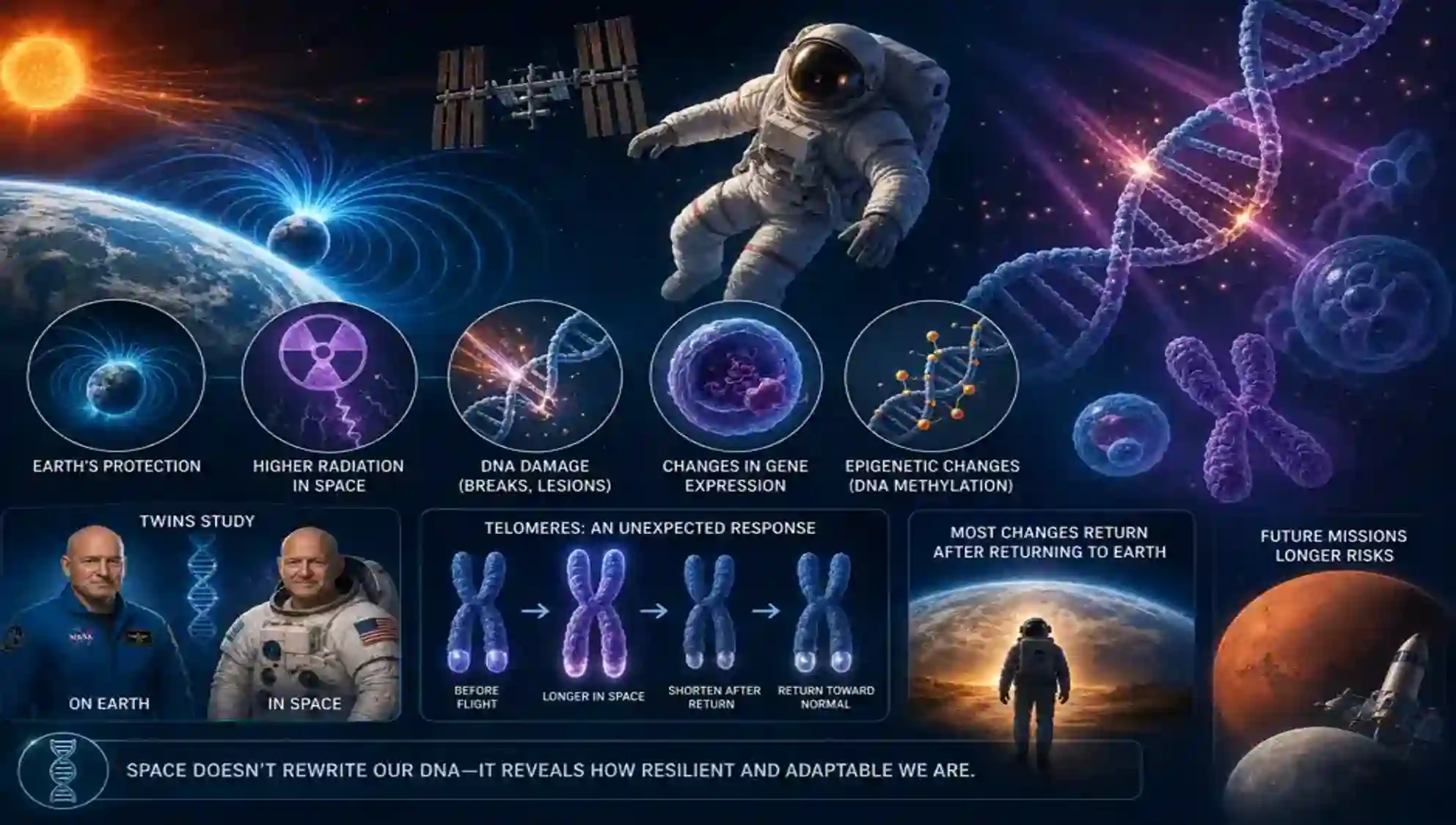
One of the biggest concerns is radiation. Earth’s atmosphere and magnetic field protect us from much of the high-energy radiation coming from the Sun and deep space. Astronauts outside Earth’s protective environment receive greater exposure to radiation, which can damage DNA and cause breaks or other forms of genetic injury. This is particularly important for future missions to the Moon and Mars, where astronauts could spend much longer periods outside Earth’s protective magnetic field.
Radiation can be thought of as an invisible storm of energetic particles. Unlike an ordinary storm, however, there may be no clouds, thunder, or warning signs. The damage can happen silently, making radiation one of the biggest long-term challenges of deep-space travel. In scientific language, this is a form of genotoxic stress, meaning stress that can harm genetic material.
But radiation isn’t the only factor. Spaceflight is a package deal, bringing several unusual conditions together. Microgravity, altered sleep, confinement, stress, and changes in metabolism can all influence how cells behave. The human body, in other words, has to rewrite its daily routine even when it does not rewrite its DNA sequence.
Spaceflight can also change gene expression, the process by which cells decide which genes to switch on or off. This doesn’t necessarily mean the DNA sequence itself has changed. Instead, the environment can alter how the existing genetic instructions are used.
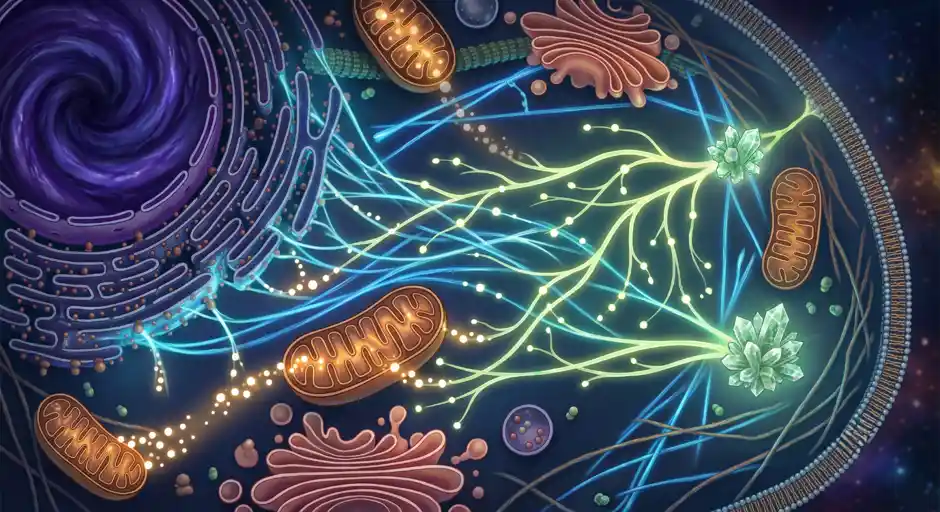
Gene expression is somewhat like a control panel in a huge building. The wiring may remain unchanged, but different switches can be turned on or off depending on what is needed. This is where the phrase “switching genes on and off” becomes useful. The genes are still present, but cells may change when and how strongly they use them.
One of the best-known examples came from NASA’s Twins Study. Astronaut Scott Kelly spent nearly a year aboard the International Space Station while his identical twin, Mark Kelly, remained on Earth. Scientists compared their biological changes before, during, and after the mission. They found changes in gene expression, DNA methylation, and other molecular processes in Scott during spaceflight. Importantly, most of these changes returned toward normal after he came back to Earth.
The twin study provided scientists with a rare natural comparison. Because Scott and Mark started with almost identical genetic backgrounds, their contrasting environments offered researchers a valuable biological reference point. It was almost like having two copies of the same scientific experiment, with one copy travelling into space and the other staying on Earth.
Another surprising finding involved telomeres, protective structures at the ends of chromosomes. Scott’s telomeres became unexpectedly longer during his year in space and then shortened rapidly after his return, with average telomere length eventually moving back toward normal. Scientists are still investigating what caused this unusual response and what it means for long-term health.
Telomeres are often compared with the plastic tips on shoelaces because they help protect chromosome ends from damage. Their behaviour during spaceflight was therefore a twist in the scientific story. Longer telomeres might sound like a clear sign of slower ageing, but biology rarely follows such a simple script. The irony is that something associated with ageing can behave unexpectedly under the unusual conditions of space.
Researchers have also observed epigenetic changes, including alterations in DNA methylation. Epigenetics can influence gene activity without changing the underlying DNA sequence itself. These changes may help cells adapt to the unusual conditions of space.
DNA methylation works like a set of molecular notes placed on the genetic instruction book. These notes can influence whether certain genes are more or less active. This is why scientists often describe epigenetics as a layer of biological control sitting on top of the DNA sequence.
So, does space permanently rewrite human DNA?
Not in the way science fiction suggests. Spaceflight can cause DNA damage and temporary changes in gene regulation, but it does not appear to fundamentally rewrite an astronaut’s genetic code. Most observed molecular changes in the Twins Study moved back toward baseline after returning to Earth.
The phrase “DNA damage” may sound like a biological disaster, but cells are not helpless. They have repair systems that constantly patrol genetic material and fix many forms of damage. It is a molecular game of damage and repair, with the cell’s repair machinery working behind the scenes. As the saying goes, “prevention is better than cure”, but in space biology, repair is equally important.
The bigger concern is what could happen during years-long missions. As humans prepare for longer journeys to the Moon and potentially Mars, understanding radiation-induced DNA damage, cellular ageing, and genetic repair will become increasingly important.
A short space mission may give the body a temporary biological shock, but years in deep space could tell a very different story. The longer the journey, the longer the exposure, and the more important cellular repair becomes. For future astronauts, the real challenge may not simply be reaching another world, but keeping their cells healthy along the way.
Space isn’t rewriting who we are, but it is revealing just how adaptable our genome can be. Our genetic code is not a rigid stone tablet, but a remarkably responsive system that interacts with its surroundings. In that sense, space is both a challenge and a teacher, showing us that the human body can bend, adapt, repair, and recover while still carrying the same fundamental genetic identity.