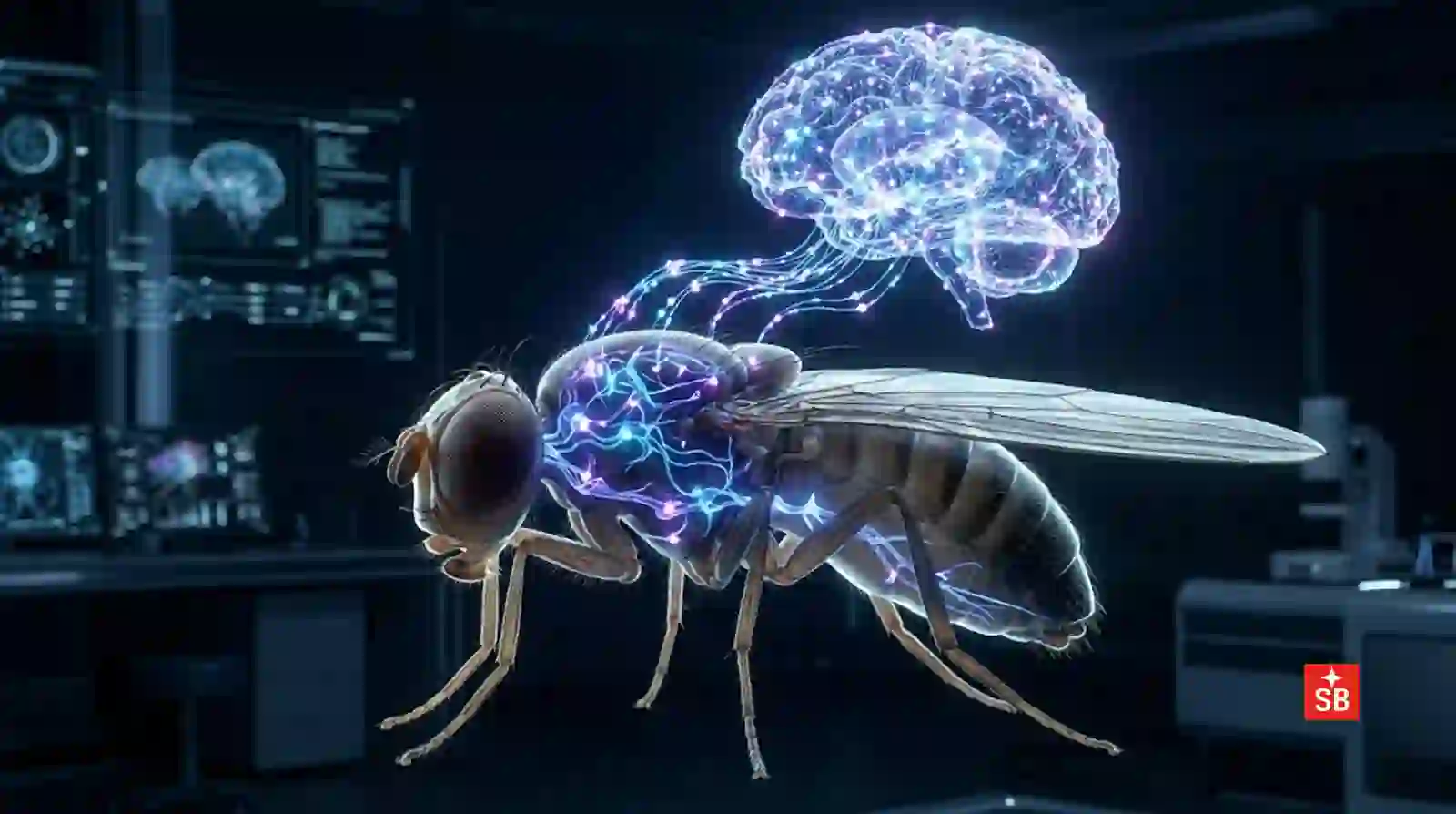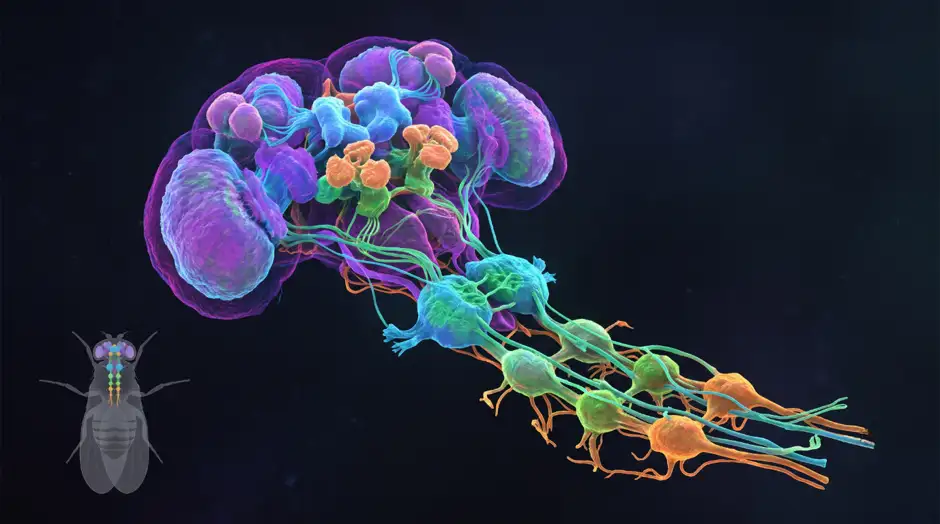
A fruit fly’s brain is smaller than a poppy seed. Yet inside that tiny space are more than 100,000 neurons connected by millions of tiny links. Now, scientists have mapped every one of them. They have created the first complete wiring diagram, or connectome, of an adult male Drosophila melanogaster nervous system. The map contains 166,691 neurons and around 125 million synaptic connections, covering not only the brain but also the optic lobes and the ventral nerve cord, the insect equivalent of a spinal cord.
But why map a fly’s brain in such detail?
A list of neurons tells how many cells a brain contains. A connectome shows something more useful: how those cells are connected. By tracing these connections, we can follow information as it moves from a sensory organ into the brain and eventually to the neurons controlling movement and behaviour. Creating this map was far from simple. They first used electron microscopy to capture millions of extremely thin slices of the fly’s nervous system. Computers and artificial intelligence then helped reconstruct the neurons in three dimensions and trace their connections. Experts checked and corrected the resulting maps to make sure the wiring was accurately represented.
The new male map also solves another problem: we can now directly compare complete male and female fly nervous systems. A female fruit-fly connectome was released earlier, containing about 140,000 neurons. Comparing the two maps revealed that most neural circuits involved in basic sensation and movement are shared. However, some neurons are found only in one sex, while others exist in both but connect differently. These differences are especially interesting in brain regions involved in social behaviours such as courtship and aggression. Studies found sex-specific and differently connected neurons concentrated in higher brain regions, where sensory information can be routed into different behavioural responses.
The map has already helped investigate how flies process vision and taste, including how sensory information can eventually influence behaviours such as eating, walking and mating. Of course, a fruit fly is not a miniature human. Its nervous system contains a tiny fraction of the neurons found in the human brain. But that is exactly what makes it useful: we can study an entire functioning nervous system at a level that is currently impossible for humans. The long-term goal is bigger than understanding flies.
By learning how a relatively small brain turns electrical signals into movement and behaviour, we hope to uncover general principles of how nervous systems work and develop better ways to study more complex brains in the future. For now, a creature we usually swat away has given neuroscience something extraordinary: a complete map of a brain’s wiring, one neuron at a time.
Sources