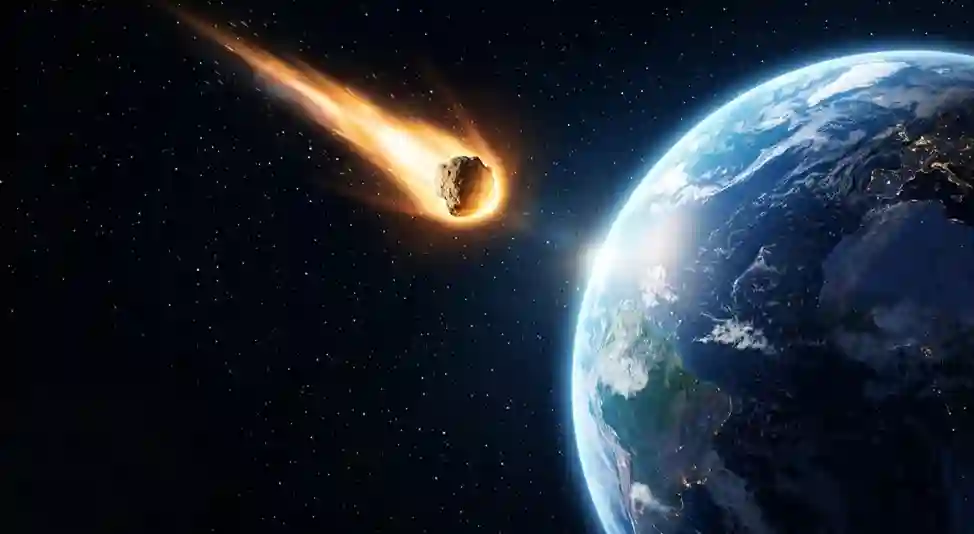
On the afternoon of September 6, 2026, a fragment of rock no bigger than a beach ball streaked into Earth’s atmosphere over the Indian Ocean, northwest of Australia, and quietly disintegrated. No one was hurt. No damage was done. Yet astronomers around the world were watching, because for only the 13th time in recorded history, they saw the asteroid coming before it arrived.
A Six-Hour Warning
The object, temporarily catalogued as CERNQ52 and later given the official designation 2026 RW1, was first picked up late on September 6 by automated telescopes at the Mount Lemmon Observatory in Arizona, part of the Catalina Sky Survey. Earlier, fainter observations were subsequently traced back to the Pan-STARRS survey in Hawaii, allowing scientists at NASA’s Center for Near-Earth Object Studies (CNEOS), based at the Jet Propulsion Laboratory, to rapidly refine the object’s orbit and predict almost exactly where and when it would hit.
Roughly seven hours after discovery, at 16:07 UTC, the roughly 0.8-meter rock struck the atmosphere near 13.77°S, 116.43°E. Richard Moissl, head of Planetary Defence at the European Space Agency, announced the incoming object hours ahead of time, noting simply that “the impact will likely cause a bright meteor.” NASA’s Planetary Defense Coordination Office echoed the sentiment, explaining that such harmless encounters “provide an invaluable test of our planetary defense capabilities” to monitor larger, more dangerous objects.
Why So Rare?
Objects this small are usually invisible until they flash across the sky as fireballs. Surveys simply aren’t sensitive enough to catch meter-scale rocks against the vastness of space until they’re nearly on top of us. What makes 2026 RW1 special is its orbit: analysts on the Minor Planet Mailing List suggested it may be the first “Aten-type” asteroid ever detected before impact, a class whose orbits keep them close to the Sun and mostly hidden in daytime glare: precisely the blind spot that ground-based, night-sky surveys struggle to cover.
That blind spot is exactly what ESA’s planned NEOMIR space telescope, to be stationed between Earth and the Sun, is designed to close, giving astronomers eyes on the sky’s most dangerous hiding place.
A Small Rock, A Big Signal
No one was ever at risk from 2026 RW1. Objects under roughly 25 meters typically burn up completely, at most scattering harmless dust or pebbles. But each successful early detection sharpens the global tracking network’s reflexes for the day a genuinely hazardous object is spotted. In that sense, this tiny meteor over the Indian Ocean wasn’t really about the rock at all. It was a live, real-world rehearsal for planetary defense.
Reference
European Space Agency. (2026). Planetary defence. https://www.esa.int/Space_Safety/Planetary_Defence
NASA Jet Propulsion Laboratory, Center for Near-Earth Object Studies. (2026). CNEOS: Center for Near-Earth Object Studies. https://cneos.jpl.nasa.gov/
Coffinet, A. (2026, September 7). 2026 RW1: Small asteroid detected before hitting Earth. EarthSky. https://earthsky.org/space/