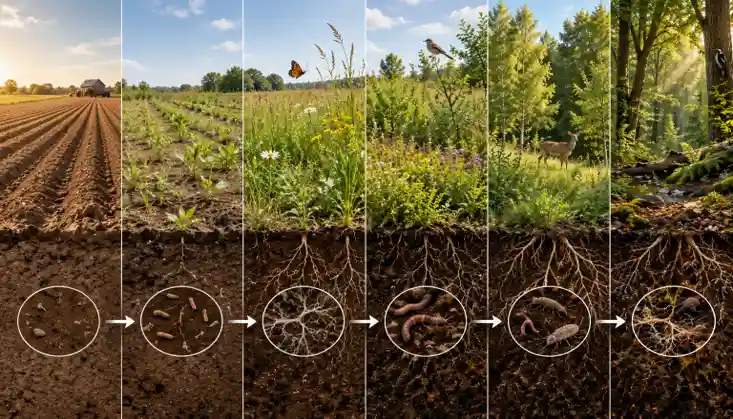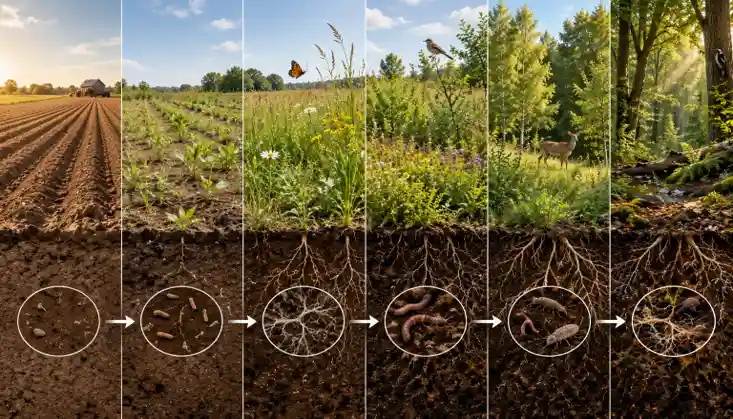
Imagine a farm field that has been cultivated for decades. Then, one year, nobody plants anything. No ploughing. No fertilizers. No pesticides. No harvesting.
What happens next?
At first, it may look like the land is simply being abandoned. But underneath the surface, an ecological transformation has already begun. The field starts undergoing secondary succession a gradual process in which biological communities change as human disturbance disappears.
The first pioneers arrive
Within the first few seasons, fast-growing weeds and grasses usually take advantage of the open space. Their roots stabilize the soil, while their leaves provide food and shelter for insects and other organisms.
As vegetation becomes denser, the ecosystem begins attracting more organisms. Pollinators, herbivores, predators, birds and soil organisms can return, creating increasingly complex food webs.
At the same time, the soil begins changing.
Without repeated ploughing, roots and dead plant material contribute organic matter to the soil. Microbes, fungi and soil animals become increasingly important in decomposition and nutrient cycling. A 2026 review emphasizes that soil biodiversity plays major roles in nutrient cycling, decomposition, plant productivity and ecosystem functioning.
From weeds to woodland?
What happens over decades depends heavily on the location.
In some regions, shrubs gradually replace grasses and eventually give way to young forests. Elsewhere, the field may remain grassland or develop into a different stable ecosystem.
Carbon can also accumulate. A meta-analysis of temperate agricultural soils found that abandoned fields had, on average, higher soil organic carbon than actively cultivated land, although the amount varied substantially with environmental conditions.
But there is an important misconception: abandonment does not automatically restore nature to its original state.
Nature doesn’t always return to what was there before
Agriculture can leave a long-lasting legacy. Compacted or depleted soils, altered nutrient levels, invasive species and the loss of nearby native species can influence what grows next.
In fact, a long-term study found that even after 91 years, formerly cultivated grasslands still had only about three-quarters of the plant diversity and half the productivity of nearby ecosystems that had never been ploughed.
Recent research also shows that the outcome can differ dramatically between ecosystems. A 2024 global analysis found that most bird and mammal species studied gained habitat after cropland abandonment, but many species still experienced habitat loss because of continued agricultural conversion elsewhere.
And sometimes, abandonment can actually reduce biodiversity. In Japanese rice fields, for example, abandonment was associated with substantial declines in species richness and abundance, particularly among organisms dependent on aquatic habitats.
So what really happens?
An abandoned farm field becomes a living experiment in ecological recovery.
It may gradually rebuild soil carbon, develop new plant communities, support more wildlife and eventually resemble a natural ecosystem. But it may also follow a completely different trajectory or require active restoration to recover its former biodiversity.
The surprising lesson is that nature is remarkably good at rebuilding itself, but recovery is not the same as simply pressing a reset button.
Sometimes, leaving a field alone is enough.
Sometimes, nature needs a little help finding its way back.
Sources: