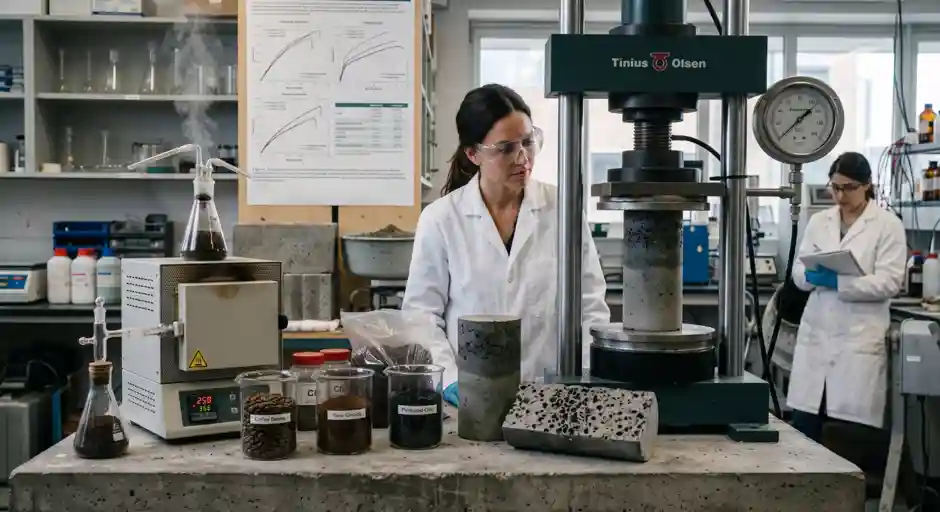
What happens to the coffee grounds left behind after your morning cup? Usually, they end up in the bin. But Australian researchers found that this waste can be given a very different second life as part of stronger concrete. Researchers at RMIT University developed a way to turn spent coffee grounds into a carbon-rich material called biochar, which can replace part of the sand normally used in concrete. In laboratory tests, the resulting concrete showed a 29.3% increase in compressive strength compared with conventional concrete under the conditions tested. The trick is that the coffee grounds cannot simply be poured into the concrete mixture.
Raw coffee waste contains organic compounds that can interfere with the hydration reactions responsible for turning cement and water into a strong solid. When they directly added untreated coffee grounds, the resulting concrete actually performed worse. So the team first subjected the spent coffee grounds to pyrolysis, heating them to about 350°C in the absence of oxygen. This converts the organic material into a more stable, carbon-rich biochar with properties that make it more suitable for use in concrete.
They then used the coffee biochar as a partial replacement for fine aggregate, essentially taking the place of some of the sand. Different replacement levels were tested, with the study finding the strongest improvement at the conditions used for the optimized mixture. The reported 29.3% increase came from concrete containing coffee biochar replacing part of the sand. There is another reason this idea is interesting: sand is not an unlimited resource. Concrete is produced on an enormous scale, creating huge demand for natural aggregates. At the same time, spent coffee grounds are generated in large quantities and often end up in landfills, where organic waste can contribute to greenhouse-gas emissions. Turning one waste stream into a useful construction material could therefore address two problems at once, reducing some dependence on natural sand while giving discarded coffee a new purpose.
And the idea has moved beyond the laboratory. RMIT researchers have worked with local authorities on coffee-biochar concrete footpaths, while later infrastructure projects have incorporated concrete containing biochar made from spent coffee grounds. However, these real-world trials do not mean the material is already ready to replace conventional concrete everywhere. Long-term performance, processing costs, supply chains and construction standards still need to be evaluated. So the next time a cup of coffee leaves behind a pile of grounds, it may be worth remembering that the waste is not necessarily worthless. With the right treatment, yesterday’s coffee could become part of tomorrow’s concrete.
Source: