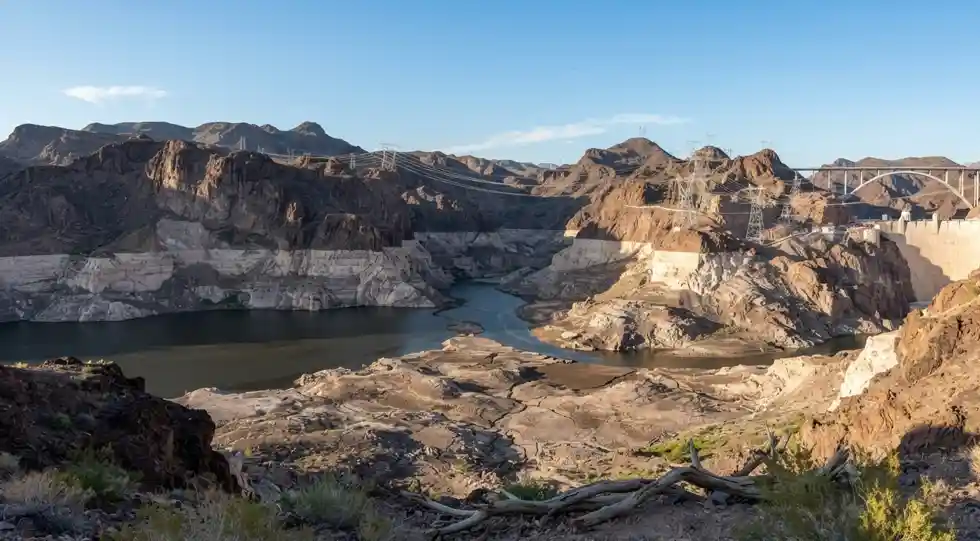
For decades, Lake Mead stood as a shimmering oasis in the heart of the Mojave Desert, a testament to 20th -century engineering that fueled the rise of the American Southwest. Today, it stands as a stark monument to a rapidly changing climate. By late 2026, the reservoir dropped to historic lows, hovering below 1,040 feet above sea level, leaving it at a staggering 26% of its full capacity. The iconic white “bathtub ring” of exposed mineral deposits now looms high above the water, revealing a parched landscape of sunken boats, forgotten World War II watercraft, and the skeletal remains of the ghost town of St. Thomas, Nevada.
Lake Mead is not just shrinking; it is a canary in the coal mine for an entire ecosystem.
The Anatomy of a Crisis: Why is Lake Mead Disappearing?
The drying of Lake Mead is not the result of a few dry seasons. It is a structural crisis driven by a combination of historical miscalculations and unprecedented environmental shifts. The American Southwest is currently trapped in a megadrought—a severe, multi-decade drought. Tree-ring data and soil moisture reconstructions show that the region is experiencing its driest period in over 1,200 years. This isn’t just a temporary weather pattern; it is a fundamental shift in the regional climate baseline.
As global temperatures rise, the atmosphere acts like a giant sponge. Higher temperatures drastically increase the rate of reservoir evaporation, stripping millions of gallons of water directly from the surface of Lake Mead before it can ever be used. Besides, Lake Mead relies entirely on the Colorado River, which is fed by melting winter snowpack in the Rocky Mountains. Due to warmer winters, less snow is falling. What does fall is often absorbed by intensely dry mountain soils or evaporates directly into the air (a process called sublimation) before it can ever melt into the rivers.
Nature isn’t the only culprit; human legal frameworks are also to blame. The 1922 Colorado River Compact: the legal agreement that divides water among seven Western states was written during an unusually wet era. It permanently allocated more water to cities and farms than the river actually produces in a normal year. For a century, we have been overdrawing from an account that was already over-allocated.
The shrinking of Lake Mead is triggering a massive domino effect across the United States:
- The Threat of “Dead Pool”: While the lake is not completely dry, it sits roughly 150 feet above “dead pool” level (895 feet). If the reservoir drops to this point, water can no longer flow through the Hoover Dam by gravity, effectively cutting off downstream supply.
- Energy Grid Instability: The Hoover Dam provides clean hydroelectric power to millions of people in California, Nevada, and Arizona. As the water level drops, the water pressure spinning the turbines decreases, crippling the dam’s power generation capacity.
- Agricultural and Urban Strain: The Colorado River Basin sustains 40 million people and irrigates over 5 million acres of farmland that supplies a massive portion of America’s winter vegetables. A dry Lake Mead threatens the food and water security of the entire nation.
Where Do We Go From Here?
The crisis at Lake Mead proves that the old ways of managing water in the West are obsolete. Reversing this trend requires aggressive climate action, strict new water-sharing agreements among Western states, and heavy investment in recycling and desalination technology. The exposed history at the bottom of Lake Mead is a reminder of our past, but the empty basin itself is a loud warning about our future.
Sources:
Milošević, M., Haddad, S., & Grmusha, M. (2026). Analysis of annual water level variability in the Mead and Powell reservoirs under the influence of climate change. Water, 18(2), 224. MDPI Water
Udall, B., & Overpeck, J. (2017). The twenty-first century Colorado River hot drought and implications for the future. Water Resources Research, 53(3), 2404–2418. AGU Water Resources Research