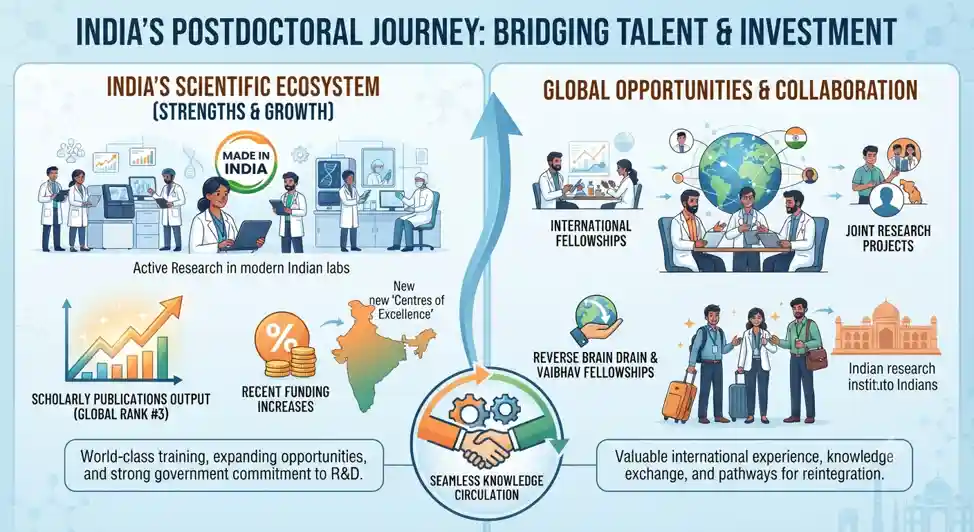
India trains some of the most sought-after scientific minds in the world. Indian-origin researchers run labs at Harvard, Oxford, and Caltech; lead divisions at NASA and Google DeepMind; and win Nobel-adjacent recognition across physics, chemistry, and medicine. Yet inside India, the postdoctoral scientist, the very career stage meant to turn a freshly minted PhD into an independent researcher remains one of the most financially precarious jobs in the country’s knowledge economy. The result is a quiet, decades-long hemorrhage of talent that shows up in every major dataset on Indian science. This isn’t a vague complaint. It’s a measurable, well-documented pattern, and the numbers are stark enough to explain the exodus on their own.
The Postdoc Paycheck Problem
Start with what a postdoctoral researcher in India actually earns. Depending on the funding agency, monthly stipends run somewhere between ₹36,000 and ₹1,00,000 (roughly $430–$1,200) across India’s postdoctoral fellowships, funded by agencies including DST, CSIR, ICSSR, DBT, UGC, and various IITs and IISc, with total fellowship amounts ranging from ₹35,000 to ₹2 lakh and durations from three months to three years. The flagship UGC scheme, the D.S. Kothari Postdoctoral Fellowship, pays ₹43,400, ₹45,000, and ₹46,500 in successive years, with a higher track topping out at ₹46,500: figures that have barely moved in years while inflation and urban living costs have climbed steadily.
Compare that to the benchmark used across the United States. The NIH’s National Research Service Award program set postdoctoral pay levels beginning at $61,008 a year in 2024, rising with experience, with further increases planned over five years toward $70,000. By late 2025, the FY2026 NIH postdoc minimum reached $63,480 a year. Even adjusting generously for purchasing-power differences, an entry-level Indian postdoc earning the equivalent of roughly $5,000–$14,000 a year is being asked to do internationally competitive research on a fraction of what a peer earns in the US, UK, Germany, or Singapore, often while helping support a family, in cities where rent alone can consume a third of the stipend.
The contingency grants that are supposed to fund actual research make the gap worse. Many Indian postdoc schemes provide an annual contingency grant of around ₹20,000, enough for a few reagents or a couple of conference registrations, not for sustained, competitive research. Compare this to the DST Nano Mission postdoctoral fellowship’s more generous ₹2,00,000 annual contingency, which stands out precisely because it is an exception rather than the rule.
A National R&D Budget is Yet to Keep Pace
The postdoc squeeze isn’t an isolated funding gap, it reflects India’s overall approach to research investment. India’s gross expenditure on R&D has been stuck at approximately 0.64% of GDP, according to the Economic Survey 2025–26, far below the 2.5–5% range of innovation-led economies like the US, China, and Israel. A more recent government report shows modest improvement: India’s R&D spending reached 0.84% of GDP in 2023–24, up from 0.64% in 2020–21, according to the Department of Science and Technology’s own statistics, with absolute R&D expenditure tripling from ₹79,355.89 crore in 2013–14 to ₹2,44,767.81 crore in 2023–24.
That sounds like progress until you see it in global context. South Korea spends around 5% of GDP on R&D, Israel over 5%, the US around 3.5%, and China roughly 2.5%, against a world average of about 1.8%. India, even at its improved 0.84%, remains less than half the global average and roughly a sixth of what South Korea invests. And one persistent structural weakness compounds the problem: private firms account for only about 36.4% of India’s gross R&D spending, compared with over 50% in most developed nations, meaning the state carries a disproportionate share of the funding burden, and when government budgets tighten, postdoc fellowships and research grants are among the first casualties.
Brain Drain, By the Numbers
The consequences show up directly in migration data. Over 3 million Indian-origin scientists and engineers currently work outside India, and more specifically, OECD data indicates over 85,000 researchers of Indian origin are working abroad, drawn away by better infrastructure and opportunity. This isn’t a fringe phenomenon; it’s a structural feature of how Indian science now operates: train at home, publish abroad.
The researcher-density numbers tell the same story from a different angle. India has just 259 researchers per million people. For context, wealthy research economies routinely report figures in the thousands. Historical government data put it even more starkly in parliamentary terms: India has roughly four researchers for every 10,000 working people, fewer than smaller economies like Kenya and Chile, which have six and seven respectively, and Indian lawmakers have directly linked this to the fact that Indian-born researchers go abroad for better prospects while very few foreign scientists choose to settle in India.
Patent output is a reasonable proxy for translating research into economic value, and a similar gap is evident here too. India registers roughly 17 domestic and foreign patents per million population, compared with 4,451 in South Korea and 3,716 in Japan.
The Money Leaving With the Talent
Brain drain doesn’t just cost India its scientific capacity; it costs the country money directly. Outward remittances for education under the Reserve Bank’s Liberalised Remittance Scheme rose from ₹975 crore in 2013–14 to nearly ₹29,000 crore in 2023–24, a sum equal to almost 53% of India’s entire higher-education budget. Every rupee in that figure represents a student or researcher who judged that their training, and often their subsequent career, would be better funded somewhere else.
Why This Specifically Hits the Postdoc Stage
The postdoctoral period is uniquely vulnerable to this dynamic for three reasons that the data above makes concrete:
1. It’s the stage with the least job security anywhere in the world, so pay and research funding matter disproportionately. A stipend of ₹37,000–₹42,000 a month: the standard JRF/SRF rate used uniformly across UGC, CSIR, and DST-administered fellowships since the January 2023 revision is competitive with a junior software engineer’s salary in a tier-2 Indian city, for someone who has spent 8–10 years earning a PhD and publishing internationally.
2. Contingency grants can’t fund modern experimental science. A ₹20,000-a-year research allowance for postdocs doesn’t cover the reagents, computing time, sequencing costs, or travel that competitive research now requires pushing ambitious researchers toward labs abroad simply to do the work at all.
3. The gap compounds with every year of delay. While NIH postdoc minimums rose to $61,008 in 2024, an 8% increase, and are scheduled to keep climbing toward $70,000, Indian fellowship stipends have moved far more slowly. The last major across-the-board hike for JRF/SRF-linked fellowships came into effect only from January 2023, per a CSIR-HRDG order, after years of scientists publicly demanding revisions.
What’s Changing on the Ground?
To be fair, the picture isn’t static. Government officials have acknowledged the problem directly. In response to questions about brain drain and vacant scientist positions, the Science Minister pointed to a suite of retention and attraction schemes: the National Post-Doctoral Fellowship, Ramanujan Fellowship, INSPIRE Faculty Fellowship, Ramalingaswami Re-entry Fellowship, MK Bhan-Young Researcher Fellowship, and the VAIBHAV fellowship for overseas and NRI scientists to collaborate with Indian institutions. Some states are experimenting independently, such as Tamil Nadu’s “Tamil Talents Plan” offers competitive pay, relocation allowances, and co-research collaborations as a state-level model.
There are also genuine bright spots in output, if not in investment. India has become the world’s third-largest producer of scholarly publications, up from seventh place in 2010, and India was the only major country in the Nature Index to increase its natural-science research output between 2019 and 2023. That’s a testament to individual researchers’ persistence. Besides, India’s push to promote translational research has been evidenced by the Union and various State Governments’ multi-faceted incentives to startups, including financial, infrastructural, legal, and regulatory support. Initiatives such as Startup India, MSME, etc. have provided unprecedented push to the startup ecosystem.
But scale matters. A handful of prestigious, oversubscribed fellowships cannot substitute for a funding base that remains, even after recent increases, a fraction of what peer economies commit. The Economic Survey itself frames India’s R&D shortfall as one of translation and private investment as much as raw funding. The country is strong at early-stage research but weak at turning it into deployable, market-ready technology, which only reinforces why the most ambitious researchers look elsewhere for the resources to see a project through to real-world impact.
The Bottom Line
The data converges on one conclusion: India doesn’t have a shortage of scientific talent, but it has a shortage of ways to keep and fund that talent domestically. A postdoc stipend that can be a third or less of the international rate, a national R&D budget still far below the global average even after recent gains, and millions of Indian-origin researchers building careers abroad aren’t separate problems. They’re the same problem, measured three different ways. Until postdoctoral funding closes some of this gap, the brain drain isn’t a risk on the horizon. It’s already the baseline.
References:
CASRAI. (2026, August). DST INSPIRE fellowship: ₹37,000–42,000 stipend. https://casrai.org/guides/dst-inspire-fellowship-india-phd-eligibility-components
CASRAI. (2026, September). NRSA stipend 2026: $29,364 predoc, $63,480 postdoc. https://casrai.org/dictionary/term/nrsa-stipend-levels
Forbes India. (2026, January 29). India’s expenditure on R&D just 0.6 percent of GDP: Economic Survey. Forbes India. https://www.forbesindia.com/article/budget-2026/indias-expenditure-on-rd-just-0-6-percent-of-gdp-economic-survey/2990842/1