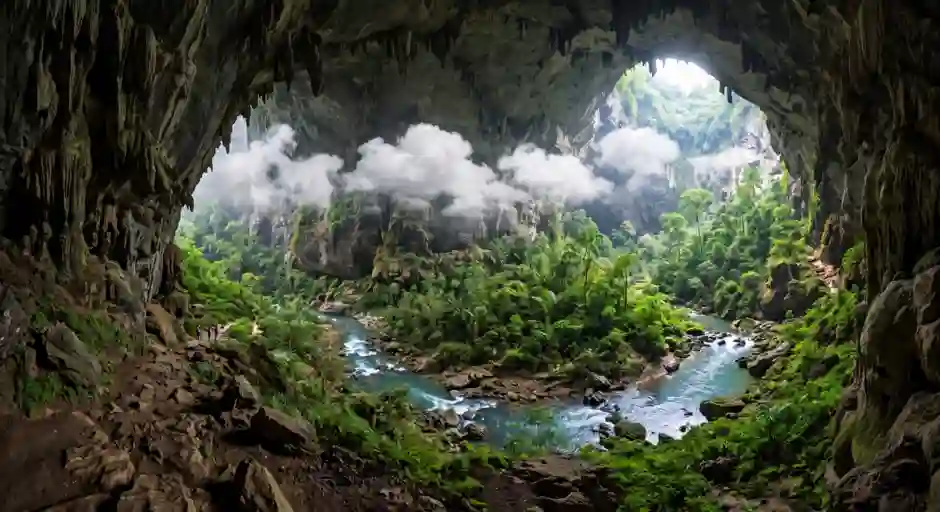
Imagine walking deep inside a mountain and suddenly looking up at a forest growing beneath you. Above the trees, clouds drift through a cavern hundreds of feet high, while a river flows along the cave floor. This isn’t a fantasy landscape. It is Hang Son Doong, a giant cave in Vietnam’s Phong Nha-Ke Bang region and its unusual underground ecosystem exists because parts of the cave ceiling collapsed.
Son Doong is considered the world’s largest single cave passage. It stretches for at least 4 miles (6.5 kilometres) and reaches about 655 feet (200 metres) in height and 490 feet (150 metres) in width. Its scale is so enormous that comparisons with skyscrapers are not an exaggeration: a 40-storey building could fit inside some sections. But size alone is not what makes the cave extraordinary. At two points along the passage, sections of the roof collapsed, creating huge openings known as dolines. These openings connect the underground environment with the surface. Sunlight can pour through them, while rain and outside air can also enter.
That changes everything. Most caves remain dark enough that plants cannot photosynthesise. But inside Son Doong, enough light reaches the floor around the dolines to support vegetation. One area, nicknamed the Garden of Edam, contains a forest where trees can reach roughly 130–165 feet (40–50 metres). Mosses and ferns grow in areas receiving less light, creating a striking transition from illuminated forest to darkness. The forest also receives nutrients from material carried into the cave, including organic matter and bat deposits. In this way, the collapsed ceiling does more than provide sunlight, it creates a connection through which energy and nutrients from the surface can enter the underground ecosystem.
Then there is the water. A large underground river runs through Son Doong. Because the cave passages are so enormous, moisture from the river can accumulate in the cavern. When air from different parts of the cave and the outside environment interacts, condensation can produce mist and clouds inside the cave. The clouds are therefore not evidence of a completely separate underground weather system; they are part of a local microclimate strongly influenced by the cave’s openings, river and surrounding atmosphere. The cave itself formed millions of years ago as water gradually dissolved and eroded the limestone beneath the mountains. Where the rock was weaker, sections of the ceiling eventually collapsed, creating the openings that now allow sunlight into the depths.
Son Doong is therefore more than a giant hole in the ground. It is a reminder that ecosystems do not always follow the boundaries we imagine. Give a dark cave enough light, water and a connection to the surface, and it can become something unexpected: a forest growing inside a mountain, beneath a ceiling where clouds can form.
Sources: