What if one of the simplest ways to reduce earthquake damage involved nothing more complicated than a metal cylinder packed with steel balls? Researchers at the University of Sharjah in the United Arab Emirates have developed a passive seismic damping device designed to reduce vibrations travelling through buildings, bridges and other structures. Unlike active systems that can depend on sensors, electronics or external power, the new device works through a much simpler principle: friction.
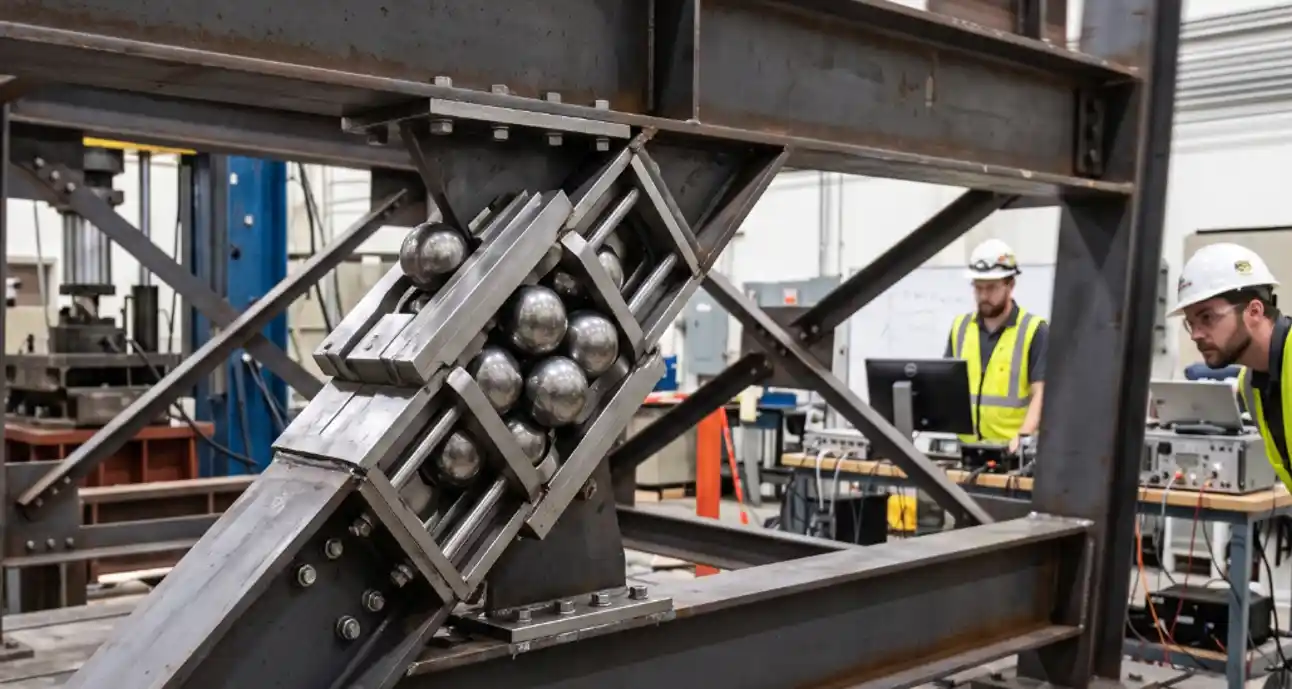
At the centre of the design is a hollow steel cylinder filled with solid steel spheres. A shaft passes through the cylinder and carries short radial rods. When an earthquake or another source of vibration causes the structure to move, the shaft moves relative to the packed steel balls. That movement forces the steel spheres to shift and rub against one another and against the surrounding components. The mechanical energy of the vibration is therefore converted into frictional energy and dissipated as heat. Instead of allowing all of the motion to pass into the structure, the damper absorbs part of it.
The idea belongs to a broader class of passive vibration-control technologies. Such systems do not need to detect an earthquake and then decide what to do. Their mechanical properties are designed so that they respond automatically when the structure moves. Early laboratory testing of the steel-sphere system produced a damping ratio of around 14%, suggesting that the device can dissipate a meaningful portion of the vibration energy under the tested conditions. They have also described potential applications beyond earthquakes, including reducing vibrations caused by wind and industrial machinery.
The lack of electricity is particularly interesting for earthquake protection. A major earthquake can damage power infrastructure and cause widespread outages, the exact moment when electrically dependent systems may face problems. A mechanically operated damper, by contrast, does not need a battery, computer or external power supply to respond to movement. But the device is not an earthquake shield, and it does not make a building earthquake-proof.
The reported results are based on experimental testing, and much more work would be needed to determine how the system performs at different earthquake intensities and when integrated into full-scale buildings or bridges. Its biggest appeal may therefore be its simplicity. Earthquake engineering often involves sophisticated materials, sensors and control systems. This approach asks whether some of that complexity can be replaced by something much more fundamental: steel moving against steel, and friction turning destructive motion into dissipated energy. Sometimes, protecting a building from an earthquake may not require more electronics. It may simply require better use of physics.
Sources: