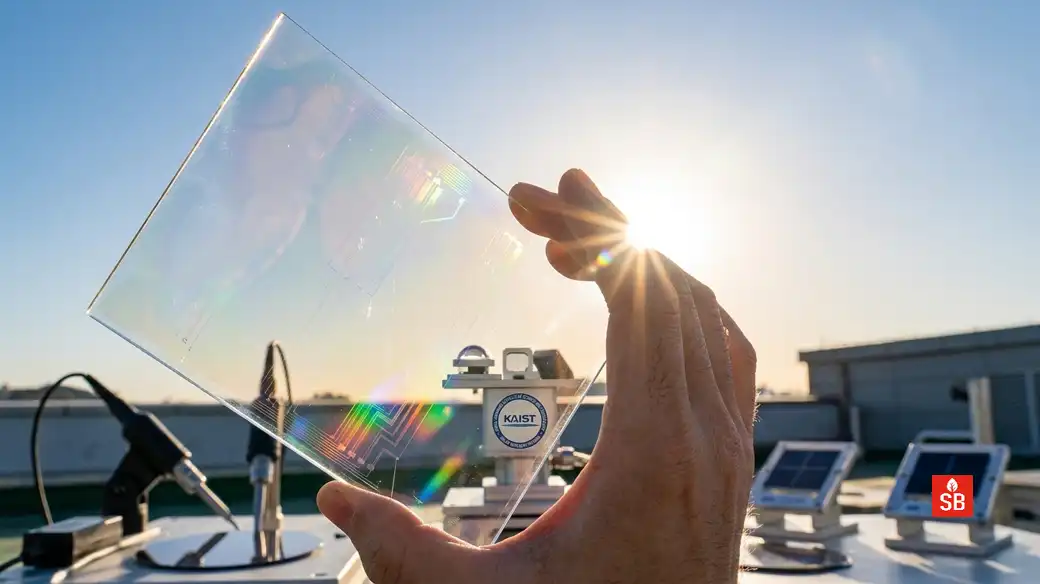
Imagine a skyscraper that generates its own electricity through its windows, or a smartphone screen that charges itself in sunlight without a single visible solar cell in sight. That vision just got a lot closer to reality, thanks to a wave of breakthroughs from South Korean researchers in transparent solar technology.
From Tinted Glass to True Invisibility
Transparent solar cells aren’t new, the concept dates back to 2014, when researchers at Michigan State University first proposed transparent solar concentrators. But early versions converted barely 1% of sunlight into electricity, far too low to matter commercially. For over a decade, transparency and efficiency seemed to be locked in a trade-off: the clearer the panel, the less power it produced. South Korean teams have now cracked that trade-off from multiple angles.
UNIST’s “Invisible” Breakthrough
Researchers at the Ulsan National Institute of Science and Technology (UNIST), working with Incheon National University, unveiled what they call the world’s first fully transparent, wire-free solar panel. The trick lies in a design called all-back-contact (ABC) transparent crystalline silicon cells. Rather than running metal wiring across the front of the glass, which normally darkens or streaks a panel, every electrical contact is tucked onto the rear. The cell doesn’t try to capture visible light at all; instead, it harvests ultraviolet and near-infrared wavelengths that are invisible to human eyes anyway, funneling that energy to hidden photovoltaic strips at the back.
The result: a 16 cm2 test panel that looks like ordinary glass but converts light at 14.7% efficiency: enough, researchers say, that a single module could charge a smartphone using only ambient sunlight.
Incheon National University’s Efficiency Leap
A separate team at Incheon National University pushed the transparency side of the equation forward using eco-friendly semiconductors, titanium dioxide (TiO2) and nickel oxide (NiO), which absorb UV light while letting visible light pass through largely undisturbed. Their efficiency gains bring transparent solar technology to nearly 10%, a tenfold jump over where the field started just over a decade ago.
Why Windows Matter So Much
The real appeal isn’t the panels themselves, it’s what they could replace. Solar adoption has always been constrained by real estate: you need open, sun-facing space, which is scarce in dense cities. Windows, by contrast, are everywhere- on every office tower, apartment block, car, and phone. Some estimates suggest that if transparent glass were deployed at scale across a city’s window surface, it could theoretically generate roughly 1,000 times more power than conventional rooftop panels covering the same footprint, simply because there’s so much more glass than roof.
What’s Next
Commercialization is now the goal. UNIST’s team is working on “seamless modularization”, joining panels edge-to-edge without visible metal gaps to make large glass facades practical and aesthetically clean. If that scaling succeeds, the humble window could quietly become one of the most important renewable energy surfaces in the built environment, generating power without anyone even noticing.
The clearest energy revolution yet may be the one you can literally see through.
Park, J., Lee, K., Lee, J., et al. (2024). “All-back-contact neutral-colored transparent crystalline silicon solar cells enabling seamless modularization.” Proceedings of the National Academy of Sciences, 121(33), e2404684121. https://doi.org/10.1073/pnas.2404684121
Lee, K., et al. (2020). “Neutral-colored transparent crystalline silicon photovoltaics.” Joule, 4(1), 235–246.