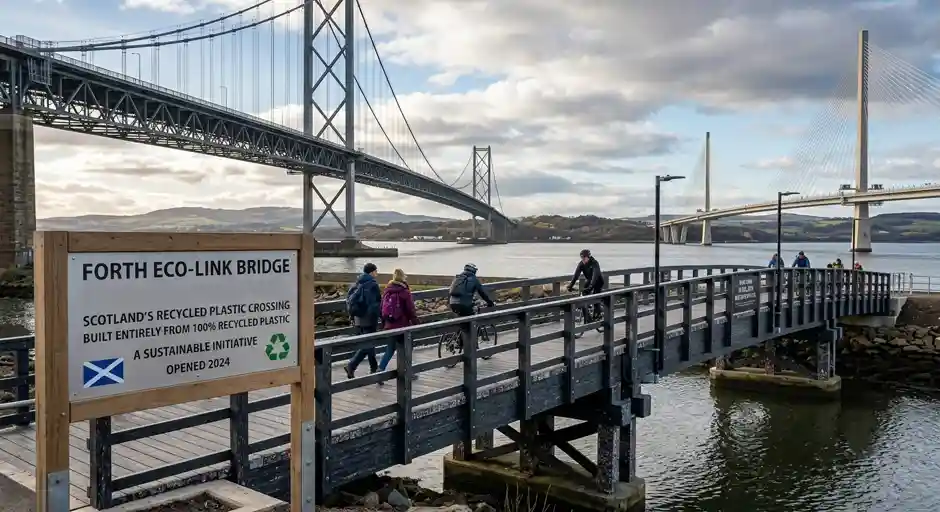
What would you expect a bridge made from recycled plastic to look like?
In 2011, a 90-foot-long road bridge arrived in Scotland in just six sections. It had been manufactured in the United States and shipped across the Atlantic before being assembled over the River Tweed near Edinburgh. The entire bridge was made using recycled plastic, making it an unusual alternative to conventional steel and timber construction. The secret was not using ordinary plastic bottles as giant building blocks. Instead, the plastic waste was processed into a structural material that could be manufactured into large components.
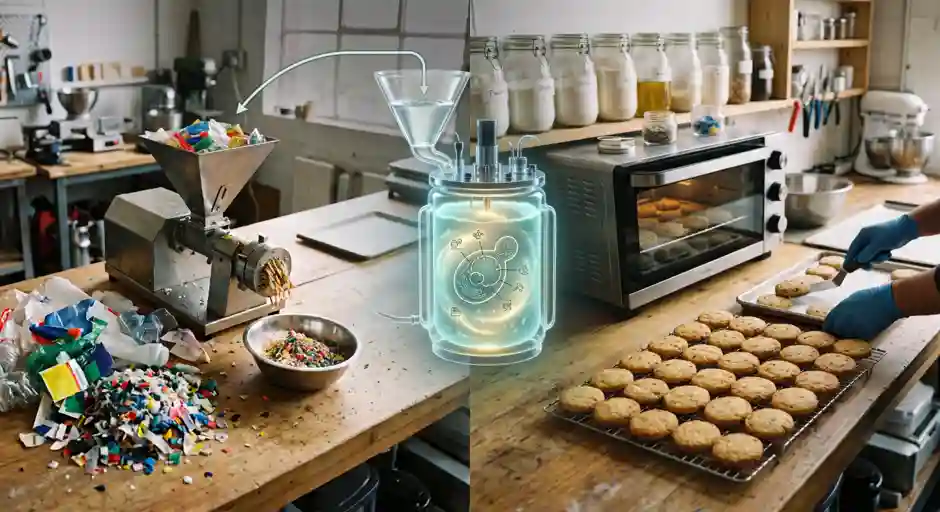
The material came from recycled high-density polyethylene (HDPE), a tough plastic commonly found in products such as containers and packaging. Rather than melting the plastic down and making another disposable product, engineers turned it into structural profiles designed to carry loads.
That approach also changed how the bridge could be built.
Instead of transporting hundreds of individual parts and constructing the entire structure beside the river, engineers manufactured large sections in a factory. The six sections were then transported to Scotland, positioned at the site and joined together. According to the American Society of Mechanical Engineers, the bridge itself could be erected in just four days, while the complete construction project took less than two weeks.
Why use recycled plastic at all?
Unlike steel, plastic does not rust. It is also relatively lightweight, which can make transportation and installation easier. And because the structural material is made from waste plastic, the bridge can give material that might otherwise have ended up in landfill another use. But recycled plastic is not automatically a better material for every bridge. Engineers still have to consider factors such as load, temperature, long-term deformation and how the material behaves under constant stress. A bridge has to remain reliable for decades, not just survive the day it is installed.That is what makes the Scottish bridge interesting. It wasn’t simply an experiment with recycled material.
It showed that plastic waste could be transformed into something strong enough to become part of everyday infrastructure.