For over a century, we’ve known T. rex from its bones, featuring skulls in glass cases, femurs the size of tree trunks, teeth like railroad spikes. What we’ve never had is a clear record of the animal actually moving. Bones tell you what an animal was built like. Footprints tell you what it did with that body on an ordinary afternoon, 66.5 million years ago.
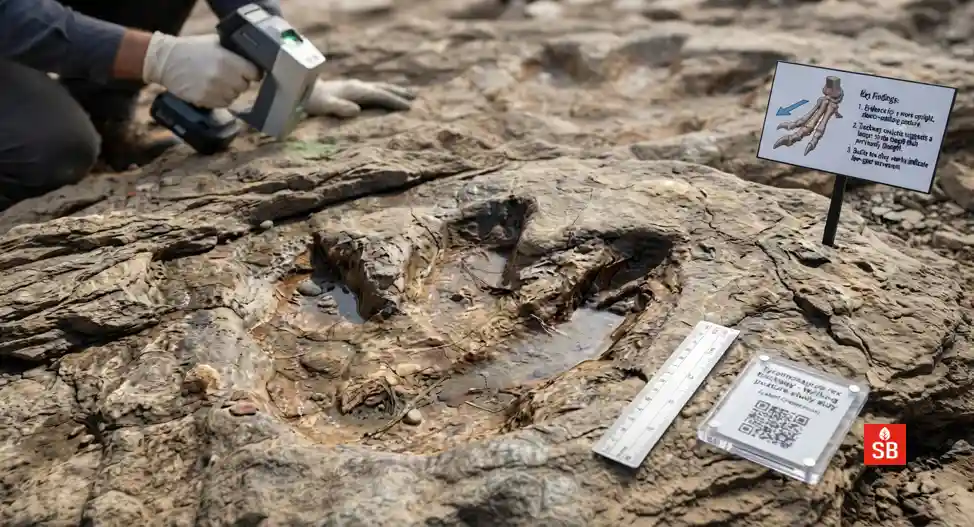
That’s exactly what turned up in the badlands of southwestern North Dakota: four connected, three-toed footprints, each about three feet long, forming a trackway roughly 23 feet from start to finish. It’s the first trackway ever confidently attributed to a full-grown T. rex: not a single isolated print, but a sequence, a walk, a moment of behavior frozen in stone.
A Teacher’s Eye for a Good Track
The discovery has a wonderful human backstory. Kent Hups, a high school science teacher and 30-year veteran fossil hunter, was recovering from knee surgery while scouting an easier route out of a narrow valley when an odd lumpy shape in the ground caught his eye. Three giant toes. He’d found it almost by accident, while looking for a way to spare his knees. The site sits in the Hell Creek Formation, near Marmarth, not far from where “Teen Rex”, a juvenile T. rex skeleton discovered by three boys on a hike in 2022 — was pulled from the same badlands. This corner of North Dakota, it turns out, was prime T. rex real estate.
The Physics of a 7-Ton Stroll
Paleontologists from the Denver Museum of Nature & Science and Liverpool John Moores University used the spacing between the prints, a stride of about 13 feet, to reconstruct the animal’s pace. The verdict: T. rex was walking at roughly 3.5 to 4.5 mph. That’s a brisk human walking speed, casually maintained by an animal that weighed more than seven tons.
Picture that for a second. A creature the size of a school bus, striding across a floodplain at a pace you could keep up with on your lunch break, leaving prints deep enough to survive an asteroid impact and 66 million years of erosion.
Why This One Print Set Matters So Much
Before this find, only two isolated adult T. rex footprints had ever been confirmed anywhere on Earth: one in New Mexico, one in Montana, and neither showed motion. Large theropod tracks are oddly rare in the Hell Creek Formation generally, which makes this sequence remarkable on its own. The tracks survived through a strange stroke of geological luck: the footprint depressions filled with fine sandstone, then groundwater cemented that sediment with calcium carbonate into hard concretions. As the softer surrounding rock wore away over millions of years, the footprints emerged like casts, ready to be found by exactly the right hiking teacher on exactly the right day.
The site was 3D-scanned, and researchers plan to recover several of the prints for study and eventual display at the Denver Museum, meaning the rest of us will eventually get to stand next to the very steps an adult T. rex took near the end of the Age of Dinosaurs.
References:
Falkingham, P. L., Hups, K. M., Tamez-Galvan, E. M., Bercovici, A. D., & Lyson, T. R. (2026). A large tridactyl trackway from the Upper Cretaceous Hell Creek Formation of North Dakota, likely attributable to an adult Tyrannosaurus rex. Journal of Vertebrate Paleontology, e2706201. https://doi.org/10.1080/02724634.2026.2706201