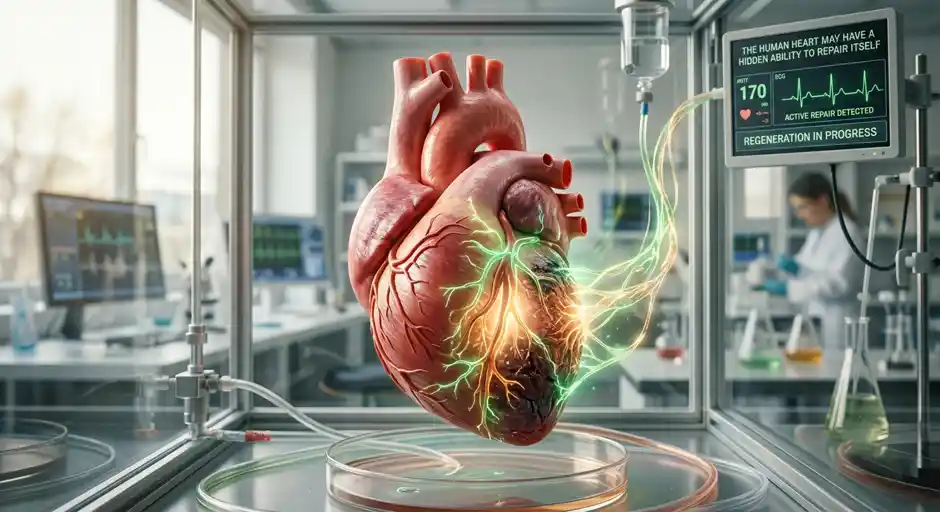
For decades, scientists have thought that heart muscle lost during a heart attack was essentially gone for good. Unlike some tissues in the body, the adult heart was believed to have very little ability to replace its damaged muscle. Now, researchers have found evidence that the human heart may have more regenerative ability than previously thought.
When a heart attack occurs, part of the heart is suddenly deprived of oxygen because blood flow is blocked. Without oxygen, heart muscle cells, called cardiomyocytes, begin to die. The damaged area is eventually replaced by scar tissue, which can provide structural support but cannot contract like healthy heart muscle. The new study, led by researchers from the University of Sydney, the Baird Institute and Royal Prince Alfred Hospital, looked at heart tissue collected from living patients undergoing bypass surgery. This gave scientists something that has been difficult to obtain in humans: samples of heart muscle from people who had experienced a heart attack.
When the researchers examined the tissue, they found increased signs of mitosis in cardiomyocytes from areas affected by the heart attack. Mitosis is the process in which a cell divides its genetic material as it prepares to produce new cells. The researchers also found evidence of cytokinesis, the stage in which one cell physically separates into two. That distinction matters. Finding cells preparing to divide is different from simply finding signs of cellular activity. Together, the observations suggest that some surviving human heart muscle cells can actually enter the process of producing new cells after injury.
The finding does not mean that a heart can currently repair itself completely. The natural response is far too weak to replace all the muscle lost during a major heart attack, and the damaged area still develops scar tissue. But that small response could provide an important starting point. If scientists can understand what signals cause these surviving cardiomyocytes to divide, they may eventually be able to develop treatments that boost the heart’s own repair mechanisms. The goal would be to replace more of the lost muscle and potentially improve heart function after an injury.
For now, the discovery does not give patients a regenerative treatment. But it changes an important question in heart research. Instead of asking whether the adult human heart can make new muscle at all, scientists can now ask how much more repair could be possible if its natural regenerative response were amplified.
Sources: