What makes a forest successful? Is it the number of tonnes of carbon it can lock away, or the number of species it can support?
A 21-year experiment in Denmark suggests that the answer depends on what we are trying to achieve. Scientists comparing forests established on former farmland found a clear difference between deliberately planted forests and forests allowed to regenerate naturally. The planted forests accumulated tree biomass and captured carbon faster. But the naturally regenerated forests developed greater biodiversity and more varied ecological structures. The experiment is particularly interesting because both approaches started with the same broad goal: bringing trees back to land that had previously been used for agriculture.
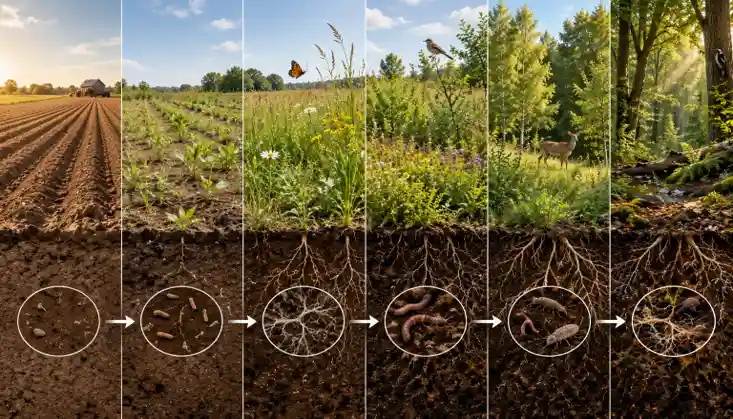
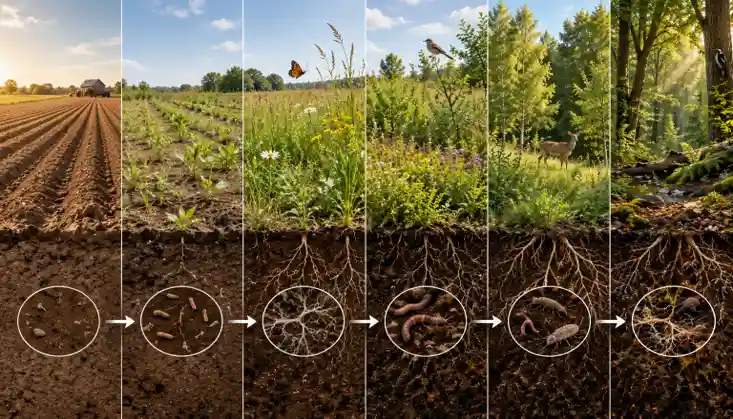
In a planted forest, people choose the species, density and arrangement of trees. This can give young trees a head start, particularly when fast-growing species are selected and planted at relatively high densities. More tree biomass accumulating in the early stages means carbon can be captured more rapidly. Natural regeneration works differently. Instead of deciding exactly which trees should occupy the land, they allow vegetation to establish through natural processes. Seeds arrive from surrounding areas, different species compete for space and light, and plants gradually create layers within the developing forest. That process can be slower when measured purely by tree biomass. But it can produce a more complex ecosystem.
After 21 years, the naturally regenerated forests contained greater diversity and more varied structures, while the planted forests had accumulated carbon more rapidly. The contrast illustrates an important point about forest restoration: carbon storage and biodiversity are related, but they are not necessarily maximised by the same strategy. That does not mean plantations are useless for conservation or climate action. A well-designed plantation can rapidly establish tree cover, store carbon and potentially provide timber or habitat. Its ecological value also depends heavily on which species are planted, how densely they are arranged and how the forest is managed.
The Danish experiment instead highlights the danger of judging a forest by only one measurement. If the immediate priority is rapid carbon accumulation, planting trees may provide an advantage. If the objective is to rebuild a complex ecosystem containing a wider range of species and structures, allowing natural processes to shape the forest may offer benefits that become increasingly visible over time. And 21 years may still be relatively early in a forest’s life. A forest is not simply a collection of trees storing carbon. It is an evolving ecosystem, where plants, fungi, insects, birds, soil organisms and countless interactions develop over decades or centuries. Therefore leaves us with a more complicated and perhaps more useful question than “Should we plant trees?” It is: What kind of forest are we trying to create?
Source: