What if treating a disease did not always mean giving the body another drug but instead physically removing something harmful from the bloodstream?
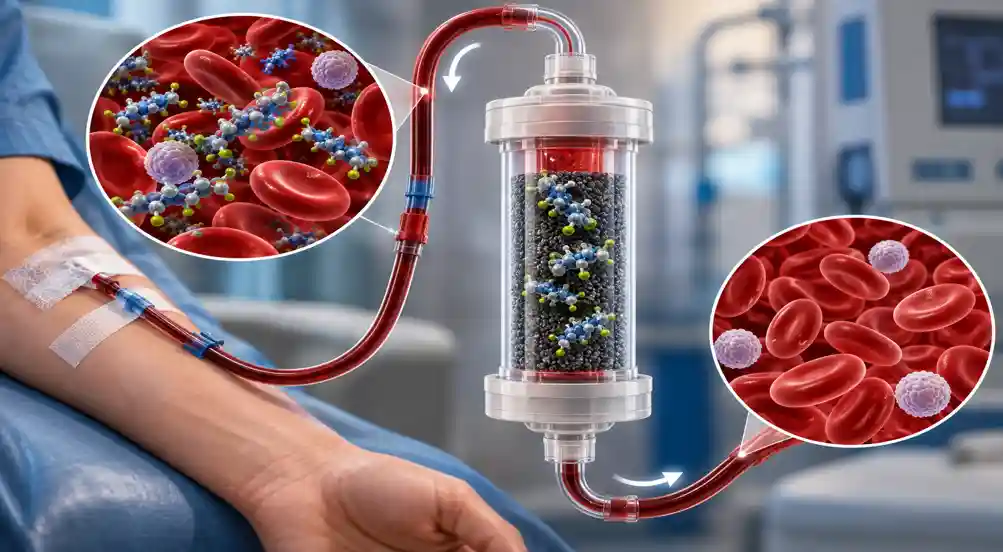
That is the basic idea behind therapeutic apheresis, a group of extracorporeal treatments in which blood is temporarily removed from the body, separated into its components, and selectively removed or modified before the remaining blood is returned.
It sounds futuristic, but apheresis is already an established clinical treatment for several serious diseases.
How does it work?
Blood contains red cells, white cells, platelets and plasma. During apheresis, a machine separates these components using centrifugation or membrane-based filtration.
The important part is that doctors do not necessarily remove the whole blood. Instead, they target the component contributing to disease.
In therapeutic plasma exchange, for example, a patient’s plasma is removed and replaced with albumin or donor plasma. This can rapidly reduce circulating autoantibodies, immune complexes, complement proteins and inflammatory mediators that contribute to tissue damage.
Other forms work differently. Red-cell exchange can replace abnormal red blood cells, while lipoprotein apheresis can remove certain cholesterol-containing particles in patients with severe lipid disorders. Leukapheresis can reduce extremely high white-cell counts in selected blood cancers.
Where is it used?
One of the best-established applications is thrombotic thrombocytopenic purpura (TTP), a potentially life-threatening disorder in which abnormal antibodies interfere with a protein involved in blood clot regulation.
Therapeutic plasma exchange is also used in selected cases of myasthenia gravis, Guillain–Barré syndrome, autoimmune neuropathies, certain vasculitides and other immune-mediated diseases, depending on the clinical situation and strength of evidence.
Importantly, apheresis is not a universal “blood detox.” Its usefulness depends on whether the disease is driven by a circulating substance that can actually be removed.
The future: increasingly selective blood purification
Researchers are now investigating ways to make apheresis more precise.
Instead of removing large amounts of plasma and replacing it, immunoadsorption and other selective adsorption technologies can use specialized materials to capture particular antibodies or molecules while leaving much of the rest of the blood unchanged.
This concept is also attracting interest in emerging areas such as persistent environmental chemicals, inflammatory mediators and extracellular vesicles.
The challenge is that removing a molecule is not automatically equivalent to treating a disease. A substance may quickly return after treatment, and removing useful proteins alongside harmful ones can produce complications.
Therapeutic apheresis therefore represents something more sophisticated than simply “filtering the blood.”
It is an example of precision medicine at the level of the bloodstream identifying a harmful biological component and physically taking it out of circulation.
Sources:
https://www.atsdr.cdc.gov/pfas/hcp/clinical-overview/clinical-evaluation-management.html?