What if the brain could make replacement neurons from cells it already has?
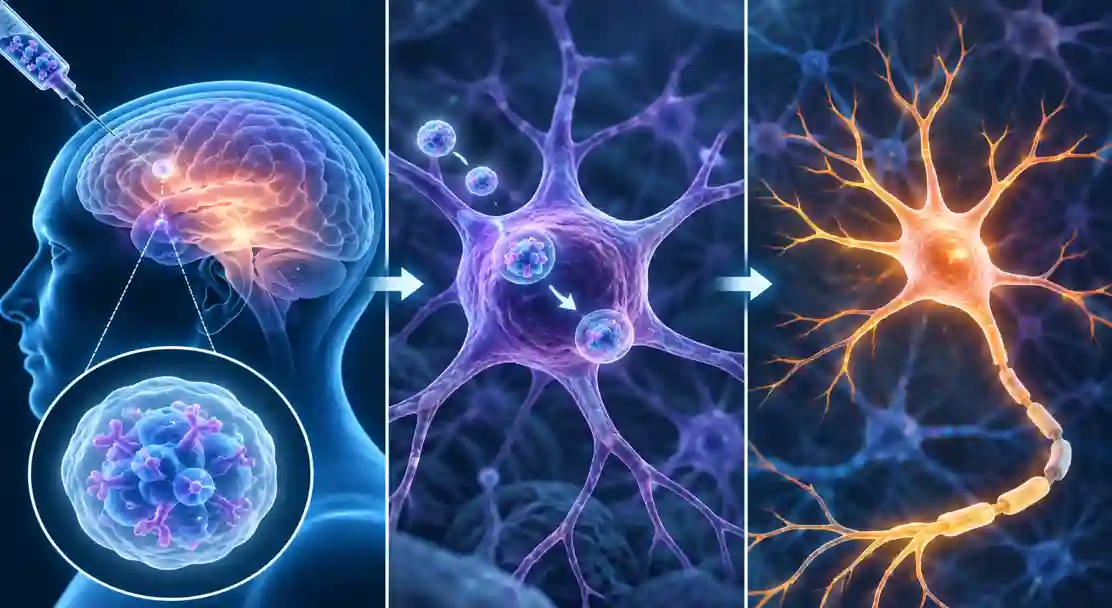
That possibility is being explored in a striking new study in which scientists developed a nanogel that can reprogram astrocytes supportive cells in the brain into neuron-like cells. In experiments involving laboratory cultures, human brain organoids and mice with Alzheimer’s-like disease, the approach was associated with increased neuronal formation and improvements in memory-related behaviour.
Turning support cells into neurons
The key target is a protein called PTBP1. Astrocytes normally perform essential jobs such as supporting neurons, maintaining the brain environment and responding to injury.
Previous research suggested that reducing PTBP1 could push astrocytes toward a neuronal identity. However, this approach became controversial because some subsequent studies questioned whether the newly observed neurons had actually originated from astrocytes.
The new research takes a different approach.
Instead of permanently altering the cell’s DNA, scientists packaged an antibody against PTBP1 inside a polymer-based nanogel called Nano-ERASER. The system is designed to cross the blood-brain barrier and deliver the antibody into astrocytes. Once inside, the antibody promotes destruction of PTBP1 through the cell’s own protein-degradation machinery.
What happened after treatment?
In laboratory experiments, treated astrocytes began developing characteristics associated with neurons. The researchers also reported neuronal conversion in human brain organoids.
The most intriguing results came from mice modelling Alzheimer’s disease. Following treatment, researchers observed increased neuronal formation, reduced inflammatory changes and improvements in learning and memory-related tests.
But there is an important scientific caveat.
The researchers have not yet definitively demonstrated that every additional neuron observed in the living animals originated directly from astrocytes. Establishing the exact cellular lineage is crucial before the approach can be considered a reliable method of neuronal replacement.
Could this eventually repair the human brain?
That is the exciting possibility but it remains far away.
The adult brain has extremely limited capacity to replace neurons lost through neurodegenerative diseases or injury. If scientists could safely transform existing cells into functional neurons inside the brain, it could eventually offer a fundamentally different strategy for conditions such as Alzheimer’s disease, stroke or traumatic brain injury.
However, astrocytes are not expendable. They perform important functions that neurons cannot replace. Scientists therefore need to determine whether converting too many of them could disrupt normal brain function, and whether the newly generated neurons integrate correctly into existing neural circuits.
The research is still preclinical, with no evidence yet that this gel can safely regenerate neurons in people.
Nevertheless, the concept represents an intriguing shift in regenerative neuroscience: instead of transplanting new cells into the brain, scientists are asking whether the brain’s own cells can be persuaded to rebuild what was lost.
Sources