What if a device could get some of its energy simply by sitting in the air?
That sounds like science fiction, but researchers in Australia have found an enzyme that can do something remarkably close. The enzyme, called Huc, can use the tiny amount of hydrogen naturally present in the atmosphere and convert the energy from that reaction into an electrical current.
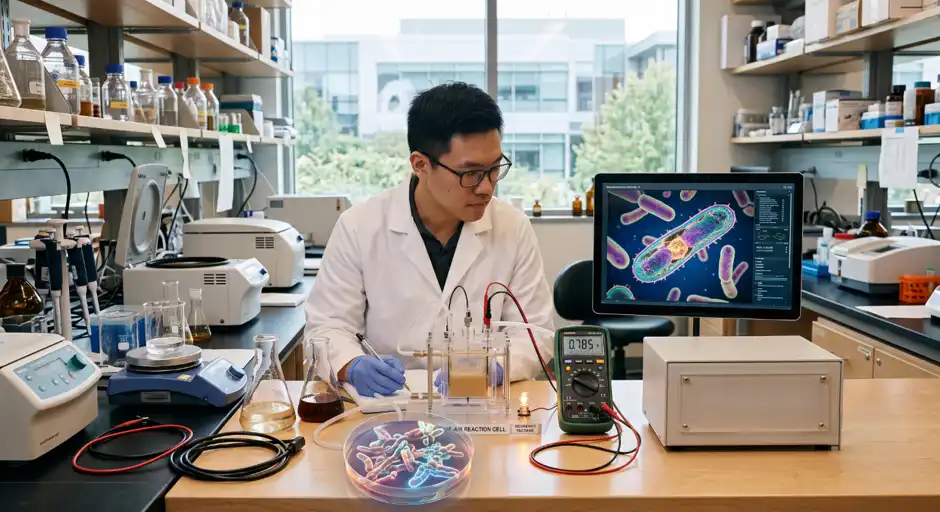
Huc comes from Mycobacterium smegmatis, a common soil bacterium. Scientists at Monash University isolated the enzyme and investigated how the bacterium manages to survive by consuming hydrogen when other sources of energy are scarce. The challenge is that atmospheric hydrogen is present in extraordinarily small quantities, only about 0.00005% of the air we breathe. Most hydrogen-consuming enzymes cannot efficiently use concentrations this low, and many are also damaged or inhibited by oxygen. Huc is different. It can consume hydrogen at concentrations below those normally found in the atmosphere while remaining active in the presence of oxygen.
So how does it make electricity?
Huc belongs to a family of enzymes called [NiFe] hydrogenases. It breaks down hydrogen molecules, releasing electrons. In the bacterium, those electrons are transferred into the respiratory system and ultimately help the cell obtain energy. When the purified enzyme was connected to an electrochemical system, researchers were able to detect an electrical current generated from tiny amounts of hydrogen. The enzyme also has an unusual level of durability. It was reported that purified Huc could be frozen or heated to about 80°C and still retain its ability to generate energy. That stability is important if the enzyme is ever incorporated into practical devices, where temperature changes and long-term storage could otherwise become major problems.
The discovery raises an intriguing possibility: could Huc eventually be incorporated into tiny devices that continuously draw small amounts of energy from the surrounding air? It is suggested for applications such as environmental sensors and other low-power electronics. The idea is particularly interesting for devices that need to operate for long periods without conventional batteries or frequent charging.
But there is an important catch. Huc is not currently an air-powered battery that can run everyday electronics. The amount of hydrogen in normal air is extremely small, so the electrical output is also limited. Considerable engineering work would be needed to scale up the enzyme and turn its laboratory activity into a practical power source.Still, the principle is striking. A soil bacterium has evolved molecular machinery capable of finding usable energy in one of the most dilute fuel sources imaginable. Sometimes, the atmosphere contains more than just air. It contains tiny traces of energy and this enzyme knows how to find them.
Sources: