Long before beer, before farming, before anyone planted a single seed on purpose, someone in an Ice Age cave on the island of Sulawesi tucked a hard little nut into their cheek and kept doing it, on and off, for years. That small, repeated habit just rewrote the timeline of human drug use.
A Mystery Written in Grooves
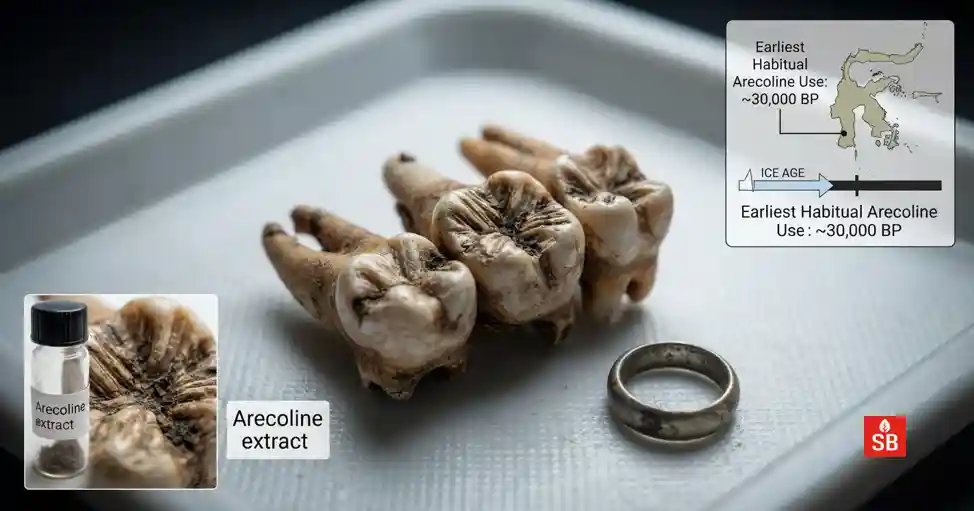
Archaeologists from Griffith University, led by Adam Brumm, were examining two rare hunter-gatherer skeletons from South Sulawesi, Indonesia, when something in the teeth stopped them cold. Not cavities. Not the flat, gritty wear you’d expect from a tough Stone Age diet. Instead: deep, rounded grooves, gouged into the molars in a pattern nobody had documented before.
One skeleton belonged to a man who died between 40 and 50 years old, sometime between 25,000 and 16,000 years ago, during the coldest stretch of the last Ice Age. The second belonged to a person who lived far more recently, around 7,600 to 6,300 years ago. Two lives separated by up to 18,000 years, and yet their teeth told the same strange story.
Cracking the Case with Frog Eggs
The team’s hypothesis: these people were sucking on whole betel nuts, the seeds of the areca palm, still chewed by hundreds of millions of people across Asia and the Pacific today. Modern users typically mix crushed betel with slaked lime, which chemically frees up arecoline, the nut’s mind-altering compound, for a stimulant kick. Scientists had assumed the lime was essential that a plain, unprocessed nut wouldn’t release much of anything.
To test that assumption, the researchers soaked whole betel seeds in artificial saliva and exposed the resulting solution to frog egg cells genetically engineered to carry human neuroreceptors. The result: measurable neuroactive effects, no lime required. Chemical analysis of the ancient teeth confirmed it further, turning up biomolecular traces of arecoline still lingering after tens of thousands of years.
An Ice Age Painkiller Gone Wrong
Both individuals had serious dental problems, and arecoline happens to be a natural painkiller. The likely story: these foragers started tucking betel nuts against aching teeth for relief, not recreation. But hard, abrasive seeds held in the mouth for hours, day after day, year after year, ground the enamel down, in some cases exposing the tooth’s pulp chamber, inviting infection, and making the pain worse. The remedy fed the very problem it was meant to solve, in a loop that likely lasted a lifetime.
Rewriting the Timeline
Before this discovery, the earliest solid evidence of habitual psychoactive substance use came from 13,000-year-old beer residue at Raqefet Cave in Israel, tied to the dawn of agriculture roughly 12,500 years ago. The Sulawesi teeth, published this month in Science Advances, push the record back by up to 20,000 years and prove the behavior didn’t need farms, pottery, or settled villages to take hold. Mobile Ice Age hunter-gatherers already knew exactly which plants could dull pain and alter the mind, and they used that knowledge long before anyone thought to grow it on purpose.
Betel nut remains the world’s fourth most widely used psychoactive substance today, after alcohol, caffeine, and nicotine. Its ancient reach, it turns out, goes back to the Ice Age.
References:
Brumm, A., Fakhri, Vlok, M., Papke, R. L., Matheson, C. D., Hakim, B., Stokes, C., Burhan, B., Suryatman, Saiful, A. M., Langley, M. C., Yuwono, P., Murti, D. B., Noerwidi, S., & Ririmasse, M. N. R. (2026). Betel nut sucking is the earliest recorded evidence for the habitual use of a neuroactive plant drug. Science Advances, 12(37), Article eaei1901. https://doi.org/10.1126/sciadv.aei1901
Brumm, A., Matheson, C. D., Fakhri, & Vlok, M. (2026, September 10). Ancient teeth reveal the Ice Age origins of the world’s 4th most common addictive drug. The Conversation. https://theconversation.com/ancient-teeth-reveal-the-ice-age-origins-of-the-worlds-4th-most-common-addictive-drug-285790