All known cellular life on Earth uses DNA to store its genetic instructions. From microscopic bacteria to humans, DNA carries the information needed for growth, reproduction and cellular function. But could life exist without this molecule? Surprisingly, scientists have discovered biological systems that use RNA instead of DNA and are even investigating whether entirely different genetic molecules could support life.
Life Without DNA: The RNA Possibility
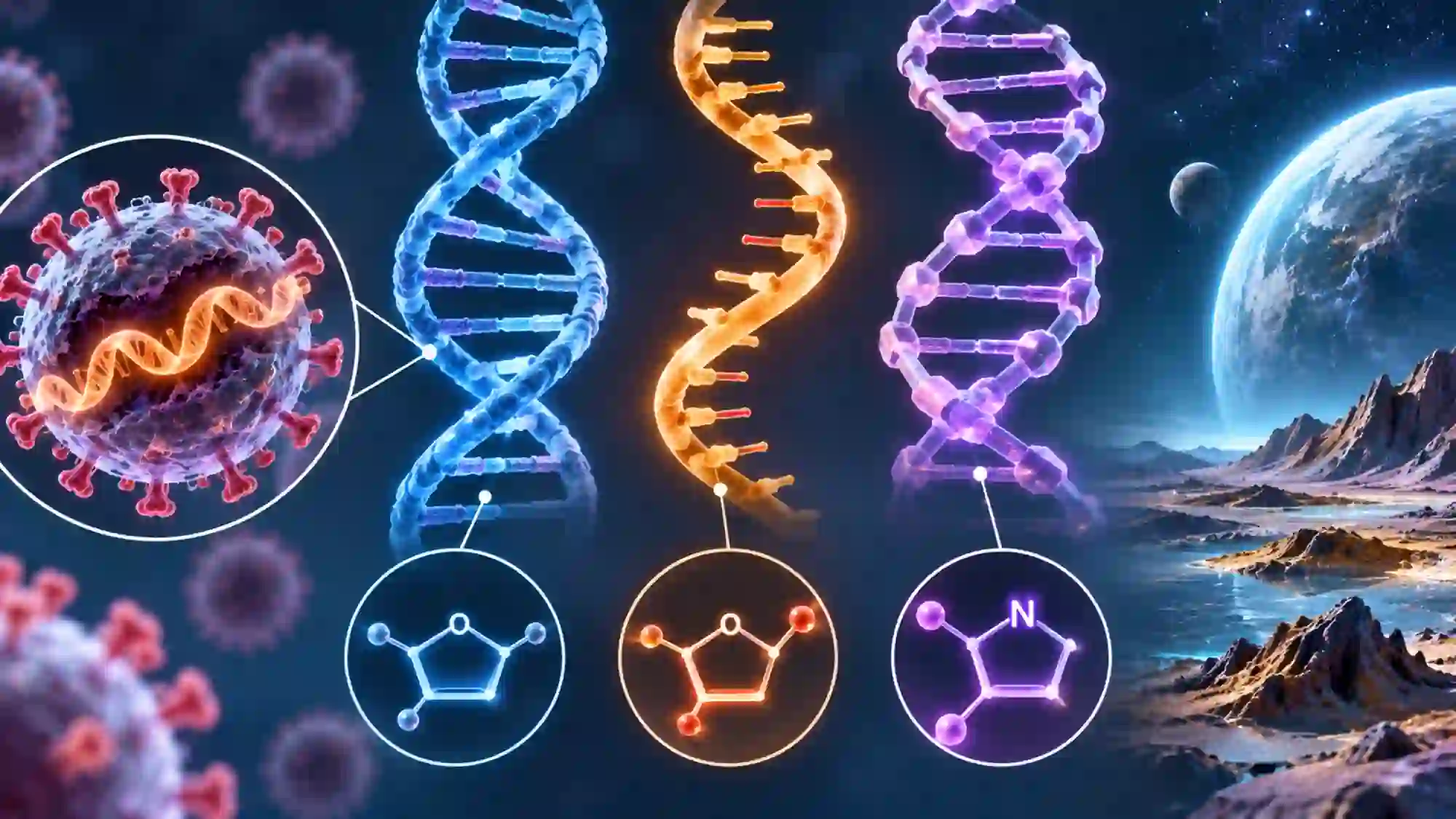
One of the strongest clues comes from RNA viruses. Unlike organisms that store their genetic information in DNA, these viruses use RNA as their genetic material. Examples include influenza viruses and coronaviruses.
RNA can store genetic information and, unlike DNA, can also perform certain chemical reactions. Special RNA molecules called ribozymes act as biological catalysts, helping chemical reactions occur without protein enzymes.
These properties form the basis of the RNA World hypothesis. It proposes that early life may have relied on RNA to both store genetic information and carry out essential chemical reactions, before DNA and proteins evolved into their specialised roles.
However, RNA viruses are not independent cellular life forms. They depend on host cells to reproduce, so they do not demonstrate that a fully independent organism can exist without DNA.
Could Life Use an Entirely Different Genetic Material?
Researchers are exploring molecules known as xeno nucleic acids (XNAs). These are synthetic genetic polymers that resemble DNA and RNA but have different chemical structures.
One example is threose nucleic acid (TNA), which uses a simpler four-carbon sugar backbone instead of the five-carbon sugar found in DNA and RNA. Another is peptide nucleic acid (PNA), which replaces the conventional sugar-phosphate backbone with a peptide-like structure.
In laboratory experiments, certain XNAs can store genetic information, form complementary molecular strands and even undergo enzyme-assisted replication. These findings suggest that genetic information may not be exclusive to DNA and RNA.
Could Alien Life Use Something Different?
If life exists elsewhere in the universe, it may not necessarily follow Earth’s biological blueprint. Different planetary environments could favour alternative molecules capable of storing information, supporting chemical reactions and enabling evolution.
However, no organism using a completely different genetic system has been discovered.
Scientists are still investigating whether alternative genetic polymers could support all the complex functions required for independent life.
The possibility challenges one of biology’s most familiar assumptions: DNA may be the foundation of all known cellular life, but it might not be the only molecular system capable of supporting life.
Science Says There Could Be Life Forms That Don’t Use DNA!
Scientists have found RNA-based viruses and lab-made genetic molecules (XNAs) that can store and replicate information, suggesting DNA may not be the only possible basis for life, though no independent organism without DNA has ever been found.