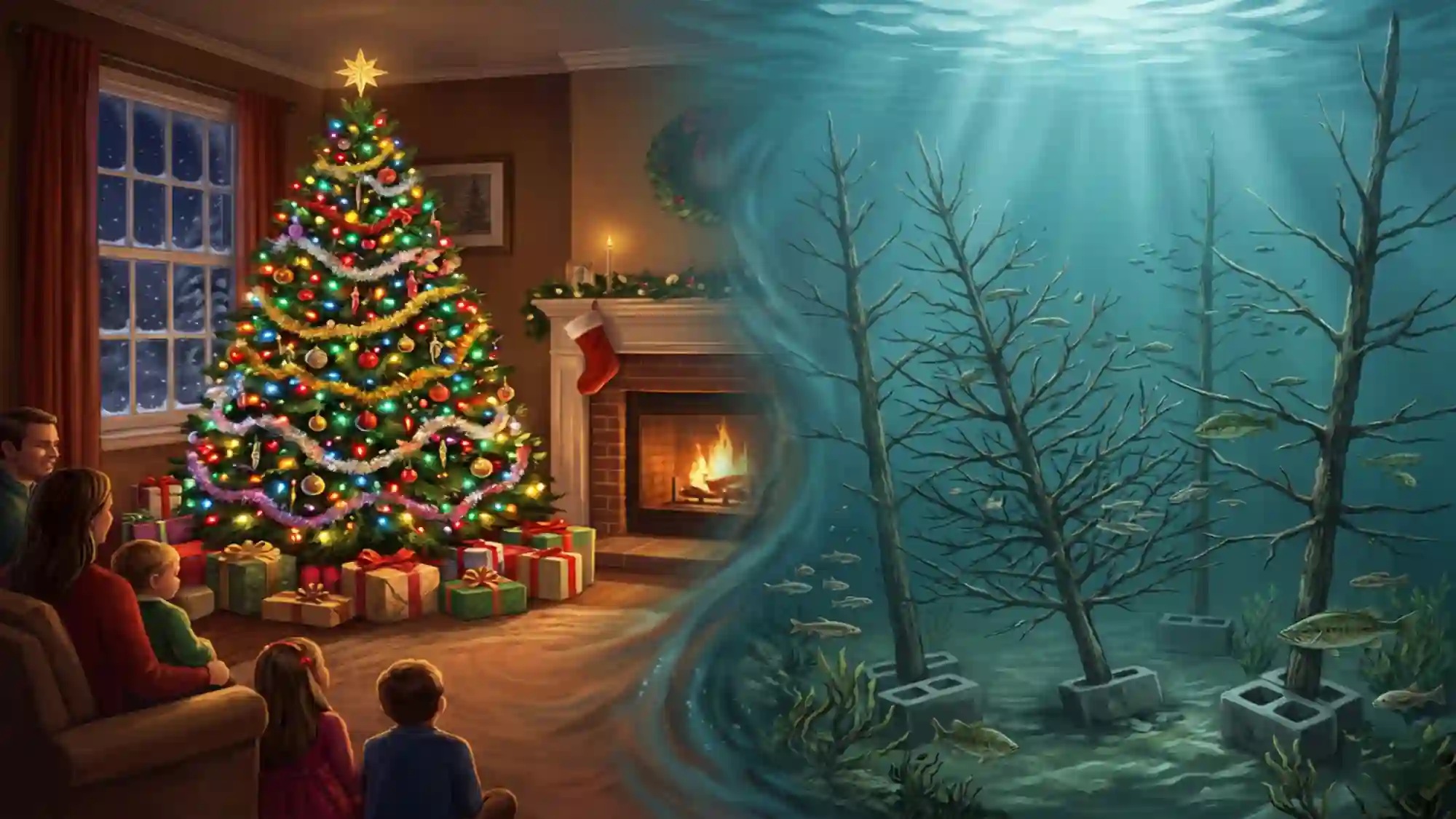
Once the holidays are over, Christmas trees often end up at the curb, waiting to be collected and discarded. But in Kentucky, USA, thousands of these trees have found a very different destination: the bottom of lakes, where their branches provide shelter for fish. In 2026, a state-run programme collected around 5,000 discarded natural Christmas trees, including approximately 1,700 that were submerged in a single lake to help restore underwater habitat. The initiative, called Christmas for the Fishes, is run by the Kentucky Department of Fish and Wildlife Resources. It transforms a seasonal waste problem into an opportunity to support aquatic life.
Why do fish need Christmas trees?
A lake may appear to be a vast, open space, but fish depend on underwater structures for survival. Submerged branches, fallen trees and logs create hiding places where smaller fish can escape predators. These structures also provide surfaces where food organisms can gather and areas where fish can feed and reproduce. Over time, however, natural wood decomposes. This is particularly relevant in Kentucky, where many lakes are artificial reservoirs created decades ago. As the original trees and woody structures disappear, fish lose some of the shelter that once filled these underwater environments. The department therefore builds replacement habitats using materials such as logs, rocks and donated evergreen trees. The 2026 Christmas tree collection included around 1,700 trees placed in Boltz Lake, helping replenish the underwater cover available to fish.
How does the recycling process work?
The process begins after Christmas, when residents bring their used natural trees to designated collection points. The trees must be stripped of decorations, including lights, ornaments and garlands. Artificial trees cannot be used. After collection, the trees are transported to selected lakes and reservoirs. Workers secure them with environmentally appropriate weights before submerging them in clusters at different depths. Their dense branches create small spaces that fish can move through and shelter in. These structures are not permanent. The wood gradually breaks down, so the department revisits lakes over time to replace habitat that has been lost. The programme is part of a wider effort to improve fish habitats across Kentucky, rather than simply a way to dispose of Christmas trees.
Can recycling help an entire lake ecosystem? Submerged trees can benefit more than the fish hiding among their branches. They provide surfaces for aquatic organisms and can attract fish that feed around these structures. Smaller fish may find refuge within the branches, while larger predatory fish gather nearby. The sites can also benefit recreational anglers because fish often congregate around underwater cover. Kentucky Fish and Wildlife records the locations of its artificial habitats and shares them through its fish-attractor maps, helping anglers locate these areas. However, the programme is not a complete solution to declining aquatic habitats. Its effectiveness depends on suitable placement, water conditions and the needs of local species. The trees also decay over time and must be replaced. Still, the initiative demonstrates how an everyday item can serve a practical ecological purpose after its original use has ended. Rather than treating every discarded Christmas tree as waste, Kentucky is giving thousands of them another role, one that begins where the branches disappear beneath the water.
Sources:
Ashley, E. (2026, January 12). Donated Christmas trees to become underwater habitat for local wildlife. FOX19 NOW. https://www.fox19.com/2026/01/12/donated-christmas-trees-become-underwater-habitat-local-wildlife/