Take a sip of water immediately after brushing your teeth and something strange happens: ordinary water can suddenly feel almost icy. The water has not necessarily become colder, so why does your mouth experience such an intense cooling sensation?
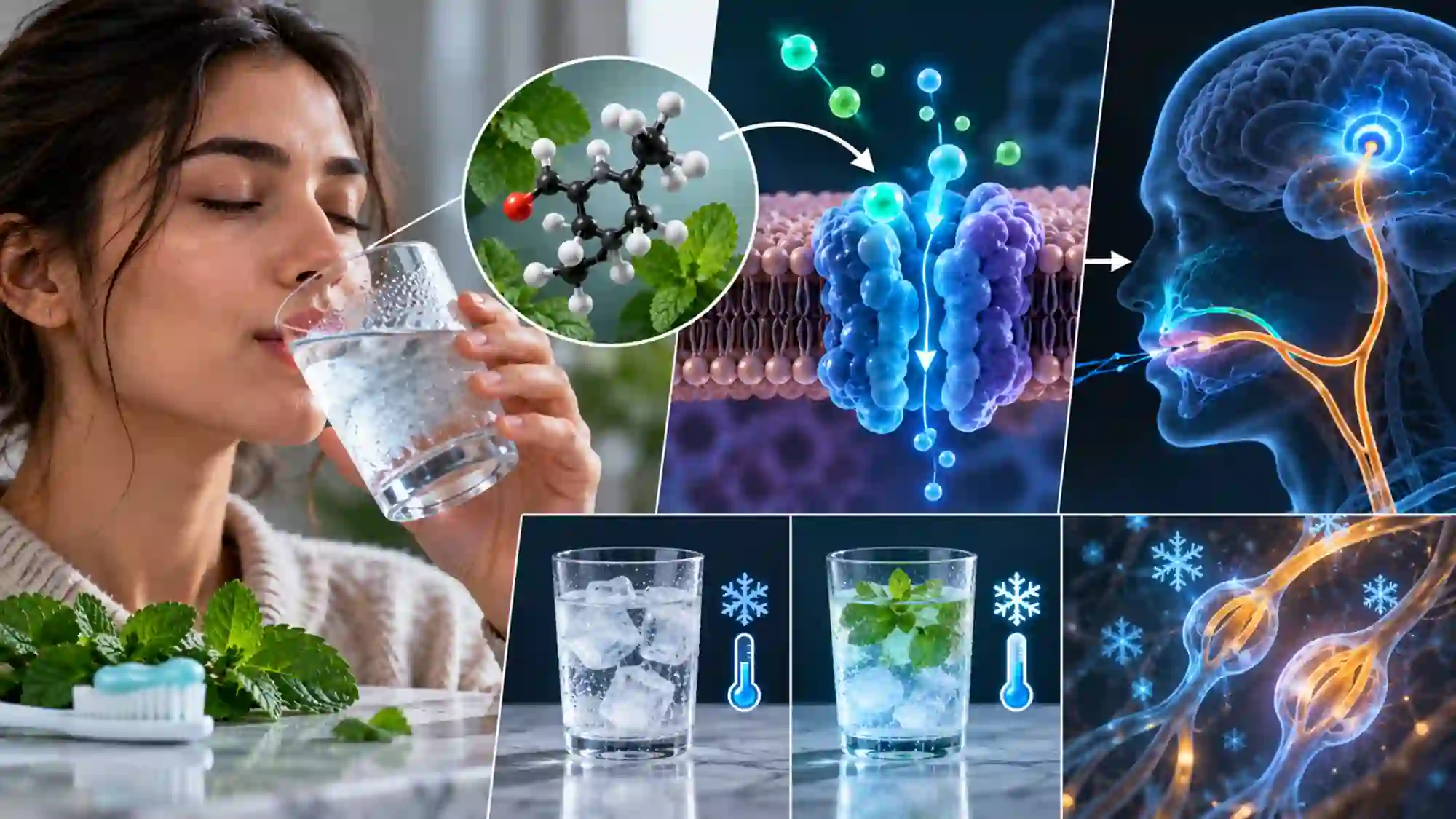
The answer lies in menthol, the compound responsible for the characteristic cooling sensation of mint. Rather than dramatically lowering the temperature of your mouth, menthol interacts directly with the sensory system that detects cold.
Our bodies contain specialised temperature-sensitive proteins called transient receptor potential (TRP) channels. One of the most important cold-sensitive channels is TRPM8, found on sensory nerve endings in the skin and oral tissues. TRPM8 responds naturally to cooling, but it can also be activated by menthol.

When you consume something containing menthol, the molecule interacts with TRPM8 and promotes opening of the channel. This allows ions to flow across the sensory-cell membrane, generating electrical signals that travel through sensory nerves toward the brain. The brain interprets this activity as coolness.
In other words, menthol is effectively pressing the body’s cold-sensing button without requiring the same degree of physical cooling.
This is particularly noticeable when drinking water. If the water is already somewhat cool, it provides an actual temperature stimulus while menthol simultaneously activates the molecular pathway associated with cold. The two signals can reinforce the sensation, making the water seem substantially colder than it really is. Experiments with menthol solutions have demonstrated that menthol can enhance the perception of cold in the mouth, particularly when the liquid is below oral temperature.
The effect is not limited to drinking. The same mechanism explains why mint toothpaste, chewing gum, and certain topical products produce a refreshing sensation. Menthol activates TRPM8 in different sensory tissues, creating the perception of cooling even when there has been little actual change in tissue temperature.
Interestingly, scientists now understand the interaction between menthol and TRPM8 at increasingly detailed molecular levels. Structural studies show that menthol binding produces conformational changes that promote activation of the channel. A 2026 study using cryo-electron microscopy provided further insight into how TRPM8 responds to both physical cold and menthol, revealing overlapping but distinct molecular mechanisms for the two stimuli.
There is an important limit, however: menthol does not actually freeze your mouth or substantially lower the temperature of the water. It changes how your nervous system interprets the thermal environment.

That makes the mint-and-water experience a fascinating example of how perception works. Temperature sensation is not simply a thermometer inside your body reporting an exact number. Instead, sensory receptors detect physical and chemical signals, and the brain combines them to construct the experience of hot or cold.
So when water feels freezing after mint, your brain isn’t being fooled exactly it is receiving a genuine cold signal from a molecule that has activated the same sensory machinery used to detect real cooling. Mint doesn’t make the water colder. It makes your nervous system better at feeling cold.
Sources:
Bautista, D. M., Siemens, J., Glazer, J. M., Tsuruda, P. R., Basbaum, A. I., Stucky, C. L., Jordt, S.-E., & Julius, D. (2007). The menthol receptor TRPM8 is the principal detector of environmental cold. Nature, 448(7150), 204–208. https://doi.org/10.1038/nature05910
Bharate, S. S., & Bharate, S. B. (2012). Modulation of thermoreceptor TRPM8 by cooling compounds. ACS Chemical Neuroscience, 3(4), 248–267. https://doi.org/10.1021/cn300006u