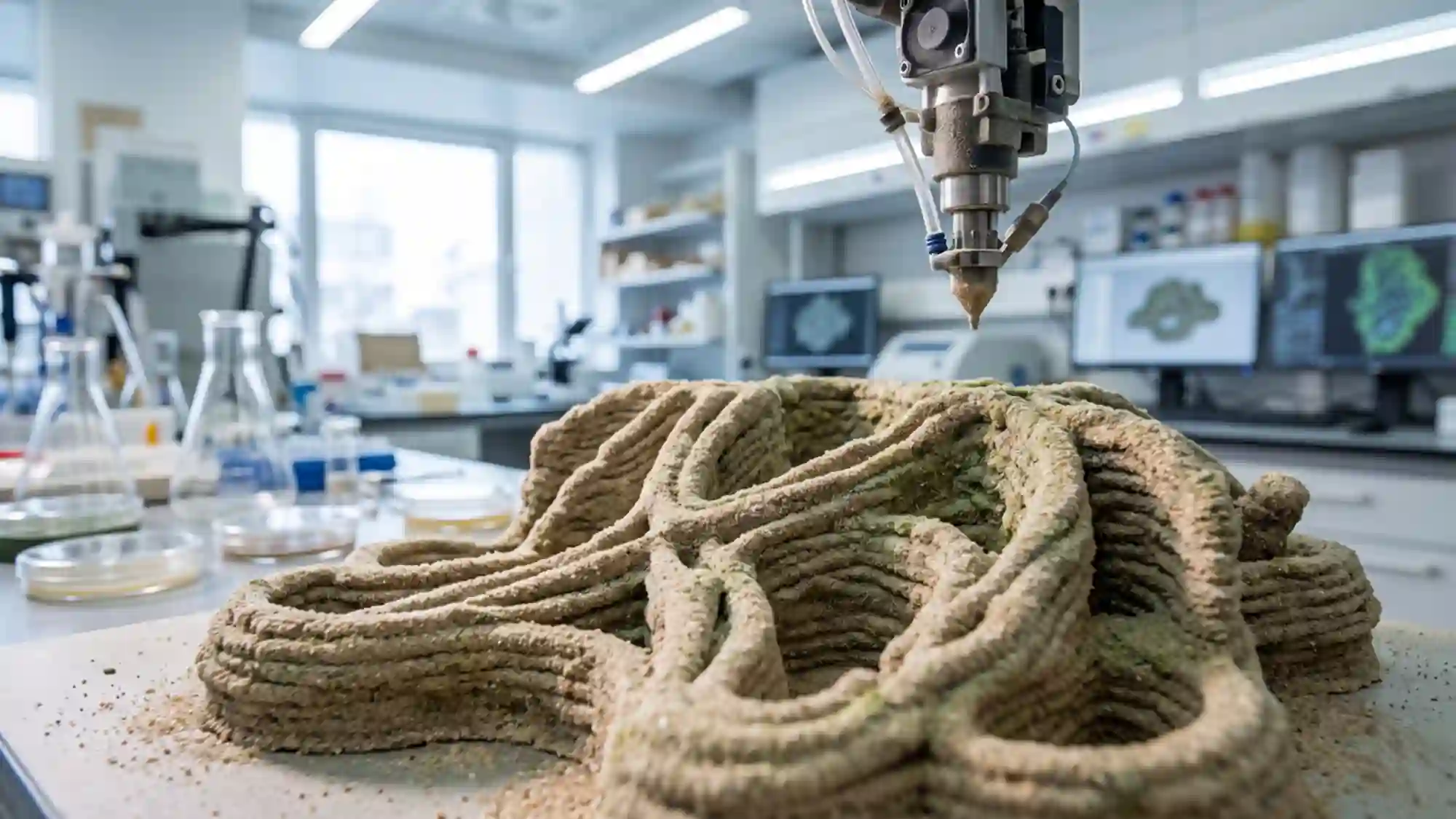
What if building materials could be manufactured without firing rocks at extremely high temperatures? Researchers at ETH Zurich are exploring a surprising alternative: using bacteria to turn loose grains of sand into solid architectural structures. By combining microbial activity with 3D printing and robotic fabrication, the team is developing a new way to shape building materials while avoiding the energy-intensive heating traditionally associated with cement production. The research, led by architect Karen Antorveza Paez, brings together microbiology, materials science and digital manufacturing. Rather than treating bacteria as an additive to conventional concrete, the team uses them as an essential part of the manufacturing process.
The technique is known as microbiologically induced calcite precipitation (MICP), or biocementation. It uses bacteria such as Sporosarcina pasteurii, which can help produce calcium carbonate, the mineral found in limestone and chalk. For the 3D-printing method, they developed a printable mixture containing sand, living bacteria and a gel made from water, alginate and xanthan. The material can be shaped into a desired design before being immersed in a solution containing urea and calcium chloride. The bacteria produce an enzyme called urease, which breaks down urea and helps generate the carbonate needed for mineral formation. Calcium ions then combine with carbonate ions to form calcium carbonate crystals. These microscopic crystals develop between the grains of sand, interlocking to bind the particles together. Instead of relying on conventional glue or high-temperature firing, the structure gradually becomes solid through biological activity and mineral formation. Depending on the desired strength, the process takes around two to five days. The mineralisation solution must be refreshed during this period, after which the structure is dried and the bacteria are no longer active.
They have developed two complementary approaches. In the first, the bacteria-containing mixture is printed into architectural shapes and subsequently mineralised. The team has demonstrated this method using a curved component measuring approximately 30 × 20 × 20 centimetres. The second approach uses a robotic arm to apply sand, bacteria and mineral-forming solutions onto a surface in successive layers. Inspired by stromatolites layered mineral structures formed with the help of microorganisms, this technique builds material gradually without requiring the same immersion bath process. The robotic spraying method was demonstrated continuously at the 2025 Venice Architecture Biennale, showing that the process can be automated. While printing is aimed at creating individual architectural components, robotic spraying is being explored for constructing layered surfaces.

Is this the future of sustainable construction? Cement production is energy-intensive, partly because conventional manufacturing requires heating limestone and other raw materials to very high temperatures. Biocementation offers a potential alternative because mineral formation can occur at room temperature, reducing the need for such heating. However, the technology is not yet ready to replace conventional concrete in major buildings. Its mechanical strength, durability and performance over time require further investigation. The process also produces ammonium as a by-product, which must be managed carefully to avoid environmental harm. For now, the technology is better suited to exploring architectural elements, panels and other applications than replacing load-bearing concrete structures. The important advance is not simply that bacteria can bind sand together, scientists have known this for years. It is that they are developing ways to control the process digitally and use it to manufacture designed structures. If future work can improve its strength, reliability and environmental footprint, microorganisms could become an unexpected part of the construction industry’s search for lower-impact materials.
Sources:
Antorveza Paez, K., Kindler, R. O., Terzis, D., Dutto, A., Pleij, T., et al. (2026). 3D biocement printing: Scaling up living mineral structures. npj Materials Sustainability, 4, Article 20. https://doi.org/10.1038/s44296-026-00110-1