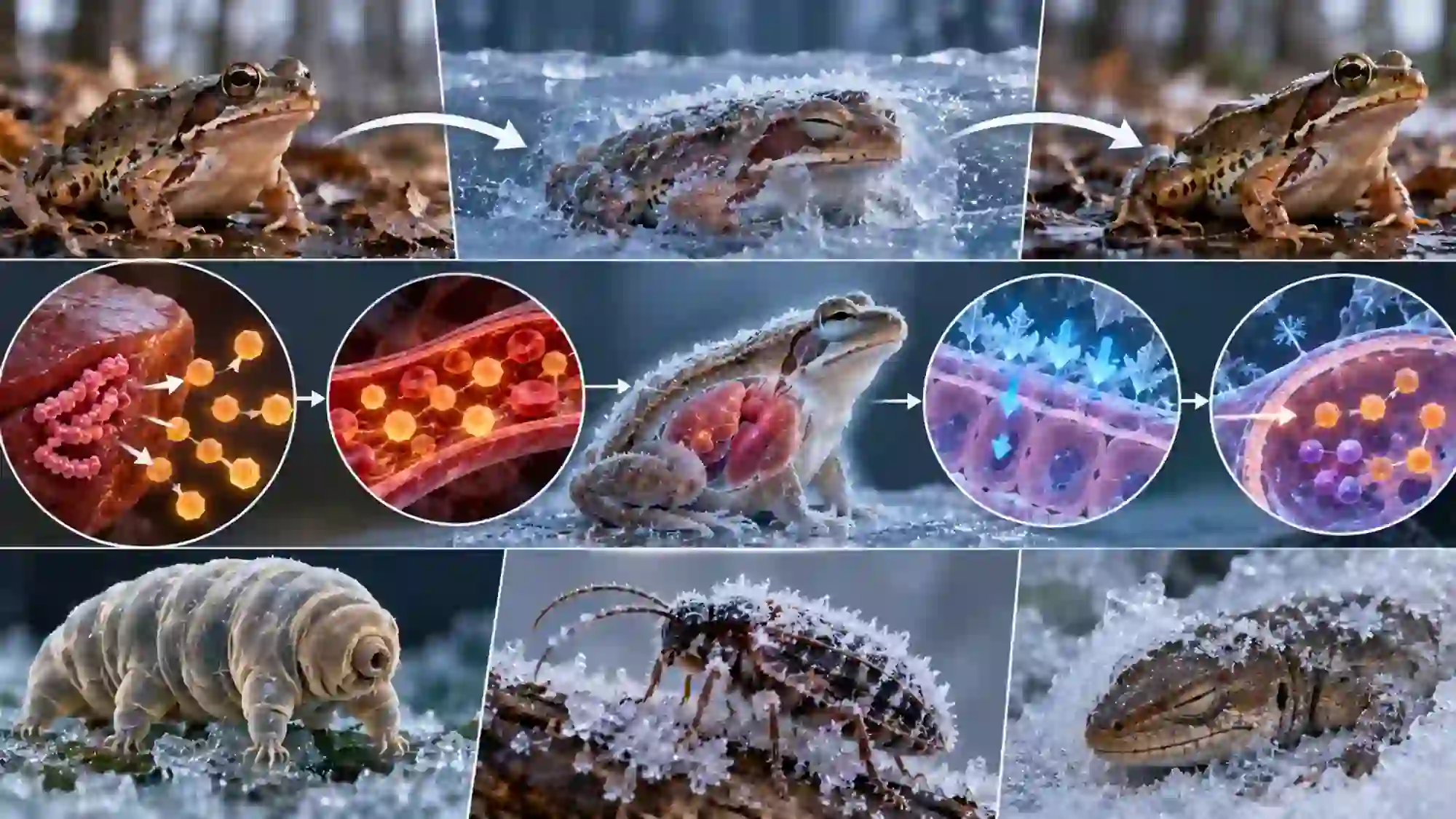
For most animals, freezing is fatal. As temperatures fall below 0°C, water begins forming ice crystals. Inside cells, uncontrolled ice formation can rupture membranes, damage proteins, and disrupt essential biochemical processes. Yet a remarkable group of animals has evolved ways to survive conditions that would normally be lethal.
One of the best-studied examples is the wood frog (Rana sylvatica). During winter, these frogs can let a large proportion of their body water freeze while their hearts stop beating, breathing ceases, and metabolic activity drops dramatically. Some populations can survive for months in this state before thawing and becoming active again.
The secret is not simply resistance to cold it is careful management of freezing itself.
When ice begins forming outside their cells, wood frogs rapidly break down stored glycogen and release large quantities of glucose into their bloodstream and tissues. Glucose acts as a natural cryoprotectant, helping cells retain water and reducing the damaging effects of freezing and dehydration. Urea also accumulates and helps protect against freezing stress.
Another crucial strategy is controlling where ice forms. Wood frogs generally tolerate ice in extracellular spaces rather than allowing large ice crystals to form inside cells. This distinction is critical because intracellular ice can cause severe physical damage. The frogs’ physiological responses help regulate ice formation and prevent catastrophic cellular injury.
Freezing also creates a second major problem: oxygen disappears from tissues. When the heart stops and circulation ceases, organs experience conditions similar to prolonged anoxia or ischemia. Instead of continuing normal energy-intensive metabolism, the frog dramatically suppresses its metabolic rate and relies heavily on anaerobic pathways. This allows its limited energy reserves to last throughout the frozen period.
Surviving freezing is therefore a coordinated biological process rather than the action of a single “antifreeze” molecule. The frogs simultaneously manage ice formation, dehydration, oxygen deprivation, energy consumption, oxidative stress and protein damage. Their cells also activate protective stress responses that help stabilise and repair damaged proteins.
Wood frogs are not the only animals capable of remarkable freeze tolerance. Some insects, reptiles and microscopic tardigrades can also survive sub-zero conditions, although their mechanisms differ. Tardigrades, for example, can enter cryptobiotic states that dramatically reduce biological activity and allow some species to withstand extreme freezing.
Understanding these adaptations has implications beyond zoology. Scientists are investigating natural freeze-tolerance mechanisms as potential inspiration for cryopreservation, including the storage of cells, tissues, and eventually complex organs.
The remarkable lesson is that freezing does not necessarily mean biological death. For some organisms, it is a carefully controlled state of suspended survival. They do not simply endure winter; they temporarily rewrite the rules of metabolism, water balance, and cellular survival to live through it.
Sources:
Storey, K. B., & Storey, J. M. (2013). Molecular biology of freezing tolerance. Comprehensive Physiology, 3(3), 1283–1308. https://doi.org/10.1002/cphy.c130007
Costanzo, J. P., do Amaral, M. C. F., Rosendale, A. J., & Lee, R. E., Jr. (2013). Hibernation physiology, freezing adaptation and extreme freeze tolerance in a northern population of the wood frog. Journal of Experimental Biology, 216(18), 3461–3473. https://doi.org/10.1242/jeb.089342