For centuries, scientists have classified species primarily by what they could see: body shape, colour, skeletons, shells and other physical characteristics. But what if some species were hiding in plain sight not because they looked identical, but because nobody had their genetic information?
Today, old DNA is giving scientists a way to revisit the past and potentially uncover biodiversity that conventional taxonomy missed.
The DNA hiding in museums
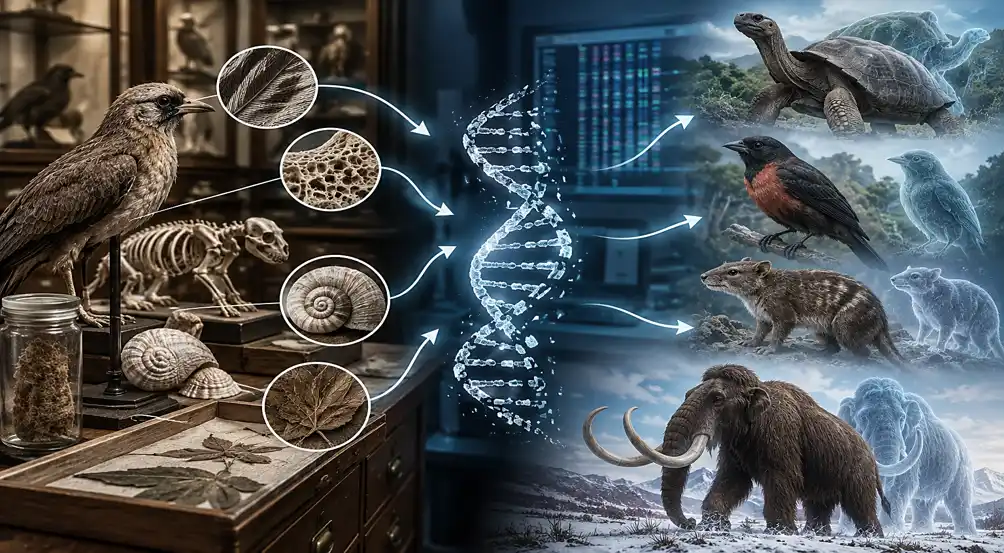
Natural-history museums contain millions of specimens collected decades or even centuries ago. Many were originally classified according to their physical appearance, but some may represent distinct evolutionary lineages that were incorrectly grouped together.
Modern sequencing techniques can recover tiny fragments of DNA from feathers, bones, skins, shells and other preserved material even when the DNA is severely degraded. Researchers can then compare those sequences with modern genomes to determine how closely related the specimens really were.
This approach, sometimes called museomics, has already revealed cryptic diversity and previously unrecognized evolutionary lineages. Historical DNA from museum bird specimens, for example, has shown that some populations once thought to be ordinary subspecies were genetically much more distinct and in some cases had already disappeared.
When extinct species leave a genetic clue
The possibilities become even more intriguing when scientists examine remains from species that are already extinct.
In August 2026, Yale researchers used computational methods to analyse extremely degraded DNA from Galápagos giant tortoise specimens. Their analysis identified two extinct lineages that had previously escaped recognition, demonstrating that museum specimens considered too genetically damaged for conventional analysis can still contain valuable evolutionary information.
Ancient DNA has also helped reveal overlooked extinct tortoise diversity in Madagascar and the western Indian Ocean, showing that morphology alone had underestimated the number of distinct lineages that once existed.
It doesn’t have to come from a specimen
Perhaps even more remarkable is environmental DNA (eDNA).
DNA released by organisms can become trapped in soil, sediment, ice or other environments. Scientists can sometimes recover those molecular traces without finding the organism itself. A 2026 study recovered DNA from plants, insects and large mammals including mammoth—from ground-squirrel burrows preserved in Yukon permafrost for up to 700,000 years. The data also revealed previously unrecognized genetic diversity in ancient ground squirrels.
Could we discover species lost to history?
Potentially, yes but DNA alone does not automatically create a new species. Scientists still need to evaluate genetic divergence alongside morphology, geography, ecology and evolutionary relationships.
The bigger implication is that our current catalogue of life may be less complete than we think.
Some species may have gone extinct before scientists ever formally described them. Others may still survive today while being classified incorrectly.
Old DNA therefore does more than reconstruct the past.
It may help scientists rewrite the biological map of life one forgotten specimen at a time.
Sources:
https://news.yale.edu/2026/08/26/reading-giant-tortoise-dna-time-forgot?