
A trusted soldier can win many battles, but even the strongest warrior struggles when the enemy learns every move. That is the story of antibiotics today. For decades, these life saving medicines have protected millions of people from deadly bacterial infections. But some bacteria have become clever survivors. They have learned how to escape the attack, making many powerful antibiotics weaker with time. Scientists are now asking an exciting question, “Instead of searching for a brand new weapon, can we make an old one powerful again?” New research suggests the answer could be yes. As the proverb says, “Old is gold.”
Antibiotic resistance is one of the biggest health challenges facing the world. Every time antibiotics are overused or misused, bacteria get another chance to learn and adapt. It is like students studying hard before an examination, except these students are harmful bacteria learning how to defeat medicines. This silent battle is happening every day in hospitals across the world. Ironically, the medicines that once frightened bacteria are now being challenged by them. Nature seems to whisper, “Keep improving, because I never stop changing.”
One of the most important antibiotics is vancomycin. Doctors often call it the last line of defence because it is used when many other antibiotics no longer work. It acts like the final goalkeeper protecting the goal when every other defender has failed. For many years, vancomycin has saved patients suffering from severe bacterial infections. However, some bacteria have gradually found ways to survive even this powerful medicine, making treatment much more difficult.
The easiest answer might seem to be creating completely new antibiotics. Unfortunately, that is far easier said than done. Developing a new medicine can take many years, cost billions of dollars, and still face the same problem when bacteria eventually develop resistance. Building a new weapon every time the old one fails is like buying a new house because one door lock is broken. Scientists wondered whether there was a smarter solution.
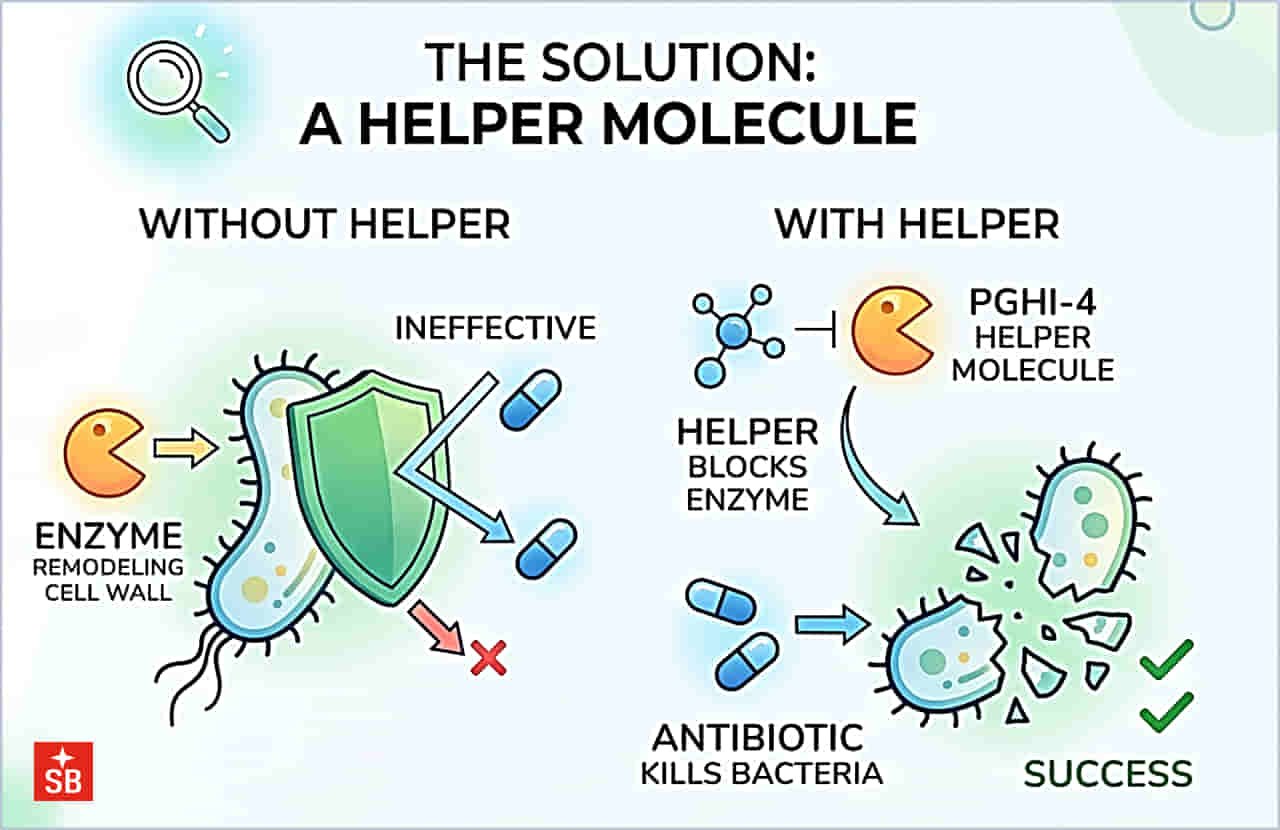
Researchers have now shown a clever new strategy. Instead of changing vancomycin itself, they combined it with a small helper molecule called pghi, 4. Think of vancomycin as a brave knight and pghi, 4 as the friend who quietly removes the enemy’s shield before the battle begins. The helper molecule does not directly kill bacteria. Instead, it weakens their natural defence system, allowing vancomycin to do its job once again. Sometimes, the strongest victory comes from teamwork rather than individual strength.
The target of this research is a dangerous bacterium called Enterococcus faecium. This microorganism is well known for causing difficult hospital acquired infections, especially in patients with weak immune systems. It survives by constantly rebuilding and modifying its cell wall using specialised enzymes. These enzymes act like skilled repair workers who quickly fix damage before the antibiotic can finish its attack. The researchers discovered that pghi, 4 blocks one of these important enzymes. Once the repair system stops working, vancomycin can successfully destroy the bacteria again.
This approach represents an exciting advance in antimicrobial research. Instead of designing entirely new antibiotics, scientists are identifying helper molecules known as antibiotic adjuvants. These compounds disable bacterial defence mechanisms without directly killing the bacteria themselves. By targeting resistance pathways rather than the antibiotic molecule, researchers hope to extend the useful life of existing medicines. This strategy could slow the growing crisis of antimicrobial resistance while reducing the time and cost needed to develop completely new drugs.
The impact of this discovery could reach far beyond vancomycin alone. If scientists identify similar helper molecules for other antibiotics, many older medicines that have lost their effectiveness may receive a second chance. This would provide doctors with more treatment options against dangerous multidrug resistant infections. In many ways, it is like repairing a trusted bridge instead of building a completely new one from the beginning.
Still, this promising research is only one step in a longer journey. The combination of vancomycin and pghi, 4 must undergo further laboratory studies, animal testing, and human clinical trials before becoming a routine treatment. Safety, effectiveness, and possible side effects must all be carefully evaluated. Science walks slowly because every careful step protects future patients.
This discovery also reminds us that antibiotics are precious resources, not unlimited gifts. Every unnecessary antibiotic prescription gives bacteria another opportunity to become stronger. Patients should always use antibiotics exactly as prescribed and never stop treatment early unless advised by a doctor. Hospitals must continue infection control measures, and researchers must keep searching for smarter solutions. As another proverb wisely says, “Prevention is better than cure.”
A simple quote captures the spirit of this breakthrough, “Sometimes the oldest sword wins again with a wiser hand.” By giving existing antibiotics a new partner instead of replacing them, scientists may have opened a powerful new chapter in the fight against antibiotic resistance, proving that fresh thinking can breathe new life into trusted medicines.
Sources:
Fam et al., (2026). Genetic and pharmacological inactivation of peptidoglycan remodeling increases antibiotic susceptibility of vancomycin-resistant Enterococcus faecium. Nature Communications.


