NASA and IBM have released an open AI model that could transform how humanity maps, studies, and ultimately explores the lunar surface.
There is a new kind of explorer looking at the Moon. It has no eyes, no spacecraft, and no landing gear. It does not need oxygen or protection from radiation. It is an artificial intelligence model. NASA and IBM have released the NASA-IBM Lunar Foundation Model, making the technology available through Hugging Face. Its purpose is deceptively simple: teach artificial intelligence to understand the Moon. But behind that objective lies a much bigger possibility.
What if AI could become one of humanity’s most powerful scientific instruments beyond Earth?
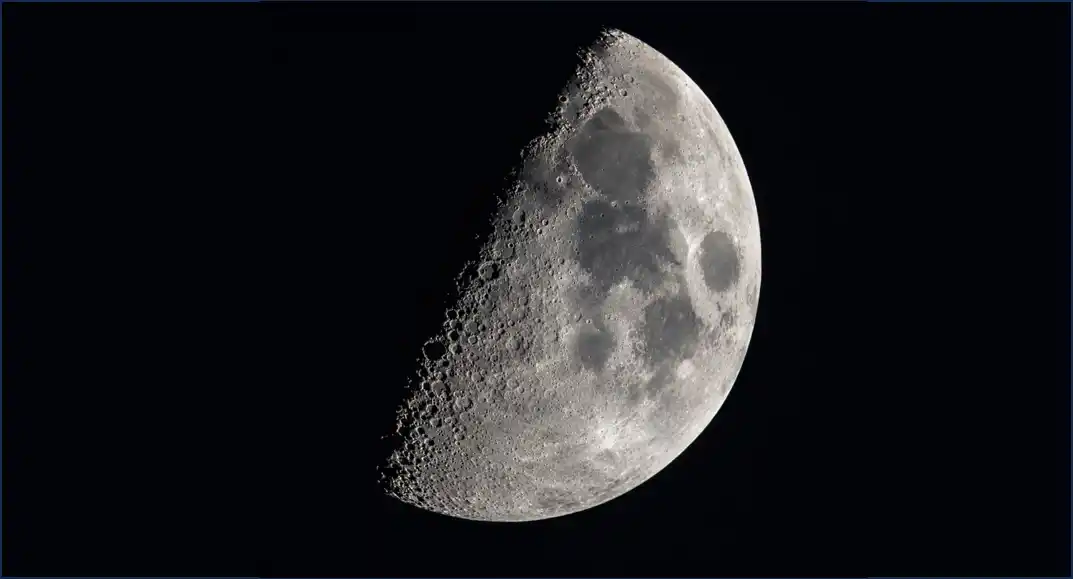
The lunar surface is not a single picture. It is a vast scientific archive assembled from decades of observations by spacecraft and instruments operating in different wavelengths and measuring different physical properties. NASA and IBM trained their Lunar Foundation Model using more than 30 layers of lunar data from nine instruments across four NASA missions, including NASA’s Lunar Reconnaissance Orbiter.
The significance is enormous. Instead of examining individual datasets independently, an AI foundation model can learn relationships between different observations of the same terrain. A crater is no longer merely a circular depression in an image. Combined with elevation, geological and other measurements, it becomes part of a much richer scientific picture. AI is effectively learning to see the Moon in multiple dimensions simultaneously.
The Hunt for Water
Inside the permanently shadowed regions of the moon, temperatures can remain extraordinarily low, creating environments where water ice may survive for billions of years. For future explorers, that ice could be among the most valuable resources in the Solar System. Water can provide drinking supplies and, through electrolysis, be separated into hydrogen and oxygen. Those elements could potentially support life and produce rocket propellant. Finding lunar ice, therefore, is not simply a scientific exercise. It could determine where humanity builds its first permanent footholds on another world. AI could accelerate the search by helping scientists identify geological features and patterns associated with potentially valuable resources.
From Algorithms to Astronauts
The Lunar Foundation Model also points toward a fundamental change in planetary exploration. Future missions will generate staggering quantities of scientific data. Humans cannot manually inspect every image, spectrum and measurement with equal speed, but AI can. By releasing the model openly through Hugging Face, NASA and IBM are effectively giving researchers around the world a starting point for building new lunar applications. That openness could be as important as the model itself. Scientists could adapt the technology to investigate craters. Engineers could use it to evaluate terrain. Researchers could search for geological structures that have escaped previous analyses. And discoveries made by one group could inspire applications by another.
The Moon Is Only the Beginning
The ultimate significance of this technology may not just be lunar. The Moon is humanity’s nearest planetary laboratory—a place where new technologies can be tested before they are required to operate hundreds of millions of kilometres away. Tomorrow’s AI systems may analyse the surface of Mars, search asteroids for resources, interpret observations of icy moons, or help autonomous spacecraft decide where to explore next. The transition is already beginning. For centuries, exploration meant sending humans to places they had never seen. Now we are developing machines that can help humanity understand those places before we arrive. The first explorers of Mars may therefore have an unexpected companion: an artificial intelligence trained on the lessons of the Moon. We are not simply teaching machines to look at other worlds. We are teaching them to help us understand them.
And perhaps, before the next giant leap in space exploration, the most important question will no longer be “Where should we go?” It will be:
“What can the machine see that we have never noticed?”
Sources:
IBM. (2026, September 10). Introducing IBM and NASA’s new foundation model for the Moon. IBM Research.
NASA. (2026, September 10). NASA, IBM launch AI foundation model for lunar science. NASA Science. https://science.nasa.gov/science-research/artificial-intelligence-lunar-foundation-model/