
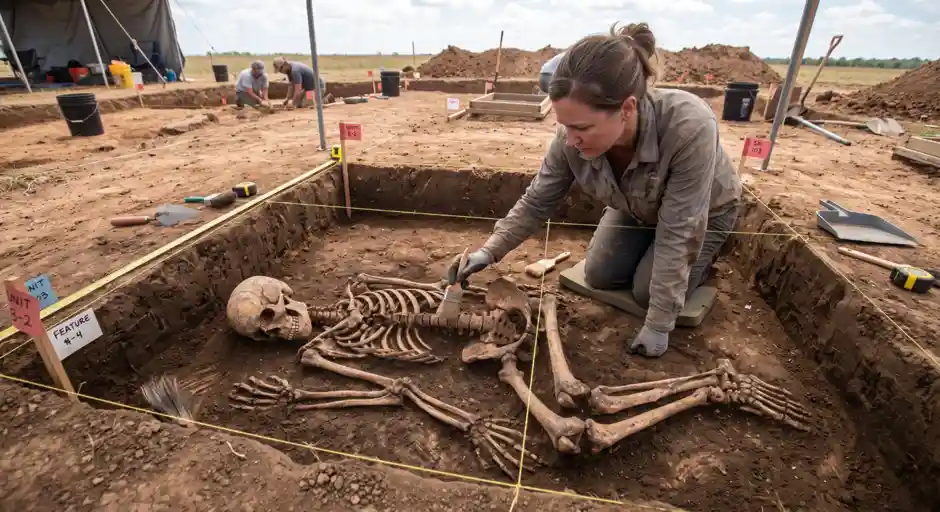
A skeleton may look like a silent frame of bones, but it is much more than that. It is like an old diary whose pages never fade, patiently waiting for someone to read its story. Even when a person has been gone for hundreds or thousands of years, the bones still carry clues about their life. As it is often said, “Every mark has a memory.” Scientists often say, “Bones may stay silent, but they never stop telling the truth.” Like detectives following tiny footprints, archaeologists and forensic experts carefully study every bone to uncover the hidden tale of a person’s age, growth, and journey through life.
The secret lies in the way our bones grow and change with time. During childhood and teenage years, bones are busy construction sites. Long bones such as the femur and tibia grow from special regions called growth plates. These plates slowly close as a person reaches adulthood, almost like doors gently shutting after the work is complete. Since different bones close at different ages, scientists can estimate the age of young people with good accuracy. Teeth also act like nature’s calendar, appearing in a fixed order that gives another strong clue about age.
Once a person becomes an adult, the story becomes more complex because the body’s main growth has ended. Scientists then look for the gentle fingerprints of time. The ends of the ribs, the pubic bone in the pelvis, and the joints between the skull bones slowly change shape with age.
Bone density also decreases in many older adults, making the skeleton resemble an old building that has weathered many seasons. This gradual change is a natural part of life, often called the golden years rather than simply getting old. No single bone reveals the complete answer. Instead, every bone contributes a small piece to the puzzle, proving that many hands make light work, even inside the human body.
Modern technology has given these silent witnesses an even stronger voice. CT scans, X-rays, and microscopic examination of bone tissue allow scientists to discover details hidden deep inside the skeleton. In forensic science, DNA testing and medical records may join skeletal analysis to build what experts call a biological profile. It is similar to putting together thousands of tiny pieces of a jigsaw puzzle until a clear picture appears. As forensic experts often remind students, “Every bone leaves a breadcrumb, you only need to know where to look.” This careful combination of evidence makes age estimation more reliable.
Even with advanced science, no method can reveal a person’s exact age from bones alone. Instead of declaring someone was exactly 42 years old, researchers usually provide an age range, such as 40 to 45 years. Human bodies do not follow identical clocks. Some age quickly, while others age more slowly, making every skeleton unique. This scientific uncertainty is not a weakness but a strength because it reflects the natural differences among people.
Whether helping solve a modern crime or uncovering the lives of ancient civilizations, bones remain faithful storytellers. They are bridges between the past and the present, connecting today’s scientists with people who lived long ago. A skeleton may appear lifeless, yet beneath its quiet surface lies a remarkable autobiography written not with ink, but with bone. In the end, actions may speak louder than words, but sometimes silent bones tell the greatest stories of all.


