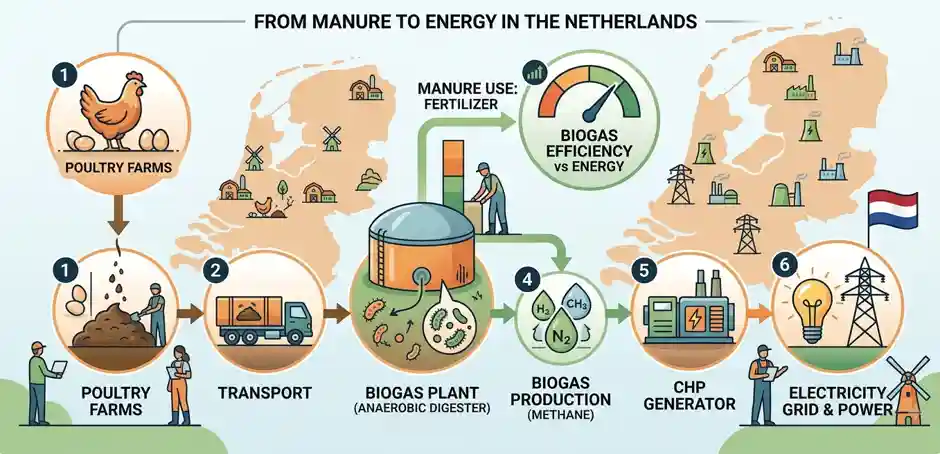
Poultry farms produce something in enormous quantities that usually isn’t thought of as a valuable resource: manure. In the Netherlands, one facility has found a way to turn that waste into something far more useful. A plant in Moerdijk processes around 420,000 tonnes of poultry manure every year, using it to generate renewable electricity for roughly 45,000 households while also recovering nutrients from the leftover ash to make fertiliser.
The idea solves two problems at once. Poultry manure is rich in nutrients, but producing and transporting such large amounts of it can create waste-management and environmental challenges. Simply leaving large quantities to accumulate isn’t practical. Instead, the Dutch facility treats the manure as a form of biomass, a material that contains stored chemical energy originating from plants and ultimately the Sun.
So how does chicken manure become electricity?
Rather than simply burning the wet waste like a log in a fireplace, the facility uses thermal conversion. The manure is processed at high temperatures, releasing energy as heat. That heat is then used to produce steam, which drives turbines connected to generators.
In other words, the same basic principle behind many conventional power plants: Heat → steam → turbine → electricity—is being applied to an unusual fuel source. But the process doesn’t end when the electricity has been generated. A large amount of mineral material remains behind as ash. And this is where the system becomes particularly interesting.
Poultry manure contains nutrients such as phosphorus, potassium, calcium and magnesium, all of which are important for plant growth. Instead of treating the ash as useless waste, the facility recovers these nutrients and processes the material into a phosphate-potassium fertiliser. The result is a circular system: something that began as agricultural waste is converted into energy, while some of its remaining nutrients return to agriculture.
This approach is an example of a circular economy, where waste from one process becomes a useful input for another. It doesn’t mean manure has suddenly become a magical unlimited source of clean energy. Thermal conversion still requires infrastructure and produces emissions that must be managed. But it demonstrates an important shift in how waste can be viewed. Sometimes, the most useful resource isn’t something that needs to be mined, drilled or manufactured. It may be sitting in a farmyard, waiting for someone to figure out what to do with it.