A newly reported peptide-based nanopore technology could open new possibilities for detecting and profiling disease-associated proteins at the single-molecule level. Varsha et al. have developed a self-assembling α-helical peptide nanopore that can recognize and distinguish biomolecules with different sizes, structures and electrical properties, providing a potential platform for highly sensitive biomarker analysis.
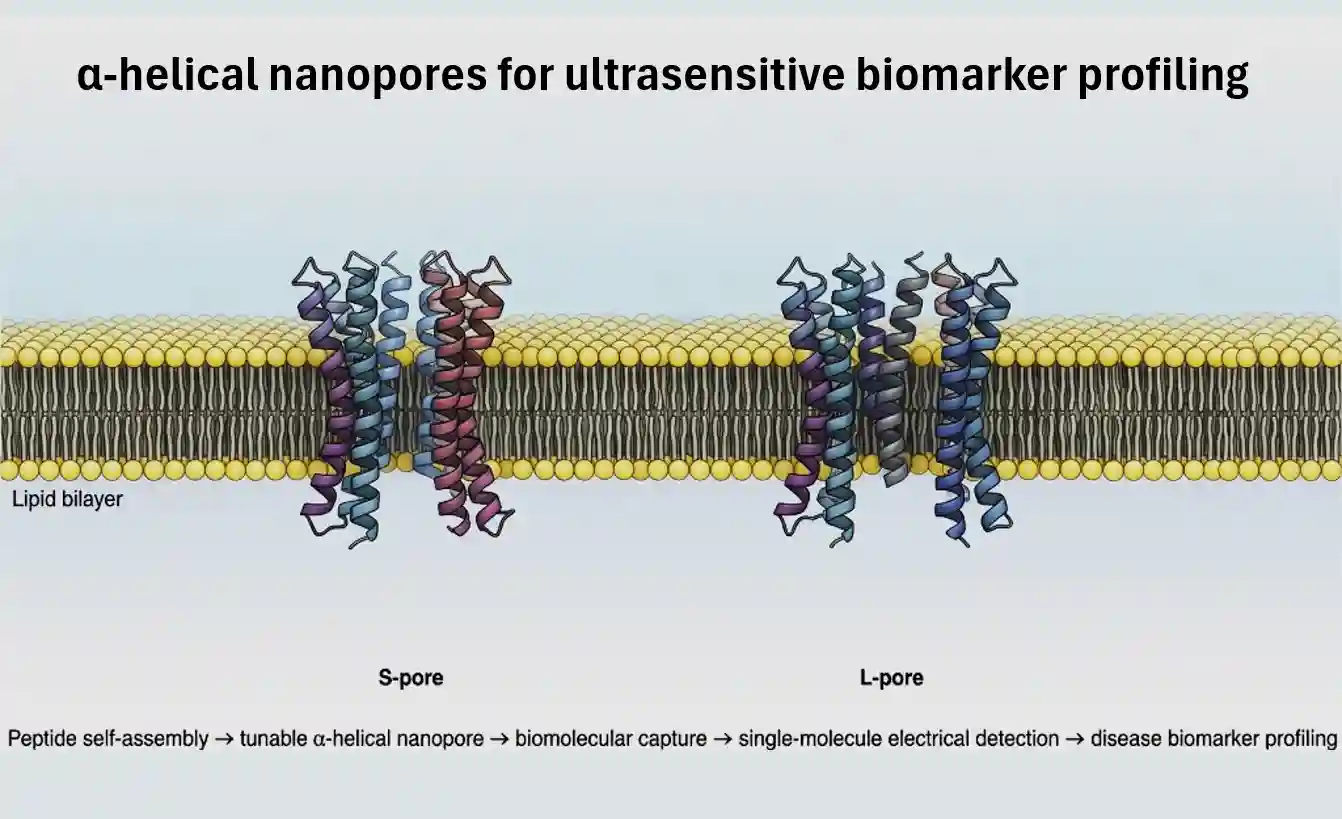
Published in Nature Nanotechnology, the study focuses on a peptide called pPorA, derived from the bacterial porin PorACj. Rather than relying on conventional rigid nanopore structures, the researchers found that pPorA can spontaneously organize into flexible α-helical assemblies within lipid membranes. These assemblies adopt two distinct pore configurations, referred to as small (S) and large (L) pores.
An important feature of the system is that both pore architectures arise from the same basic octameric peptide assembly. By introducing strategically selected unnatural amino acids, Varsha et al. were able to alter the pore dimensions while maintaining the overall oligomeric organization. Electrical measurements showed single-channel conductances of approximately 2.4 nS for the S-pores and 3.5 nS for the L-pores in 1 M KCl, demonstrating that the peptide architecture can be tuned to generate different sensing characteristics.
The nanopores were subsequently tested with a range of molecular targets. Their sensing capability extended from relatively small molecules, such as sugars and peptide enantiomers, to much larger intrinsically disordered proteins (IDPs). These proteins are particularly challenging analytical targets because they can adopt multiple conformations and form dynamic assemblies.
One of the most significant demonstrations involved α-synuclein (α-syn), a protein strongly associated with Parkinson’s disease. The large pores were able to detect different α-syn variants, including a disease-associated C-terminal deletion mutant. According to Varsha et al., this mutant interacted with the nanopore with a dissociation constant of approximately 20 nM, indicating strong molecular recognition.
The researchers also exploited electrostatic interactions involving the α-syn N-terminus. This enabled individual α-syn species with different charge characteristics to be distinguished within mixtures, an important capability for analyzing heterogeneous protein populations.
Beyond detecting individual protein species, the nanopores provided a means of monitoring α-syn aggregation. The technique could resolve changes occurring as α-syn progressed from monomeric forms through oligomeric intermediates toward fibrillar structures. Such measurements could potentially assist investigations into the molecular mechanisms underlying neurodegenerative disease and the identification of compounds that interfere with formation of toxic oligomers.
The smaller S-pores demonstrated complementary capabilities by detecting smaller disease-relevant peptides, including humanin and peptides derived from superoxide dismutase. This size-dependent sensing illustrates how pore dimensions can be used to tailor nanopores for different biomolecular targets.
Varsha et al. suggest that these conformationally programmable α-helical nanopores could eventually contribute to biomarker profiling, therapeutic screening and other molecular sensing applications. However, further structural characterization and computational refinement will be needed, particularly to understand how pore architecture controls molecular recognition under physiological conditions.
The study therefore represents a step toward programmable peptide nanodevices capable of translating individual biomolecular interactions into measurable electrical signals, potentially expanding the toolbox available for ultrasensitive disease biomarker detection.
Source:
Varsha Shaji., Jain, R., Puthumadathil, N. et al. A self-assembled peptide forms α-helical nanopores for ultrasensitive biomarker profiling. Nat. Nanotechnol. (2026). https://doi.org/10.1038/s41565-026-02265-3.