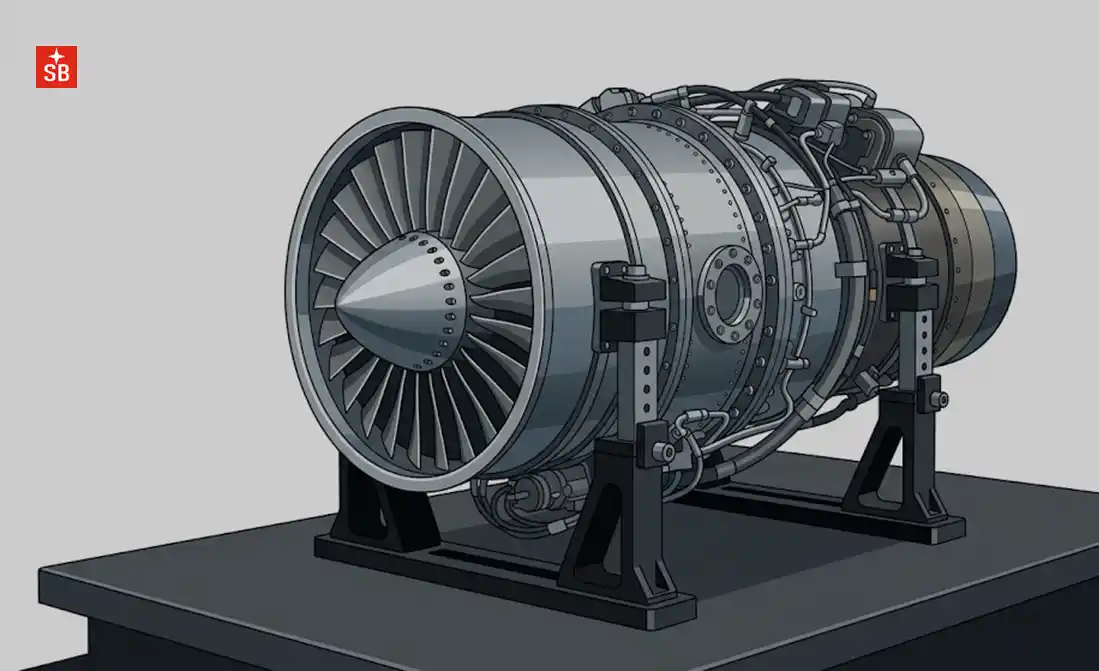
A small engine can sometimes power a giant dream. India has now taken one such important step. On 22 July 2026, Hyderabad based Azad Engineering Limited handed over the country’s first fully indigenous expendable turbojet engine to the Gas Turbine Research Establishment, GTRE, under the Defence Research and Development Organization, DRDO, in Bengaluru. At first glance, the engine may look like just another metal machine, but it carries the weight of decades of scientific effort. It is a reminder that “Rome was not built in a day.” Every great technological nation begins with one successful milestone, and this engine is one more brick in India’s growing aerospace fortress.
Building a jet engine is often compared to conducting a perfect orchestra where every instrument must play in complete harmony. A tiny mistake in temperature, airflow, pressure, or material strength can bring the whole system to a halt. That is why only a handful of countries have mastered the complete science of designing and manufacturing jet engines. “I was born to fly,” the engine seems to whisper as its blades prepare to spin at astonishing speeds. This achievement places India more firmly among nations capable of producing one of the world’s most demanding engineering products.
The engine was designed by GTRE, DRDO’s propulsion laboratory, while Azad Engineering manufactured and assembled it under a long term agreement signed in 2024. During the handover, Azad Engineering Chief Executive Officer Rakesh Chopdar presented the engine to GTRE Director General Dr. K. Rajalakshmi Menon and GTRE Director Dr. S. V. Ramanamurty. Defence Secretary and DRDO Chairman Rajesh Kumar Singh described the achievement as an important milestone for India’s defence sector. For Azad Engineering, this marks a remarkable journey. The company has long supplied precision engineered components to major global aerospace manufacturers, but it has now graduated from making parts of the puzzle to assembling the complete picture.

The new engine belongs to the 350 kilogram thrust class and follows a simple yet highly dependable design philosophy. It uses a single spool turbojet with a four stage axial flow compressor, an annular combustor, and a single stage uncooled axial flow turbine connected to a fixed exit nozzle. Together, these components generate about 3.4 kilonewtons of thrust. In engineering jargon, this configuration prioritises reliability, compactness, and affordability rather than extremely high efficiency. That is because expendable engines are designed for missions that may last only once, such as powering missiles or target drones, where dependable performance matters more than long service life.
This engine is expected to power India’s medium range anti ship missile programme and may also find applications in unmanned aerial vehicles and drones. Although its thrust is far lower than that required for fighter aircraft, its importance should not be underestimated. It is like learning to build a sturdy bicycle before attempting to build a racing car. The technologies, manufacturing standards, quality control systems, and testing methods developed through this programme create a strong foundation for more advanced propulsion systems in the future, including next generation indigenous fighter engines.
For decades, jet propulsion has remained one of India’s biggest technological hurdles. While aircraft like the Tejas have successfully demonstrated indigenous airframe design, they continue to rely on imported engines. The long running Kaveri engine programme has faced numerous technical challenges in achieving fighter class performance. There is an interesting irony here. A nation capable of launching satellites into space still depended on foreign engines for many of its military aircraft. This new achievement does not immediately solve that challenge, but it narrows the gap and strengthens India’s ability to build increasingly sophisticated propulsion technologies.
The achievement also reflects a changing landscape in India’s defence industry. Traditionally, strategic aerospace manufacturing was dominated by public sector organisations. Today, private companies such as Azad Engineering are becoming trusted partners in national defence programmes. Their transformation from supplying precision components for international companies to manufacturing complete engines for DRDO reflects the growing strength of India’s industrial ecosystem. This is a shining example of the vision behind Atmanirbhar Bharat, where government laboratories and private industry work hand in hand like two wings of the same bird.
Globally, engines in this thrust category have long been dominated by companies such as France’s Microturbo and the United States based Williams International. Their engines have powered famous cruise missiles and target drones for decades, earning reputations built through thousands of successful missions. India’s new engine enters this highly specialised field as a newcomer. It may not yet possess decades of operational experience, but every established technology once began with a single successful prototype. Every mighty banyan tree was once a tiny seed.
The road ahead will involve extensive testing, qualification, and production before the engine earns the same level of confidence as its international counterparts. Yet the significance of this achievement goes far beyond one machine. It demonstrates that Indian scientists, engineers, and industries are steadily mastering technologies once considered out of reach. This turbojet engine is more than a source of thrust. It is a symbol of confidence, capability, and national ambition, proving that India’s journey towards aerospace self reliance is gathering speed with every successful rotation of its turbine blades.