A delicious steak on your dinner plate should never feel like an enemy. Yet for some people, a tiny tick bite can quietly rewrite the body’s food rules, turning a favourite meal into a medical emergency. It is like a trusted friend suddenly wearing the mask of a stranger. “I was only enjoying dinner,” Sarah whispers, “how did my meal become my enemy?” How “A small spark can start a great fire.” In the same way, one tiny tick, hardly bigger than a sesame seed, can trigger a chain of biological events that changes a person’s life for years.
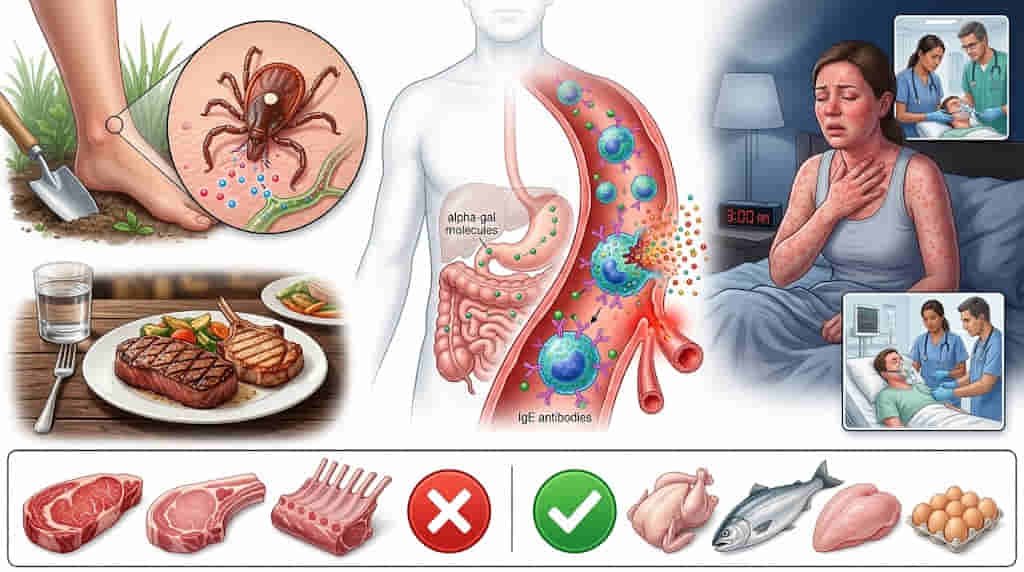
Sarah had always loved grilled beef and pork. One pleasant evening, she enjoyed a family barbecue and went to bed feeling perfectly healthy. But around three o’clock in the morning, she woke up covered in itchy red rashes. Her stomach cramped, her throat tightened, and breathing became frighteningly difficult.
She was rushed to the hospital, where doctors treated her for anaphylaxis, a severe allergic reaction that can become life threatening. The strange part was that the steak had been eaten nearly six hours earlier. The real culprit was not the dinner, but a tick bite she had almost forgotten two months before.

This is exactly what happens in Alpha gal Syndrome, commonly called the red meat allergy. It develops after the bite of certain ticks, including the Lone Star tick. The bite quietly changes the way your immune system reacts to a natural sugar found in red meat. What was once a perfectly safe meal can suddenly become a delayed medical emergency, with symptoms appearing three to eight hours after eating. It is as if the body’s internal alarm clock has been been reset to ring long after dinner is over. By understanding the science behind Alpha gal Syndrome, we can make safer food choices, read food and medicine labels carefully, and adapt our lifestyles to this unexpected modern health challenge.
The surprising condition is called Alpha gal Syndrome. It develops after the bite of certain ticks, including the Lone Star tick. Scientists call the tick a vector because it carries biological substances from one host to another. During feeding, the tick injects saliva into the skin. That saliva may contain a sugar molecule called alpha gal, which comes from the blood of mammals such as deer, cows, and pigs. The tick quietly whispers to the immune system, “Meet this stranger,” and the immune system never forgets the introduction.
Alpha gal is a natural sugar found in most mammals, but not in humans, apes, or monkeys. Millions of years ago, human ancestors lost the ability to produce this sugar. Because our bodies no longer make alpha gal, the immune system recognizes it as foreign. Normally, when people eat red meat, the digestive system breaks down this sugar without causing trouble. It passes through quietly like a peaceful traveller crossing a border. But after a tick bite, the story changes dramatically.
The immune system now treats alpha gal as a dangerous invader. It starts producing special allergy antibodies called Immunoglobulin E, or IgE. These antibodies sit on immune cells like loaded mousetraps waiting for the next encounter. “The next time I see alpha gal, I will attack,” the antibodies seem to declare. This biological memory transforms an ordinary meal into a potential trigger for a serious allergic reaction.
Another patient, David, discovered just how unpredictable this allergy can be. One day he ate a lean venison burger and felt only mild stomach discomfort. A week later, he enjoyed a fatty beef burger with a glass of beer and ended up in an ambulance.
The difference was not luck. It was biochemistry. Unlike peanut allergies that usually appear within minutes, alpha gal hides inside fat molecules. Those fats travel slowly through the digestive system before entering the bloodstream. It is like taking a long village road instead of a fast highway, which explains why symptoms often appear three to eight hours after eating.
During digestion, fats are packed into tiny transport particles called chylomicrons. These particles travel through the lymphatic system before reaching the blood. Only when they finally break apart does the hidden alpha gal become visible to the waiting immune cells. The immune system immediately releases histamine, a powerful chemical that widens blood vessels, causes itching and swelling, and can narrow the airways. Alcohol can make matters worse because it increases gut permeability, allowing these fat particles to enter the bloodstream more quickly. Ironically, the drink that many people believe helps them relax may speed up a dangerous allergic reaction.
Living safely with Alpha gal Syndrome means changing food choices, not giving up good nutrition. Chicken, turkey, fish, and other seafood do not contain alpha gal because birds and sea creatures are not mammals. These foods provide excellent sources of protein without triggering the allergy. However, hidden dangers remain. Alpha gal may also be present in gelatin capsules, gummy sweets, certain medicines, dairy products, and other ingredients made from mammals. Reading food labels becomes as important as reading a road map before a journey.
Scientists are also concerned that climate change is helping ticks spread into new regions, increasing the number of people who may develop this unusual allergy. Doctors continue to study Alpha gal Syndrome to improve diagnosis and treatment while raising public awareness. Knowledge is becoming the strongest shield against this invisible threat.
The next time you hear about someone developing an allergy to red meat after a tick bite, remember that it is not magic or myth. It is a remarkable example of how a tiny parasite can rewrite the body’s immune instructions. Nature often reminds us that size does not decide strength. Sometimes the smallest creature can change the biggest part of a person’s life, proving that in biology, even the tiniest bite can tell the biggest story.