In the span of a single week, between September 18 and 24, 2026, the US FDA cleared three targeted therapies for cancers of the breast, the bile duct, and the kidney. These are very different diseases, and the drugs act on very different targets. Read together, though, the approvals show a field that now defines treatment by the molecular lesion driving a tumor rather than by the organ it arose in. Two of the three depend on a diagnostic test to identify eligible patients, and the third exploits one of the best-understood vulnerabilities in solid tumor biology.
Renal cancer: attacking a lost oxygen sensor from two sides
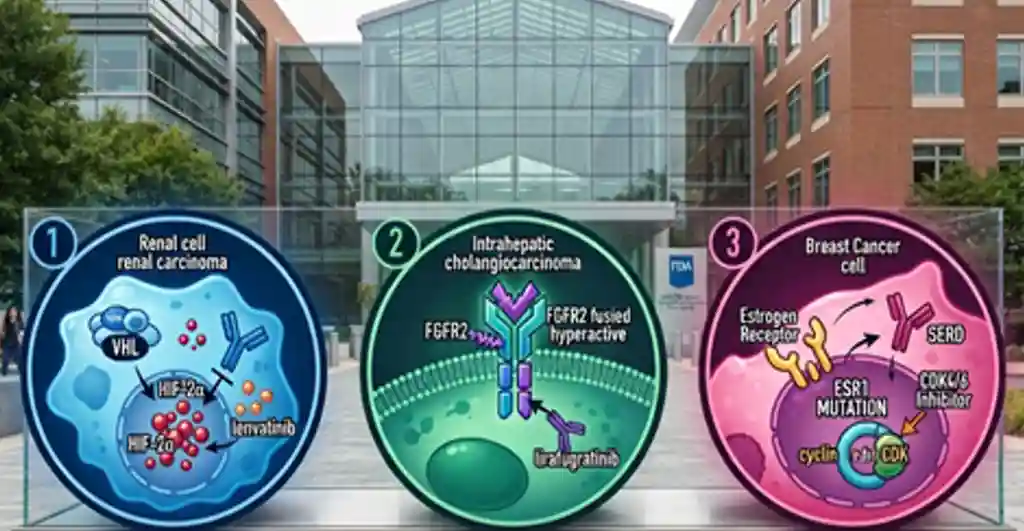
Most clear cell renal cell carcinomas lose the VHL tumor suppressor, which leaves HIF-2α stabilized and free to drive angiogenic and pro-survival transcription. This is the biology behind the September 24 approval of belzutifan with lenvatinib. Belzutifan is an oral HIF-2α inhibitor, and lenvatinib is a multitargeted receptor tyrosine kinase inhibitor, so the combination blocks the pathway at its transcriptional source and again at the receptors that carry its downstream signals. The indication covers adults with advanced clear cell RCC following a PD-1 or PD-L1 inhibitor, which is the setting where options narrow most quickly.

The evidence comes from LITESPARK-011, an open-label phase 3 trial that randomized 371 patients to the combination and 376 to cabozantinib. Cabozantinib is itself an established multitarget VEGFR inhibitor, so the comparison was a demanding one. Median progression-free survival was 14.6 months with the combination against 10.6 months with cabozantinib, and the objective response rate was 53% against 40%. The approved regimen is 120 mg of belzutifan with 20 mg of lenvatinib once daily until progression or unacceptable toxicity. The approval also extends belzutifan’s footprint, since it is the third ccRCC indication for the drug, after adjuvant use with pembrolizumab and monotherapy after both immunotherapy and a VEGF TKI. (FDA Approved Belzutifan Plus Lenvatinib in Advanced ccRCC – OncoDaily +3)
Bile duct cancer: a sharper tool for a rare driver
The September 23 approval of lirafugratinib (Lyrfigtu) addresses a smaller but biologically precise population. In intrahepatic cholangiocarcinoma, FGFR2 fusions or rearrangements can lead to constitutive receptor activation, which drives oncogenic signaling and gives clinicians something to target. The numbers are modest: such fusions occur in roughly 15% of intrahepatic cases and in under 3% of other bile duct subsites, so any given center will see only a handful of eligible patients. (oncodaily) (clinicaltrialvanguard)
The approval rests on REFOCUS, a single-arm trial in 116 patients who had not previously received an FGFR inhibitor and who had progressed after chemotherapy or chemoimmunotherapy. The reported objective response rate was 46.5%, and the duration of response was 11.8 months. Lirafugratinib is a highly selective, irreversible FGFR2 inhibitor designed to cover both driver alterations and resistance mutations, which matters because acquired resistance has limited earlier agents in this class. (FDA Approves Lirafugratinib for Previously Treated, Unresectable, Locally Advanced or Metastatic Cholangiocarcinoma – The ASCO Post +3)
Its arrival does not settle questions of sequencing. It is the third approved FGFR inhibitor for this indication, and the three cannot be compared head-to-head because they were studied in different populations. Practical differences will probably emerge through tolerability: the label warns of ocular toxicity, hyperphosphatemia with soft tissue mineralization, and embryo-fetal toxicity. (cancernetwork) (oncodaily)
Breast cancer: pairing a receptor degrader with a cell-cycle brake

The September 18 approval is narrower than a headline might suggest. It covers adults with ER-positive, HER2-negative, ESR1-mutated advanced or metastatic breast cancer, as detected by an FDA-authorized test, and disease must have progressed after at least one line of endocrine therapy. ESR1 mutations arise under the selective pressure of long-term aromatase inhibition and keep the estrogen receptor active without its ligand. An oral selective estrogen receptor degrader such as imlunestrant is designed to overcome exactly that escape route, and combining it with the CDK4/6 inhibitor abemaciclib adds a second block on proliferation. (fda) (ascopost)
The supporting trial, EMBER-3, enrolled 874 adults previously treated with an aromatase inhibitor, with or without a CDK4/6 inhibitor. Adding abemaciclib roughly doubled median progression-free survival in ESR1-mutated disease compared with imlunestrant alone. The FDA approved the Guardant360 CDx assay at the same time as the companion diagnostic, so therapy and test now move as a pair. The regimen is 400 mg of imlunestrant daily alongside 150 mg of abemaciclib twice daily, and key risks include diarrhea, neutropenia, ILD/pneumonitis, hepatotoxicity, and venous thromboembolism, so careful monitoring is part of the package. (FDA approves imlunestrant in combination with abemaciclib for ER-positive, HER2-negative, ESR1-mutated advanced or metastatic breast cancer +3)
What the three approvals have in common
Each approval pairs a drug with a defined biological lesion, whether that is a loss of VHL, an FGFR2 rearrangement, or an ESR1 mutation. Two make molecular testing a prerequisite, and that places genomic profiling at the start of the treatment pathway rather than as an afterthought. Two of the three also use rational combinations that block parallel or sequential nodes in the same circuit, which reflects a lesson learned from years of single-agent resistance.
Important questions remain open. REFOCUS was single-arm, so lirafugratinib’s value relative to existing FGFR2 inhibitors will have to be judged from cross-trial comparisons and real-world experience. The kidney cancer regimen was tested against cabozantinib rather than against every post-immunotherapy option, and the field is still waiting on mature overall survival data across all three settings. These are the questions the next wave of studies and registry data will have to answer.
| References: 1. FDA. FDA approves belzutifan in combination with lenvatinib for advanced renal cell carcinoma with a clear cell component. Sept 24, 2026. fda.gov/drugs/resources-information-approved-drugs/fda-approves-belzutifan-combination-lenvatinib-advanced-renal-cell-carcinoma-clear-cell-component 2. FDA. FDA approves lirafugratinib for previously treated, unresectable, locally advanced or metastatic cholangiocarcinoma. Sept 23, 2026. Listed on FDA’s “Resources for Information | Approved Drugs” page. 3. FDA. FDA approves imlunestrant in combination with abemaciclib for ER-positive, HER2-negative, ESR1-mutated advanced or metastatic breast cancer. Sept 18, 2026. fda.gov/drugs/resources-information-approved-drugs/fda-approves-imlunestrant-combination-abemaciclib-er-positive-her2-negative-esr1-mutated-advanced-or |