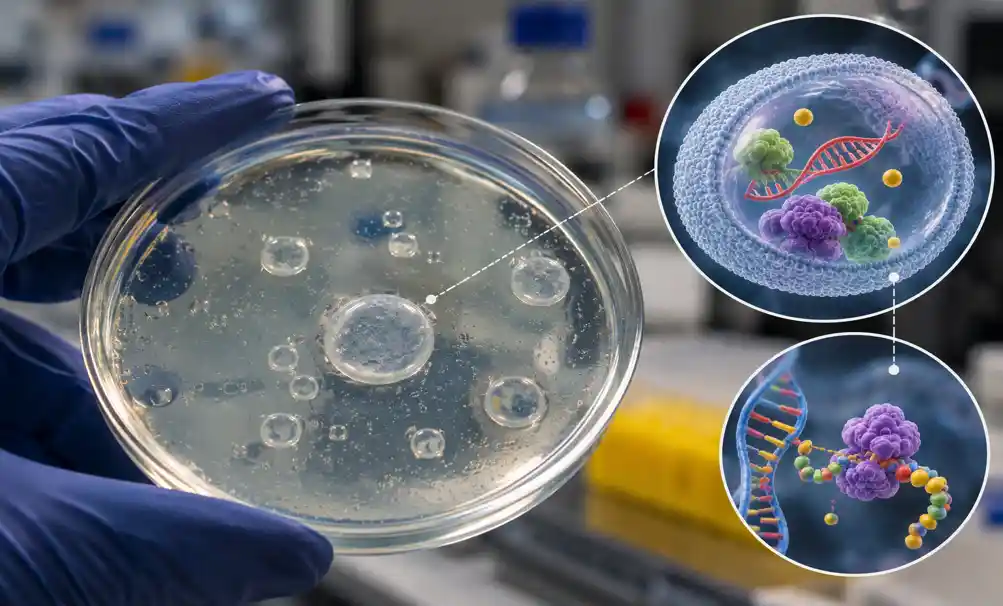
Some of the most useful chemical reactions work beautifully in a laboratory flask but become difficult when you move them into the watery environment of biology. Olefin metathesis is one of them.
The reaction is a way of rearranging carbon–carbon double bonds to build new carbon–carbon bonds. In simple terms, a catalyst helps two molecules swap parts of their double bonds, allowing chemists to construct new molecular structures. It has become an important tool for making pharmaceuticals, polymers and complex molecules. The problem is that biological systems are mostly water. Many of the powerful ruthenium catalysts used for olefin metathesis are not stable enough in aqueous environments, so they lose activity before they can do much useful chemistry.
Researchers at the University of Basel have now developed a ruthenium catalyst designed to overcome some of that problem. Its key ingredient is a specially designed ligand called a cyclic (alkyl)(amino) carbene, or CAAC. The ligand helps stabilise the ruthenium catalyst in water while also giving researchers a way to attach it to biological molecules. That second feature is particularly interesting. The researchers added an aniline-based chemical handle to the catalyst, allowing it to be linked to proteins and peptides. In experiments under biologically relevant conditions, the catalyst remained active through as many as 600 reaction cycles. It was also successfully attached to human carbonic anhydrase II, peptides and ubiquitin.

Why does attaching a catalyst to a protein matter?
It could eventually allow chemists to bring a synthetic chemical reaction directly to a biological molecule, rather than taking the molecule out of its natural environment and processing it separately. That opens possibilities for chemical biology, where researchers use chemistry to study or manipulate biological processes. This does not mean scientists can now freely perform olefin metathesis inside living humans. The new catalyst is an important proof of concept, and questions about toxicity, selectivity and how well such reactions work in complex living systems still need to be answered.
But it changes what is possible: a reaction traditionally associated with synthetic chemistry is becoming increasingly compatible with the molecular world of biology.
Source: