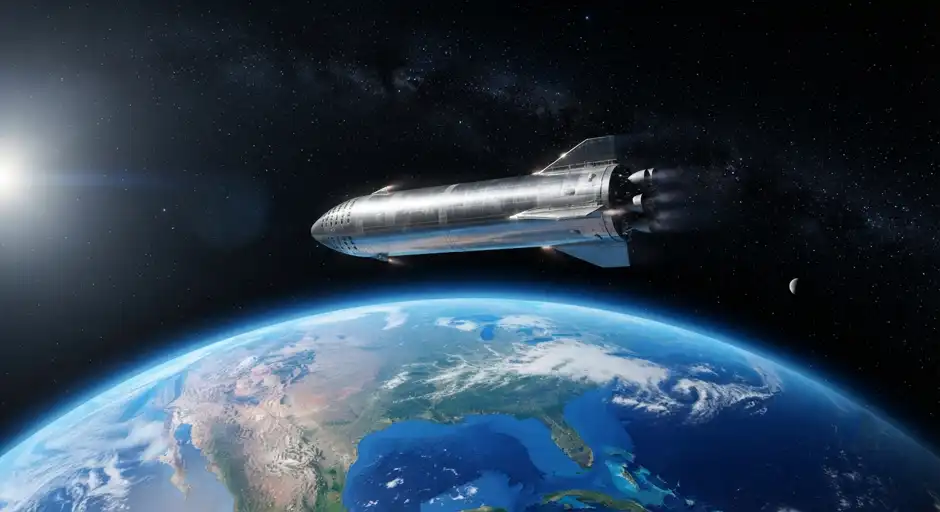
SpaceX’s enormous Starship rocket has flown into space before. But on its next test, the goal is much harder: put Starship into orbit around Earth for the first time.
The distinction is important. Reaching space only requires a spacecraft to climb high enough above Earth. To enter orbit, however, it must also travel sideways fast enough that as it falls back toward Earth, the planet’s surface curves away beneath it. At around 28,000 kilometres per hour, the spacecraft can continuously fall around Earth rather than simply falling back down.
That is what SpaceX is attempting with Starship Flight 14, scheduled for September 28 from Starbase, Texas. The 124-metre-tall vehicle consists of two stages: the Super Heavy booster, which provides the initial thrust, and the Starship spacecraft on top.
The first 13 integrated Starship test flights deliberately followed suborbital trajectories. This time, SpaceX plans for the upper stage to reach an orbit about 275 kilometres above Earth and complete roughly six trips around the planet before returning toward Earth.
The mission is expected to last about 10 hours. There is also a practical test hidden inside the mission. Starship will carry 26 next-generation Starlink V3 satellites, which will be deployed after the spacecraft reaches orbit. Three of them have cameras that will record the spacecraft’s heat shield during flight, giving engineers more information about how its thousands of protective tiles behave.
The booster will not be caught by the launch tower on this flight. Instead, SpaceX plans to guide Super Heavy to a controlled splashdown in the Gulf of Mexico. The Starship upper stage will eventually splash down in the Pacific Ocean. That may sound like a step backward for a vehicle designed to be fully reusable, but this flight is primarily about gathering data and proving that Starship can operate in orbit.
If the test succeeds, SpaceX can begin tackling the next challenges, including recovering the upper stage and eventually refueling Starship in orbit, something it would need for missions beyond Earth orbit, including planned lunar and Mars missions.
For Starship, getting into space was the first chapter. Getting into orbit is where the next one begins.
Sources:

- SpaceX. (2026). Starship Flight 14.
- Will Robinson-Smith. (2026, September 28). Live coverage: SpaceX to launch first Starlink V3 satellites to orbit on Starship. Spaceflight Now.