
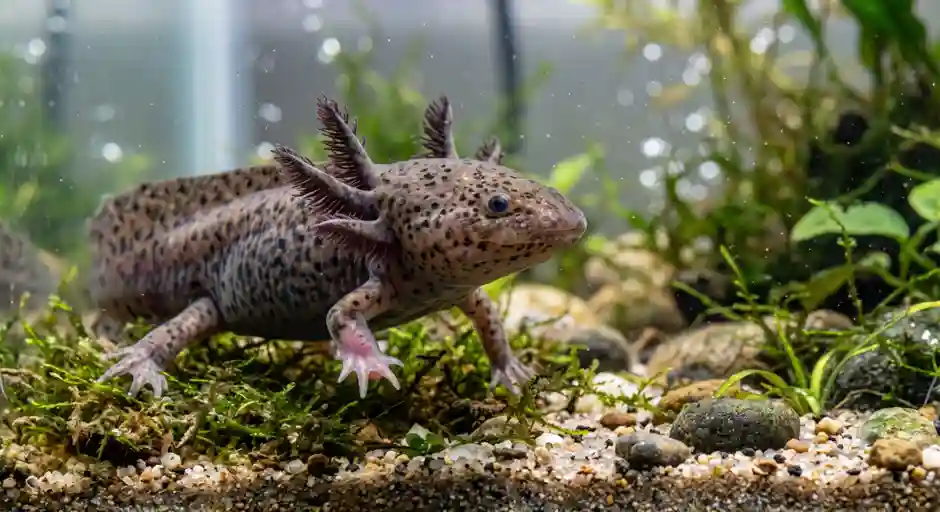
Losing an arm and watching it grow back over the next few months, complete with bones, muscles, nerves, blood vessels, and skin, sounds like science fiction for humans. For salamanders, it is simply part of life. Their bodies seem to carry a biological repair manual that humans have largely lost. Salamanders are among the few animals capable of regenerating entire limbs, as well as parts of their heart, spinal cord, tail, and even sections of their brain. Scientists have studied this remarkable ability for decades, hoping it might one day inspire new treatments for serious injuries in humans.
For a salamander, an injury is not necessarily the end of the story. It can be the beginning of a remarkable rebuilding project. The difference begins with how our bodies respond to injury. When humans are wounded, the immune system quickly seals the damaged area and forms scar tissue. This rapid response helps prevent infection and blood loss, but the scar also acts as a barrier that limits further tissue growth. It is like repairing a broken road by quickly covering the hole with concrete, the road becomes safe, but rebuilding the original structure is much harder.
Salamanders take a different approach. Instead of forming a permanent scar, cells near the injury transform into a collection of unspecialised cells known as a blastema. These cells behave much like those found in a developing embryo. The blastema can be thought of as a biological construction site, where cells receive instructions about what needs to be rebuilt and where it should go. Guided by chemical signals, they multiply and gradually rebuild every missing part of the limb in the correct order, from bone and muscle to nerves and skin.
This is where the real biological magic begins, although there is no magic involved. It is a carefully controlled process involving cells, genes, molecular signals, and the immune system. The body appears to know that the missing limb is not simply a wound to be closed, but a structure that needs to be rebuilt.
Researchers have discovered that the salamander immune system also plays an important role. Rather than triggering prolonged inflammation, immune cells create an environment that supports regeneration. In humans, inflammation can be useful because it helps the body respond quickly to injury, but prolonged inflammation can interfere with proper healing. In salamanders, the immune system seems to know when to fight and when to step aside, almost like a disciplined security team that knows when the emergency is over.
Scientists are also studying genes such as Prod1 and signalling pathways including FGF, Wnt, and BMP, which help coordinate the complex process of rebuilding tissues. These molecular pathways act like traffic signals, guiding cells towards the right place at the right time. If these instructions become confused, regeneration could go off track. Biology, after all, is not simply about having the right cells, it is also about giving them the right instructions.
Humans are not completely unable to regenerate. Young children can sometimes regrow the tip of a finger, and organs such as the liver have a remarkable capacity to repair themselves. However, humans generally heal by replacing damaged tissue with scar tissue instead of recreating the original structure. There is a striking irony here: the human body is exceptionally good at survival, yet it is not equally good at rebuilding what has been lost.
A salamander seems to follow a different biological rule, “repair the blueprint, not just the damage.” Its cells do not merely rush to close the wound. They participate in a carefully organised rebuilding process. That difference is one of the biggest clues scientists are trying to understand.
Understanding why salamanders regenerate while humans cannot has become one of the most exciting areas of regenerative biology. Researchers hope that by uncovering the molecular instructions behind this process, they may eventually develop treatments that improve wound healing, repair damaged nerves, or even regenerate complex tissues. The idea is ambitious, but science often begins by asking questions that once sounded impossible.
While growing an entire human arm remains far beyond today’s medicine, every new discovery in salamanders brings scientists one step closer to understanding what regeneration truly requires. The journey is not about copying a salamander overnight. Instead, researchers are trying to decode the biological language that tells cells how to rebuild tissues.
The salamander may therefore be more than a curious creature with an unusual talent. It could be a living laboratory for understanding the body’s hidden repair machinery. Its remarkable ability raises a simple but profound question: if nature has already solved the problem of regeneration in one animal, can science learn enough from it to help humans heal better?
For now, the answer remains uncertain. But every regenerated limb offers scientists another clue, another molecular signal, and another piece of the puzzle. As the proverb says, “Little drops of water make the mighty ocean.” In regenerative medicine, every small discovery could eventually contribute to a much bigger breakthrough.


