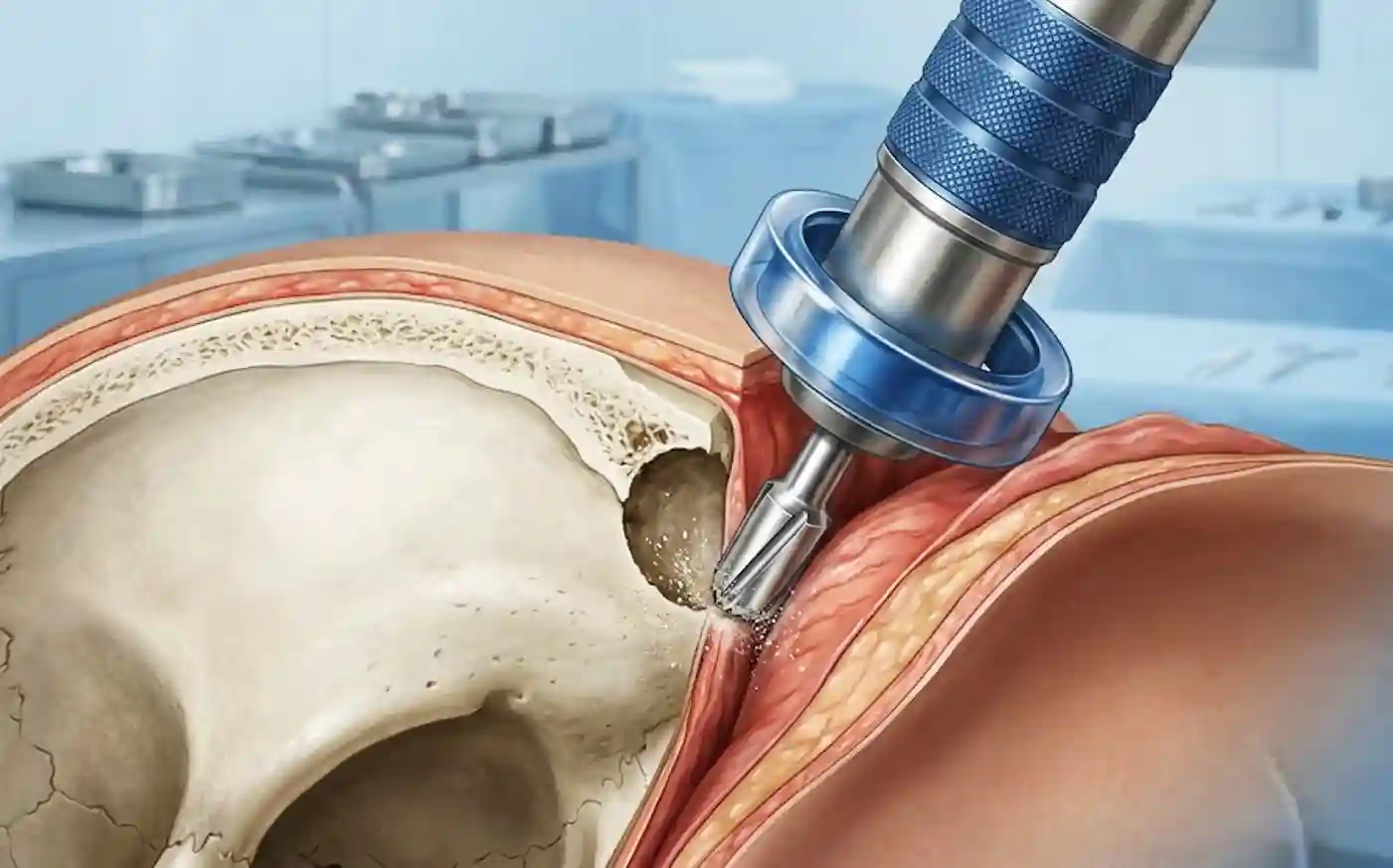
A high-stakes operating room can feel like a place where precision matters more than ever. A neurosurgeon may work a mere millimetre away from a patient’s exposed brain. The air is heavy with tension. The doctor holds a fierce surgical drill spinning at an incredible 37,000 revolutions per minute. One tiny slip, a single microsecond of a trembling hand, and a traditional cutting burr would instantly shred through delicate nerves or slash open a major artery, changing a life forever. For decades, this terrifying reality was a catastrophic risk that surgeons simply had to accept.
At such close quarters, the difference between safety and danger can be thinner than a strand of hair. The surgeon needs a tool that behaves almost like a careful gatekeeper, allowing the drill to attack hard bone while protecting the soft tissue nearby. In surgery, precision is not merely desirable, it is the difference between doing the job and causing unintended damage.
However, a revolutionary medical device called the Surgify Halo has shattered this paradigm. It stands as an engineering marvel capable of aggressively grinding through rock-hard human bone while remaining entirely harmless if run directly across soft, delicate human skin. To witness this remarkable action, scientists often test it on a raw egg: the drill violently obliterates the hard outer shell while leaving the razor-thin, translucent inner membrane completely untouched and intact.

The contrast is almost like a hammer that knows when to stop striking. The hard shell meets force, while the delicate membrane escapes it. This simple demonstration offers a striking analogy for the basic idea behind the device, selective cutting. In other words, the tool does not simply cut everything in its path, it responds differently to hard and soft surfaces.
The Physics and Medicine Behind the Magic
The secret behind this seemingly impossible tool relies on simple physics combined with a deep understanding of human anatomy. Traditional surgical drills use raw cutting balls that tear through everything they touch. The Halo, built with proprietary HaloSense technology, introduces a mechanical bodyguard: a tiny, pressure-controlled safety ring that sits directly around the spinning blade.
This small ring plays the role of a silent guardian. It is a physical barrier between the aggressive cutting edge and the vulnerable tissue. There is no complicated electronic brain making the decision, the mechanics of the instrument itself provide the protection.
The magic lies in how the ring utilises the difference in physical resistance between elastic soft tissue and hard crystalline bone. Inside the drill, a masterfully tuned mechanical spring responds instantly to tactile feedback.
In simple terms, the device can distinguish between something that gives way and something that resists. Soft tissue behaves somewhat like a cushion, while hard bone behaves more like a wall. This difference in mechanical resistance becomes the key to the tool’s safety mechanism.

Because human skin yields to pressure, the safety ring simply bumps the tissue out of harm’s way. But the moment the tool encounters unyielding, hard bone, the rigid surface pushes the ring back into the drill’s body, exposing the blade. It is a brilliant system governed purely by Newtonian physics, executing its safety feature flawlessly without needing a single electronic wire, sensor, or software code.
It is almost as if the drill has learned a simple rule: “Soft tissue, step aside. Hard bone, engage.” This is where physics becomes a practical safety feature. The system uses mechanical feedback, a technical term for information created by physical contact and movement, rather than depending on electronic sensing.
A New Era of Surgical Advantages
Before this invention, bone surgery was a game of extreme, exhausting caution. Traditional drills frequently suffer from a dangerous phenomenon known as “chattering”, where the spinning tip violently “jumps” or skids across the hard bone surface unpredictably. A single jump inside a tight spinal canal can spell instant paralysis. By utilising a self-centering safety ring, the Halo absorbs these micro-vibrations, completely eliminating chattering and granting surgeons flawless control.
For a surgeon, such unwanted movement is more than an irritation, it can be a serious hazard. It is similar to trying to draw a perfectly straight line while someone repeatedly shakes your hand. The smaller the surgical space, the greater the importance of stability and control.
| Biological Target | Physical Reaction | Drill Mechanism Action | Surgical Outcome |
| Soft Tissue & Skin | Flexes, compresses, and bends under direct pressure | Internal spring remains extended; safety ring stays raised to shield the blade | No Cut: The spinning blade never contacts or harms the flesh |
| Hard Human Bone | Resists compression; presents an unyielding, rigid surface | Hard surface forces the safety ring backward, compressing the spring | Clean Cut: The high-speed cutting blade is exposed to slice through bone |
Furthermore, it minimises direct mechanical trauma and indirect heat damage. When traditional burrs frictionally grind against bone, they create excessive heat and smoke, which can burn nearby living tissues. The selective mechanics of the Halo result in less friction and cleaner cuts. This translates directly to shorter surgery times, reduced blood loss, and significantly faster healing for patients who no longer have to recover from accidental microtears to their surrounding tissue.
Heat is another hidden enemy in surgery. Friction may seem harmless, but at very high speeds it can turn mechanical energy into unwanted heat. The drill therefore has to fight two battles at once, cutting the bone while avoiding unnecessary injury to the surrounding tissue. This is a classic case of “less is more”, where better control can produce a safer result.
The Future Need for Smart Tools
As medicine evolves towards minimally invasive procedures, where surgeons operate through tiny, keyhole incisions with very limited visibility, the need for tissue-selective tools is skyrocketing. Human eyes can easily misjudge depth through an endoscope camera, but a mechanical shield like the Halo cannot be fooled.
This is where smart mechanical design can become an extra layer of safety. A surgeon provides judgement, experience, and skill, while the instrument can provide a physical safeguard against certain unwanted movements. It is a partnership between human expertise and clever engineering.
The future of surgery lies in expanding this touch-sensitive technology to other high-stakes procedures, such as robotic surgeries, joint replacements, and emergency trauma operations in the field, where environments are chaotic. By embedding safety directly into the mechanics of the instruments, we protect patients from human error and ensure that even the most aggressive medical tools inherently care for the fragile flesh they are built to save.
The irony is striking: the more powerful the surgical tool becomes, the more carefully it must learn where not to cut. This principle may shape the next generation of medical instruments, where power and protection work side by side. As the proverb says, “Measure twice, cut once.” In modern surgery, that old wisdom takes on a remarkably high-tech meaning.