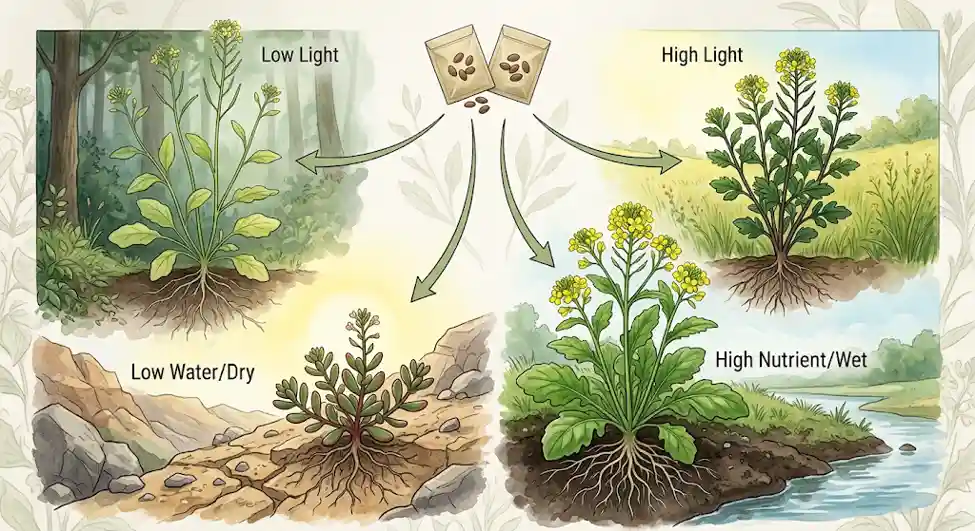
Picture two seeds from the exact same plant. One lands in a sunny meadow. The other blows onto a shady, dry hillside nearby. They share identical DNA. Yet weeks later, they look like they came from two different species.
This isn’t magic. It’s one of nature’s cleverest survival tricks, and scientists just published a big review of everything we know about it.
Plants Can’t Run, So They Adapt Instead
Animals facing bad weather can migrate, burrow, or hide. Plants are stuck wherever their seed happens to land. So evolution gave them a different superpower: the ability to grow into different versions of themselves depending on what the environment throws at them. Scientists call this phenotypic plasticity – basically, one genetic blueprint, many possible outcomes.
You’ve seen it before, even if you didn’t know the name for it:
Aphids grow wings only when it’s time to move to a new plant.
Water plants often grow completely different-shaped leaves above versus below the waterline, because the two worlds demand different survival tools.
Flowering plants shift their bloom times based on temperature and daylight, timing their flowers to arrive exactly when pollinators are buzzing around.
None of this is accidental. It’s the product of millions of years of fine-tuning.

Why This Actually Matters to You
Here’s the part that hits closer to home than you’d think: your food depends on this.
Remember the “Green Revolution” — the moment in the 20th century when crop yields exploded and helped feed billions more people? Part of that success came from breeding wheat and rice varieties that responded differently to fertilizer than older varieties did. In other words, scientists were already tinkering with plasticity decades ago, without fully realizing it.
Now climate change is throwing curveballs like hotter summers, unpredictable rain, sudden droughts and farmers need crops tough enough to handle all of it. Nobody wants a crop that performs great in a perfect year and then falls apart the moment conditions get rough. What breeders want is reliability: a crop that keeps producing decent yields no matter what the weather decides to do.
The traits that make this possible are how roots grow, when a plant flowers, how it manages water – are all shaped by plasticity. Learn to control it, and you can breed sturdier crops for an unstable future.
The Plant’s Secret Thermostat
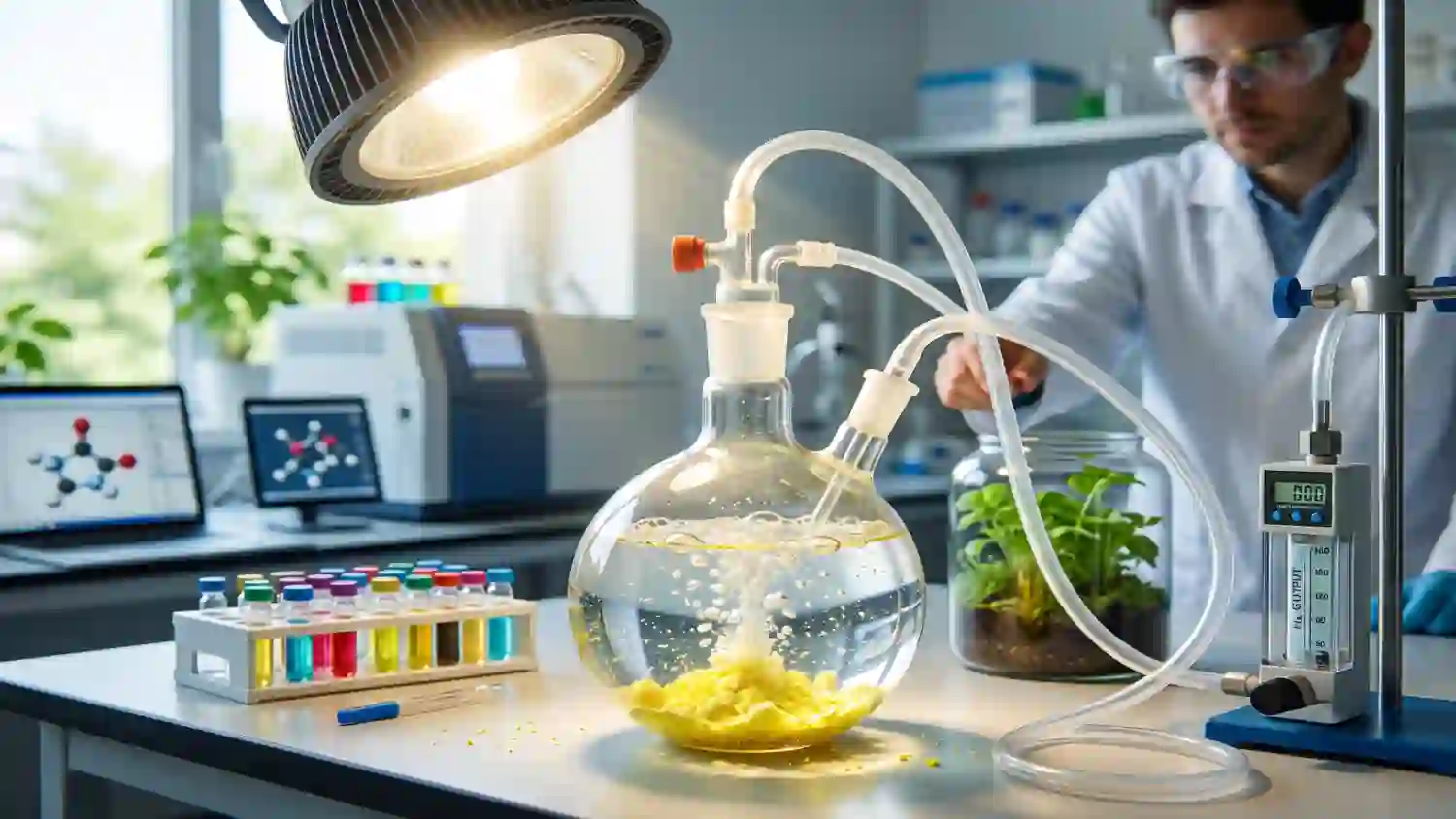
Some of the coolest discoveries in the review involve how plants literally sense temperature at the molecular level.
One protein, called ELF3, acts like an internal thermometer. When it’s cool out, it stays active and keeps growth in check. But as temperatures climb, the protein clumps together into tiny droplets inside the plant’s cells – essentially switching itself off and letting growth speed up. It’s a beautifully simple mechanical trick for detecting heat.
Interestingly, plants that evolved in naturally hot climates have tweaked versions of this thermostat that are far less twitchy – meaning they don’t overreact to heat the way plants from cooler regions do. That’s exactly the kind of natural trick breeders would love to borrow for future heat-tolerant crops.
But It’s Not All Good News
Plasticity has trade-offs. The same gene that controls something useful, like flowering time, sometimes also secretly controls something unrelated, like water efficiency – meaning breeders can’t always tweak one trait without accidentally messing with another.
And not every “adaptation” actually helps. Researchers found that roughly a third of the plastic responses they studied in wild plants weren’t beneficial at all – sometimes a plant’s automatic response to a new environment just doesn’t pan out.
There’s also a quieter worry: as heat rises, some plants are producing smaller flowers with weaker scents, making them less appealing to bees and other pollinators. A tiny shift in plasticity today could ripple out into much bigger ecological problems tomorrow.
What Comes Next
Scientists still don’t fully know which genes control plasticity for most traits, even ones we’ve studied for decades. Root systems – hidden underground and hard to observe – remain a big blind spot, though new imaging tools are starting to change that.
Perhaps the most exciting frontier: researchers are now combining genetic data with detailed environmental records to essentially simulate how an unplanted crop variety would perform in a future climate – before a single seed goes into the ground. Early tests in crops like sorghum and maize are already showing this kind of prediction works.
The Bottom Line
Plants have been quietly rewriting their own game plan for millions of years, adjusting to whatever nature hands them. Now scientists want to read that playbook closely enough to help our crops do the same, staying productive and resilient no matter how unpredictable the climate gets. It’s not flashy science, but it might be one of the most important things happening in agriculture right now.
| Reference: Based on: René Schneider, Isabel Bäurle, Zoran Nikoloski, and Michael Lenhard (2026). “Plant Phenotypic Plasticity: From Molecular Mechanisms to Breeding and Climate Change Adaptation.” Annual Review of Plant Biology, 77:707–731 |