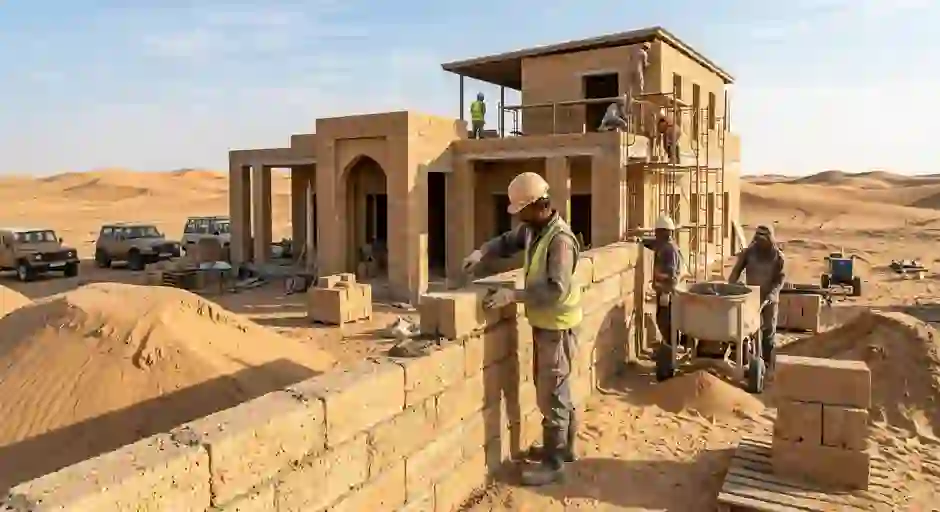
The UAE has no shortage of sand. Its deserts stretch for thousands of kilometres, yet much of that sand is surprisingly difficult to use for building. Now, scientists have developed a method that can turn desert sand into strong construction bricks without requiring the high-temperature heating traditionally used to harden many building materials. The approach could potentially reduce dependence on imported construction materials while giving an abundant local resource a new purpose.
The problem begins with the sand itself. Not all sand behaves the same way. Desert sand is generally made up of very fine, rounded grains that have been repeatedly shaped by wind. These grains don’t lock together particularly well, making desert sand less suitable for producing conventional concrete than the coarser, more angular sand commonly used in construction.
So how can loose grains of sand become a solid brick?
The new approach uses a chemical binding process rather than relying on intense heat. Instead of simply melting or firing the sand, scientists introduce materials that react with the components present in the mixture and create strong bonds between individual particles. As the reaction progresses, the loose sand grains become locked into a rigid structure.
This is important because conventional production of many construction materials can require enormous amounts of energy. Cement manufacturing, in particular, involves heating limestone and other raw materials to very high temperatures. That process consumes substantial energy and releases large amounts of carbon dioxide. Finding ways to produce building materials without depending so heavily on high-temperature processing could therefore have environmental benefits. The UAE has another reason to be interested. Much of its construction industry depends on materials that must be imported because the country’s natural resources are not always suitable for conventional concrete production. Turning locally available desert sand into useful building products could reduce some of that dependence while also reducing the need to transport raw materials over long distances.
But this doesn’t mean every pile of desert sand can suddenly replace concrete. The new material still needs to be tested for strength, durability, water resistance, long-term performance and safety before widespread construction use. Scaling a laboratory-developed material into something capable of supporting real buildings is a much bigger challenge. Still, the idea represents an interesting shift in construction science: instead of asking “Where can we find the right material?”, scientists are beginning to ask “Can we change what we already have into the right material?”
In a region where sand is abundant but conventional construction resources are limited, that question could prove surprisingly valuable.