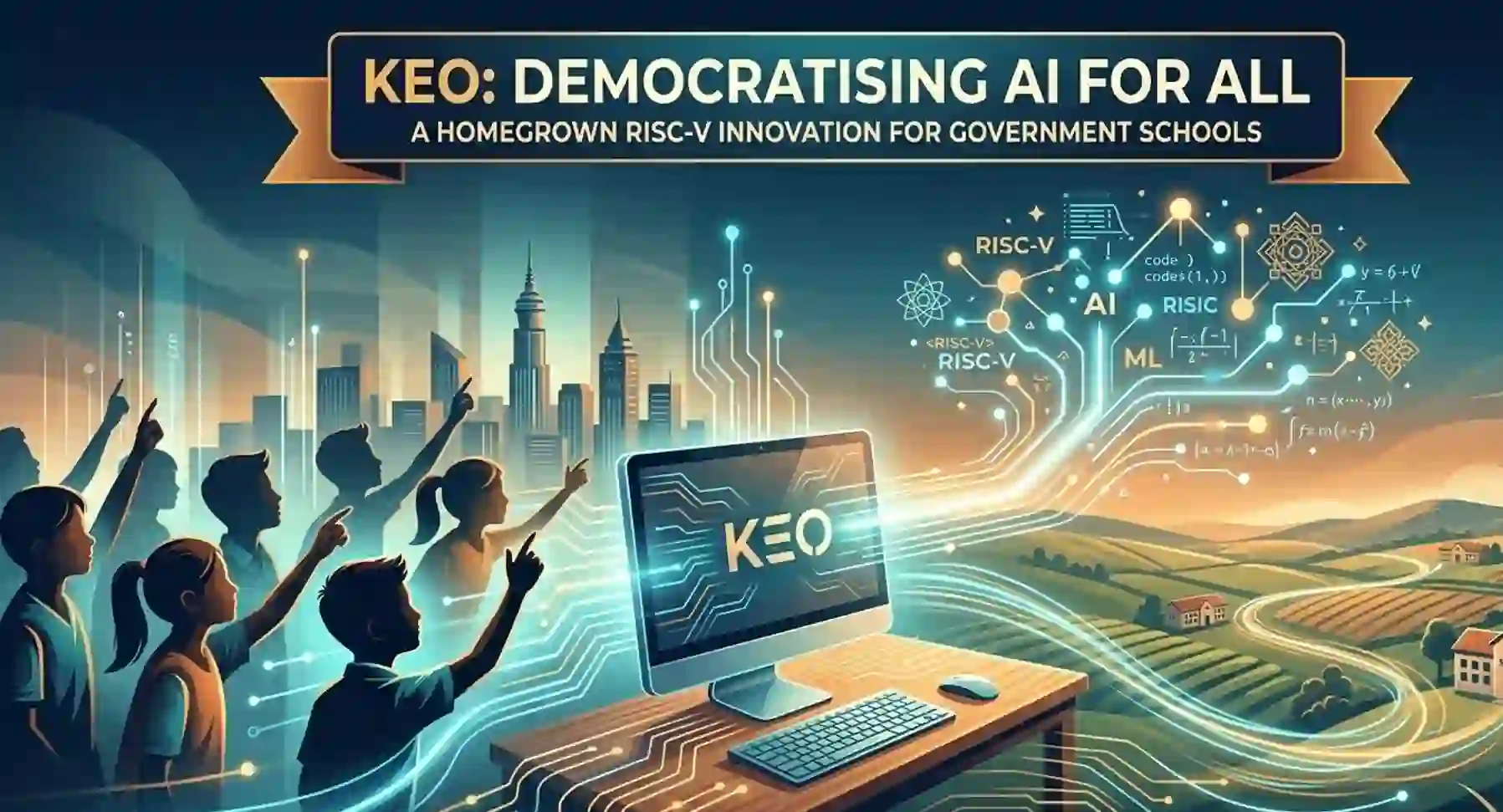
Karnataka has taken a major step toward making artificial intelligence accessible to every government school student in the state. Chief Minister D.K. Shivakumar launched KEO, an AI-enabled computing device developed through the Karnataka State Electronics Development Corporation (KEONICS), calling it a step towards democratising access to artificial intelligence for government school students across the state.
What Is KEO?
KEO stands for Knowledge-driven, Economical and Open-source. It is a compact, AI-ready computer built around an open-source RISC-V processor architecture, featuring open-source hardware and software along with a dedicated AI accelerator, allowing it to run AI applications locally rather than depending entirely on cloud connectivity. The device was developed through collaboration between the Department of Electronics, IT and Biotechnology, KEONICS, semiconductor partners, and AI-focused system integrators. Notably, the locally developed AI-ready PC was first unveiled at the Bengaluru Tech Summit in 2025 before this formal statewide launch.
A Dream, Not Just a Device
At the launch event, the Chief Minister framed the initiative in emotional terms, saying the government wasn’t simply introducing new hardware but shaping a larger vision of making technology and AI accessible to children across Karnataka, from rural villages to urban centres. He emphasized that a child’s access to technology and opportunity should not be determined by their geographical location, describing the rollout as “not a pilot” but “a commitment” and “a promise.”
Rollout Plans
The government will initially deploy 1000 KEO AI Personal Computers in government schools, with the broader aim of eventually extending the technology to every government school in Karnataka. Officials say the device can help students build skills in coding, artificial intelligence, machine learning, and electronics, while also enabling teachers to use AI-powered interactive learning tools. The CM also said KEO represents the evolution of KEONICS from merely supporting technology projects to developing solutions aimed at creating wider social impact.
Reversing Bengaluru’s Talent Concentration
A key goal behind KEO is decentralizing India’s tech talent pool. D K Shivakumar also noted that for years, talent flowed toward Bengaluru, and with KEO, the state aims to reverse that trend, envisioning rural students eventually becoming technology innovators, entrepreneurs, and problem-solvers. He also called for greater participation from industry players and CSR organisations to help expand KEO’s deployment across government schools.
Ministerial Support
Karnataka’s Home Minister Priyank Kharge also spoke at the event, describing KEO as the state’s homegrown AI PC and an affordable computing solution designed to make computing more accessible while enabling students to learn, create, and code. He added that the project carries institutional significance, as KEONICS worked with chip-design companies, technology partners, and startups to develop the product.