Pope Leo XIV wants artists and the Church to join forces against machine-made art. Is faith helping steer technology, or just decelerating innovation?
The news
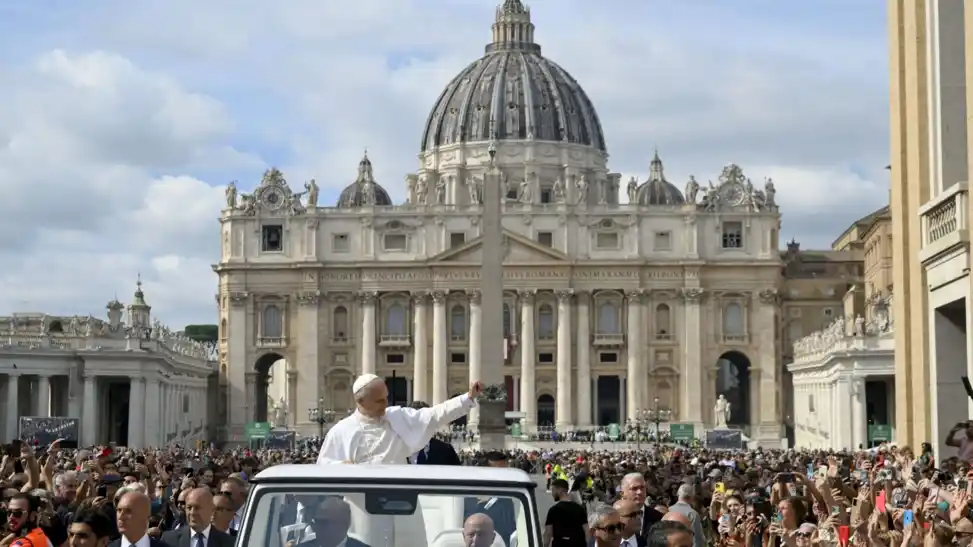
On Friday, Pope Leo XIV told artists at the Vatican there is an ontological difference between art and what a machine produces by statistical calculation on millions of images made by others. He said the Church and artists must ally “to safeguard our humanity.” It isn’t his first move. In May, he established a Vatican commission on AI, and he has also released an encyclical on the subject. He is no doomsayer, either: he says he still sleeps at night but wants expert warnings taken seriously.
The case that it’s good
Religions are old hands at asking “should we?” Engineering asks whether something can be built. Traditions that have debated dignity, labor, and power for millennia are well placed to ask whether it should. This pope is explicit about the lineage, comparing today’s challenges to the first industrial revolution, which Leo XIII answered with Rerum novarum.
The concerns aren’t only theological. Artists argue models were trained on copyrighted works without permission or pay, and that AI output can displace human creators. The Pope is amplifying grievances that are legal and economic, not only spiritual, and an institution with over a billion adherents can get a hearing that individual artists can’t.
Pluralism helps. Leo has argued diverse groups should contribute to AI’s development. Letting only companies write the values of powerful systems is hardly a neutral alternative.
The case that it’s bad
Metaphysics isn’t measurable. “Algorithms lack the spark of humanity” is a statement of belief, not a testable claim. Policy built on unfalsifiable premises is hard to debate and hard to revise. The Church’s record has famously included sluggish adaptation, as in the Galileo affair.
It can blur the useful distinction. Society needs practical rules: provenance labels, consent for training data, liability. Europe’s AI Act already requires synthetic content to be marked. One analyst notes that the Pope is asking for the thing a label cannot prove. A spiritual “difference” can’t be enforced in a courtroom.
Religious authority isn’t representative. Believers and non-believers both use and are affected by these tools. Giving any faith a privileged seat in tech governance invites the objection: why this one, and why not others?
AI isn’t only art. Models also help with protein structure prediction, weather forecasting, and accessibility tools. Moral alarm focused on creativity could spill over into blanket suspicion.
A fair verdict
Religion isn’t intruding into tech so much as joining a conversation that tech itself has declared open. The useful test is how it participates:
- Helpful: raising questions about dignity, labor, consent, and who benefits, then letting evidence and democratic processes shape the rules.
- Unhelpful: treating contested metaphysics as settled fact and expecting law to follow.
By that test, the Pope’s alliance with artists is strongest where it overlaps with concrete, checkable demands such as consent, compensation, and transparency, and weakest where it rests on claims about a “spark” that no experiment can detect.
The better question may be who gets a voice when the tools reshape everyone’s life. The Church deserves one, but not the last word.
References
- Leo XIII. Rerum novarum (encyclical), 1891. vatican.va
- Dicastery for the Doctrine of the Faith & Dicastery for Culture and Education. Antiqua et Nova: Note on the Relationship Between Artificial Intelligence and Human Intelligence, January 2025. vatican.va
- Rome Call for AI Ethics, Pontifical Academy for Life, 2020. romecall.org
- Regulation (EU) 2024/1689 (Artificial Intelligence Act), Article 50 (transparency obligations). eur-lex.europa.eu