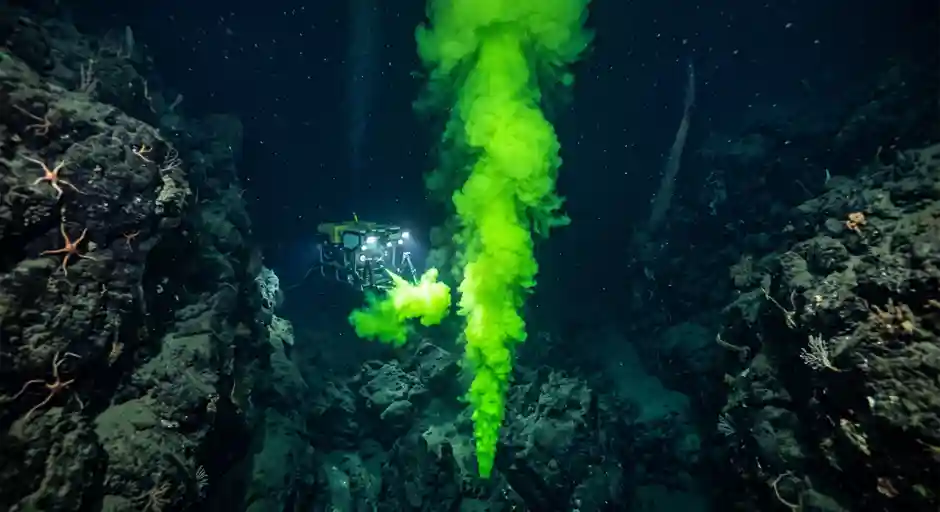
Nearly two kilometres beneath the North Atlantic, there is no sunlight, no crashing waves and no obvious sign that the water is moving rapidly upward. But in 2021, scientists found a way to make this hidden movement visible. They released fluorescent dye into a deep underwater canyon and followed its path through the darkness. What they discovered was striking: near the seafloor, water was being pushed across density layers at a rate of around 100 metres per day, roughly 10,000 times the global-average rate needed to sustain the ocean’s deep overturning circulation. The finding provides direct evidence for a process oceanographers had long suspected but struggled to observe. A fluorescent signal nearly 2 km below the surface
The experiment took place in a submarine canyon cutting into the eastern side of the Rockall Trough in the North Atlantic, northwest of Ireland. In July 2021, researchers lowered a specially designed release system to about 1,870 metres below the surface and roughly 10 metres above the canyon floor. They released a mixture containing fluorescein, a fluorescent dye that could be detected by instruments even after it had become highly diluted. The release system carried sensors for measuring depth, temperature and other properties of the surrounding water. They then chased the dye for about three days. A rapidly profiling instrument called the FastCTD repeatedly moved through the water column while a fluorometer detected the dye’s changing concentration. At the same time, other measurements captured turbulence and water movement around the canyon. Instead of simply spreading sideways, the dye showed that water near the canyon floor was being mixed into lighter-density water above it. The ocean’s deep-water problem This matters because the deep ocean is part of a gigantic circulation system.
Cold, dense water forms at high latitudes and sinks toward the ocean floor. For the global overturning circulation to continue, some of that deep water eventually has to return toward shallower levels. For decades, we have known that turbulent mixing helps drive this return journey. The problem was that the open-ocean interior appeared too weakly mixed to account for the amount of upwelling required. One possibility was that the missing mixing occurs disproportionately around rough features of the seafloor such as underwater ridges, slopes and canyons.
The dye-based estimates of upwelling varied considerably, from about 51 to 325 metres per day depending on the calculation method. Despite this spread, all the approaches pointed toward vigorous upwelling on the order of 100 metres per day near the canyon floor. The important detail is that this does not mean the entire deep Atlantic is rising at 100 metres every day. The measurement came from a relatively small, turbulent region close to the seafloor. The researchers were measuring rapid diapycnal upwelling, water moving across density layers within this particular canyon. The comparison with the global average is therefore about the rate of the localized process, not the amount of water in the whole ocean. The canyon’s steep terrain appears to be important. Tides interacting with underwater topography can generate internal waves and strong turbulence. That turbulence mixes water near the bottom, allowing dense deep water to move into lighter density classes and ultimately toward shallower depths.
The ocean is one of Earth’s major systems for transporting heat, carbon and nutrients. Its deep circulation therefore affects how heat and carbon are redistributed around the planet. If intense mixing is concentrated around relatively small areas of rough seafloor rather than being spread evenly throughout the deep ocean, then identifying these “hotspots” becomes important for understanding how the entire circulation system works. They suggest that submarine canyons and other steep features could contribute disproportionately to the upwelling needed to balance the sinking of dense water elsewhere in the ocean. But one canyon cannot tell scientists how widespread this mechanism is. The study directly observed the phenomenon at one location, and further observations are needed to determine how frequently similar processes occur around the world’s oceans.
For now, the glowing trail of dye has done something remarkably useful: it turned an invisible movement nearly two kilometres beneath the Atlantic into something scientists could actually follow. And it suggests that some of the ocean’s most important circulation may be happening not in the open water, but in narrow, turbulent corridors carved into the seafloor.