For years, artificial intelligence has been used in biology as a tool for analysing data, predicting protein structures, identifying disease-associated genes and searching scientific literature. But a new generation of AI systems is attempting something fundamentally different: conducting parts of the scientific process itself.
Instead of simply answering a researcher’s question, these systems can search scientific literature, formulate hypotheses, propose experiments, analyse experimental data and use the results to develop new hypotheses. The goal is to create an iterative scientific loop in which AI does more than provide information it actively participates in discovery.
One striking example is Robin, a multi-agent system reported in Nature in 2026. Robin combined literature-search and data-analysis agents to generate hypotheses and experimental directions for biological research. In work on dry age-related macular degeneration, it proposed enhancing phagocytosis by retinal pigment epithelial cells and identified ripasudil and KL001 as candidate compounds. Laboratory experiments subsequently confirmed activity for both compounds, and Robin proposed a follow-up RNA-sequencing experiment that identified ABCA1 as a possible mechanistic target.

Another system, Co-Scientist, was designed to generate and refine research hypotheses through multiple interacting AI agents. In biomedical applications, it generated drug-repurposing and combination-therapy hypotheses that were subsequently tested experimentally, including work involving acute myeloid leukaemia. The important distinction is that these systems did not independently replace the laboratory: their proposed ideas still required experimental validation.
AI agents are also beginning to operate directly on biological datasets. CellVoyager, for example, can autonomously generate and execute single-cell RNA-sequencing analyses. In evaluations involving published studies, it was able to reproduce aspects of researchers’ analytical decisions and generate additional findings that experts considered scientifically plausible.
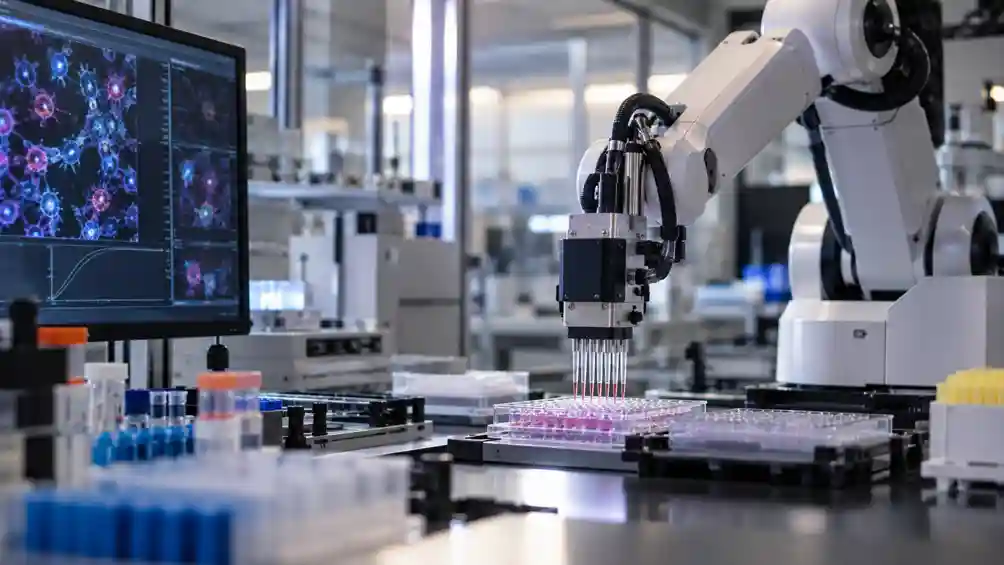
The next step is the self-driving laboratory. These systems combine AI with robotics and automated instruments so that an algorithm can propose an experiment, have machines perform it, analyse the resulting data and select what should be tested next. Recent reviews describe this as a transition from laboratory automation toward more autonomous scientific discovery.
But autonomy introduces new problems. An AI can generate a convincing hypothesis that is nevertheless wrong, misinterpret noisy experimental data or optimize for an objective that does not capture what scientists actually care about. Reproducibility, data provenance, safety, evaluation standards and human oversight therefore become increasingly important as AI moves closer to physical experimentation.
The most important shift may therefore be conceptual. AI in biology is moving from a system that tells scientists what is already known toward one that can help decide what should be tested next. If these systems become reliable enough, the laboratory of the future may not simply contain smarter instruments it may contain an AI-driven experimental loop that continuously learns from biology itself.