For decades, computers have relied on electrons moving through semiconductor circuits to store, transmit and process information. But as artificial intelligence demands increasingly enormous amounts of computation, conventional electronics are facing growing challenges in speed, heat generation and energy consumption.
One possible alternative is to use something that already moves extremely quickly: photons, the particles of light.
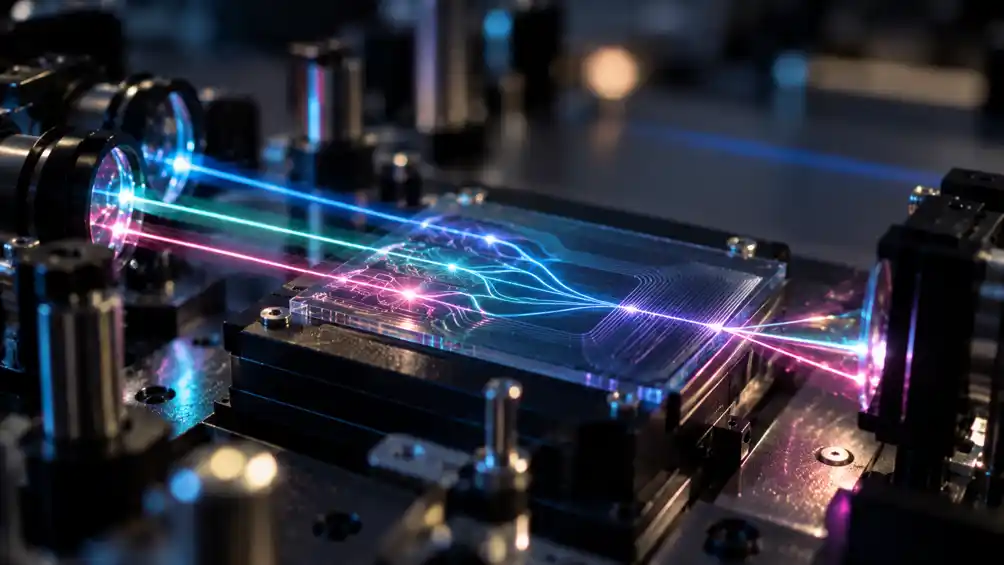
This concept is known as photonic or optical computing. Instead of representing information entirely through electrical signals, photonic systems encode information in properties of light such as intensity, phase, wavelength and polarization. Because multiple optical signals can travel simultaneously through the same system, photons offer enormous bandwidth and natural parallelism.

The potential advantage is particularly important for artificial intelligence. Many AI calculations involve repeatedly multiplying large matrices. Optical systems can perform these mathematical operations using the interference and propagation of light, potentially completing certain calculations much faster and with less energy than conventional electronic processors.
Recent research shows that this idea is moving beyond laboratory demonstrations. In March 2026, researchers reported an integrated photonic neural network capable of performing both computation and on-chip backpropagation training. The system achieved more than 90% accuracy in two nonlinear classification tasks and performed its computations without relying on a separate digital computer for the neural-network training process.
Another major development is the growing integration of photonics with conventional silicon electronics. Modern research increasingly focuses on combining optical components with established semiconductor manufacturing, allowing photons to handle high-bandwidth communication and selected computational tasks while electronics continue to perform functions for which they remain superior.
This hybrid approach may be more realistic than replacing electronics completely. Photons are excellent for moving information and performing certain parallel mathematical operations, but they are not naturally suited to every task. Memory, nonlinear processing, signal conversion and precise control can still require electronic components. Every conversion between electrical and optical signals can also consume energy and introduce complexity.
The field is nevertheless advancing rapidly. A 2026 Nature Photonics perspective concluded that photonic accelerators are increasingly competitive with digital accelerators in throughput, latency and energy efficiency, while identifying scalability, optical nonlinearities and electro-optical interfaces as major remaining obstacles.
So, will photons replace electrons?

Probably not completely. The more likely future is a hybrid computer in which electrons control and store information while photons rapidly move and process selected workloads. If that architecture can scale economically, the computers powering future AI systems may not be entirely electronic or entirely optical but something in between.