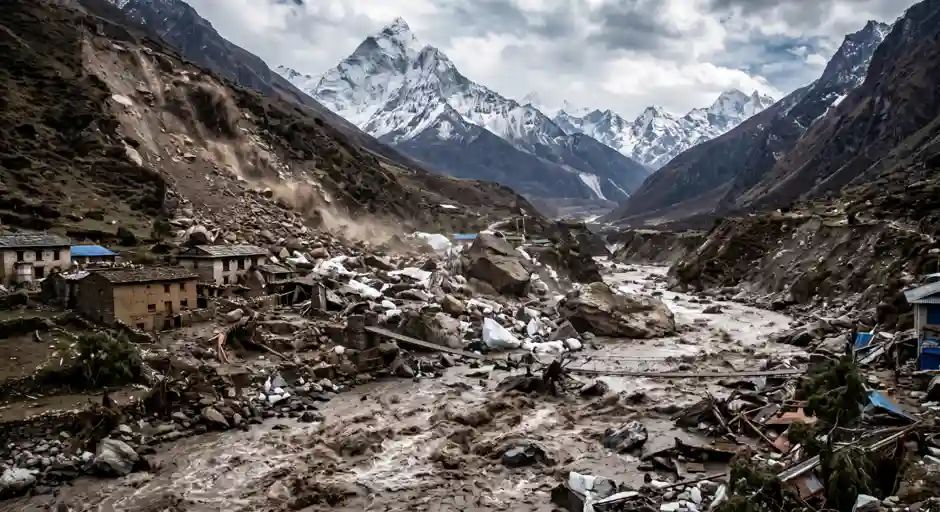
A river can rise slowly. But what happens when millions of tonnes of ice, rock and water suddenly move downhill at once? That is what happened in Nepal on August 26, when a devastating flash flood struck communities near the country’s border with China. The disaster began high in the Himalayas and quickly developed into a chain reaction involving a glacier collapse, falling rock and ice, a river surge and a powerful debris flow.
The worst damage occurred in Rasuwa district, along the Bhote Koshi River and its tributaries. The flooding destroyed roads, bridges, buildings and hydropower infrastructure and swept people and vehicles downstream. Communities farther along the Trishuli River were also affected. But this was not simply a case of heavy rain filling a river.
According to preliminary investigations, a section of glacier near Langtang Lirung destabilised and collapsed. The falling ice and rock entered the Lhende Khola river system in Tibet, producing a huge mass of debris and water. The debris temporarily blocked part of the river, creating a dangerous buildup upstream. Then the blockage failed. Once the stored water and debris were released, they rushed downstream with enormous force. Instead of behaving like ordinary flowing water, the mixture carried mud, boulders, ice and broken material. This type of fast-moving mixture is known as a debris flow. The sudden surge dramatically raised river levels. In parts of the region, the Trishuli River reportedly rose by as much as nine metres within about 30 minutes, leaving very little time for people near the river to react.
The disaster shows how Himalayan floods can be so difficult to predict. A dangerous event does not necessarily have to begin where the damage eventually occurs. A glacier can collapse high in the mountains, trigger a landslide or temporary river blockage, and send a surge hundreds of kilometres downstream.
Scientists are also examining the role of a warming climate. Higher temperatures can contribute to glacier retreat and destabilisation of ice and rock in high mountain regions. However,they are still investigating the exact chain of events behind this particular collapse, so it would be premature to attribute the disaster to climate change alone.The tragedy is a reminder that in the Himalayas, ice, rock and water are closely connected. A collapse that begins thousands of metres above sea level can become a wall of mud and water far downstream within minutes. And as the mountains continue to change, understanding these connections could become just as important as rebuilding after the disaster.
Sources: