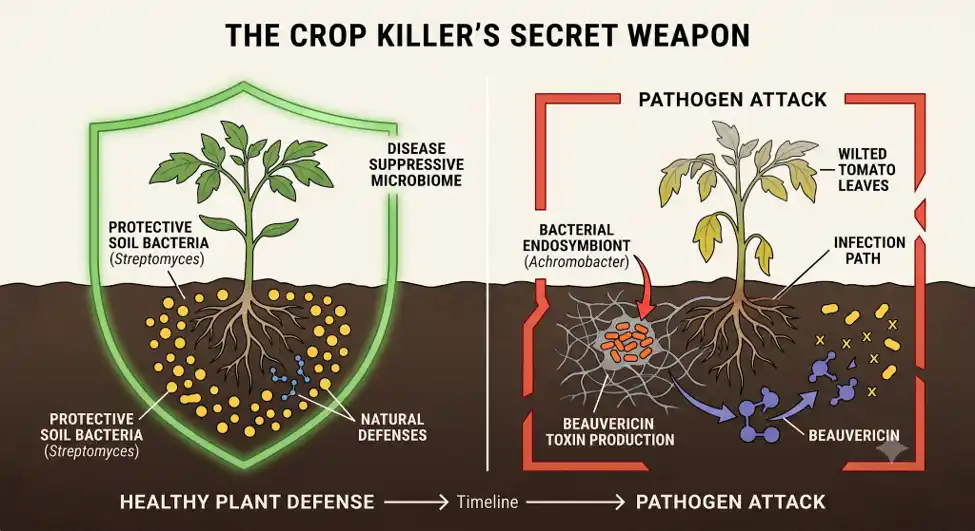
Tomato plants have a bodyguard team of helpful soil bacteria. Scientists have just found out how one of the world’s worst fungi gets rid of them, and it does not do the job alone.
Every tomato plant is standing in a crowd. The soil around its roots holds billions of bacteria, and some of them are on the plant’s side. They attack invading fungi, compete with them for food, and even switch on the plant’s own immune system. Scientists call this the disease suppressive microbiome, and it is a real line of defence, as important in its way as the plant’s internal immunity. So when a fungus wants to attack a root, it has to get past the bodyguards first.
A new study in Cell Host and Microbe by a team from China, Spain and the United States shows how one notorious fungus does exactly that. And the trick involves a partner nobody expected: bacteria living inside the fungus itself.
The fungus in question
The villain here is Fusarium oxysporum f. sp. lycopersici, usually shortened to FOL. It causes Fusarium wilt of tomato, where leaves yellow, the plant droops, and eventually it dies from the inside as its water pipes are blocked. The wider Fusarium oxysporum group is among the ten most destructive plant fungi on earth and attacks about 100 different plant species. Fungal diseases like this wipe out roughly 14% of the world’s crop yield every year and are the reason for about 17.5% of all pesticide use.
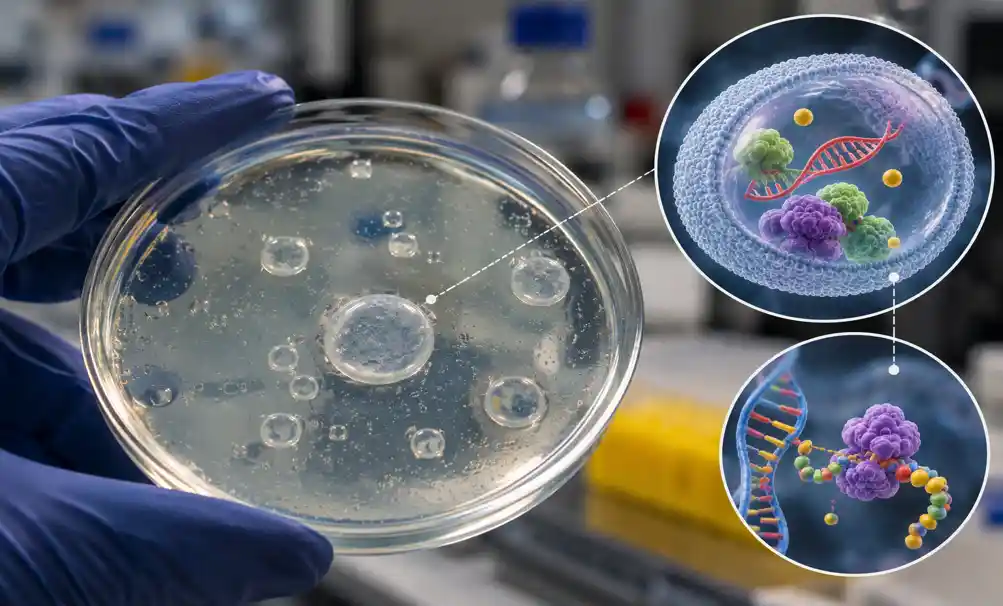
When the researchers looked closely at the fungal threads, they found bacteria living inside them. The bacteria belonged to a group called Achromobacter, and they were alive and well inside the fungus, passed down through generation after generation as the fungus grew. This kind of tenant is called an endosymbiont.
The clever experiment
Here is the part that makes the study convincing. The team took the fungus and treated it with antibiotics until the bacteria inside were gone. They called this the cured fungus. Then they put the bacteria back in, making a restored fungus. So they had three versions of the same organism: with bacteria, without bacteria, and with bacteria returned.
The cured fungus was noticeably less dangerous. Tomato plants infected with it stayed much healthier, and there was less fungus in the soil around their roots. Put the bacteria back and the fungus turned nasty again.
Then came the detail that pointed to the real mechanism. The difference between the two versions was much bigger in ordinary field soil than in sterilised soil. If the bacteria were simply making the fungus stronger, the gap should have been the same either way. Instead, the effect depended on the presence of other soil life. Something about the bacteria was helping the fungus deal with the plant’s microbial bodyguards.
The chemical hit job
The bacteria themselves were harmless. Put them into soil alone and tomato plants grew perfectly normally. They also did not attack the helpful soil bacteria directly.
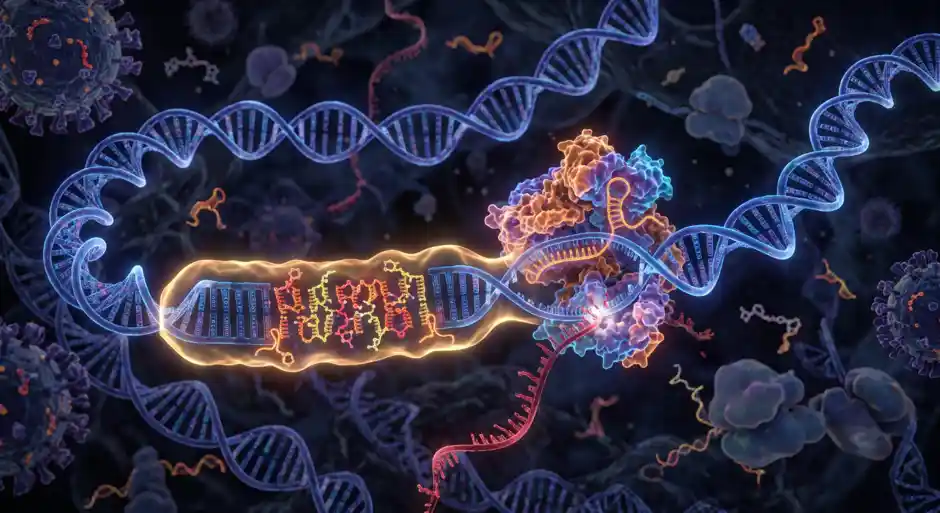
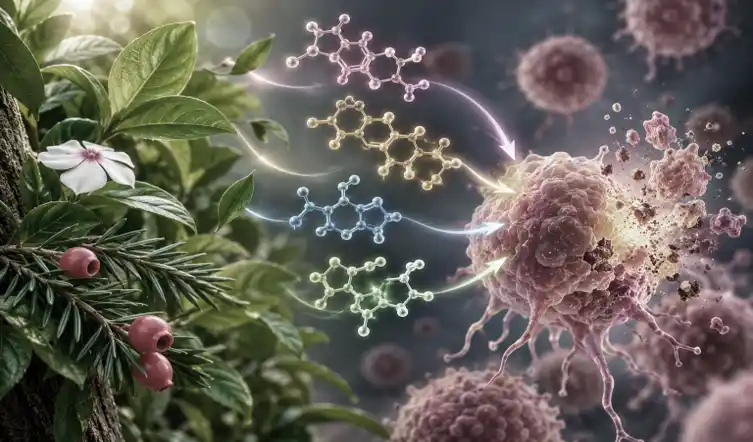
What they did instead was change the fungus. In their presence, the fungus switched up a gene and pumped out far more of a compound called beauvericin, a toxin already known from various fungi. The bacteria cannot make beauvericin themselves. They do not even carry the gene for it. They simply push their host into making more.
And beauvericin turned out to be a targeted weapon. It knocked back Streptomyces, a group of soil bacteria famous for protecting crops. One strain, isolated by the team from tomato roots and named St52, could slow the fungus in a dish and clearly reduced wilt in pots. But its power depended on who it was fighting. Against the cured fungus, St52 cut disease by about 60%. Against the version carrying bacteria, only about 32%. The toxin was blunting the bodyguard.
To be sure, the team deleted the beauvericin gene from the fungus. With that gene gone, having bacteria inside no longer gave the fungus any advantage at all.
Soil with a memory
The final experiment is the one worth remembering. The researchers added beauvericin straight into soil, with no extra fungus. The Streptomyces population dropped. Then they took a small amount of that treated soil, mixed it into clean soil, grew a fresh generation of tomato plants, and infected them. Those plants got sicker than plants grown in soil that had never seen the toxin.
In other words, the damage outlived the chemical. The toxin had reshaped the community of bacteria in the soil, and the soil itself had become a worse place to be a tomato.
Why it matters
This changes how we picture a plant infection. It is not one fungus against one plant. It is a fungus carrying a bacterial passenger that alters its chemistry, using that chemistry to clear away the plant’s bacterial allies, so the plant is left facing the attack with fewer friends.
That also opens two doors. One is to strengthen the protective bacteria in farm soil so they can hold their ground. The other is stranger and more interesting: interfere with the partnership inside the fungus. Take away the bacterial tenant and the crop killer loses much of its bite, without anyone spraying a single drop of fungicide.
Source:
Zhou, X., Zhang, X., Ran, L., Liu, D., Jia, H., Zhang, J., Zhang, N., Khashi u Rahman, M., Jousset, A., Dini-Andreote, F., Wu, F., & Wei, Z. (2026). Bacterial endosymbionts enhance fungal virulence by disrupting the disease suppressive rhizobiome. Cell Host and Microbe, 34(9), 1704–1715. https://doi.org/10.1016/j.chom.2026.08.001
Dean, R., Van Kan, J. A. L., Pretorius, Z. A., Hammond-Kosack, K. E., Di Pietro, A., Spanu, P. D., Rudd, J. J., Dickman, M., Kahmann, R., Ellis, J., & Foster, G. D. (2012). The top 10 fungal pathogens in molecular plant pathology. Molecular Plant Pathology, 13(4), 414–430. https://doi.org/10.1111/j.1364-3703.2011.00783.x
Caloni, F., Fossati, P., Anadón, A., & Bertero, A. (2020). Beauvericin: The beauty and the beast. Environmental Toxicology and Pharmacology, 75, 103349. https://doi.org/10.1016/j.etap.2020.103349