Plants, animals, fungi and humans all belong to one enormous branch of life: eukaryotes. Our cells contain nuclei, mitochondria and intricate internal structures that allow them to perform vastly more complex functions than typical bacteria.
But where did this complexity come from?
Scientists are increasingly looking toward a strange group of microorganisms called Asgard archaea for answers.
Meet the Asgards
First identified from DNA recovered from marine sediments in 2015, Asgard archaea are single-celled organisms that appear to be among the closest known microbial relatives of eukaryotes. Their genomes contain genes once thought to be almost exclusively associated with complex cells including genes involved in cytoskeleton formation, membrane trafficking and cellular organization.
For years, however, there was a major problem: scientists could mostly study Asgards through their DNA because the organisms were extremely difficult to grow in the laboratory.
That is now changing.
Researchers have successfully established cultures of several Asgard species and are beginning to observe what these remarkable cells actually look and do like. Some have long, branching protrusions extending from their cell surfaces. These structures may help them move, interact with other microorganisms or exchange resources.
The ancient partnership that changed life
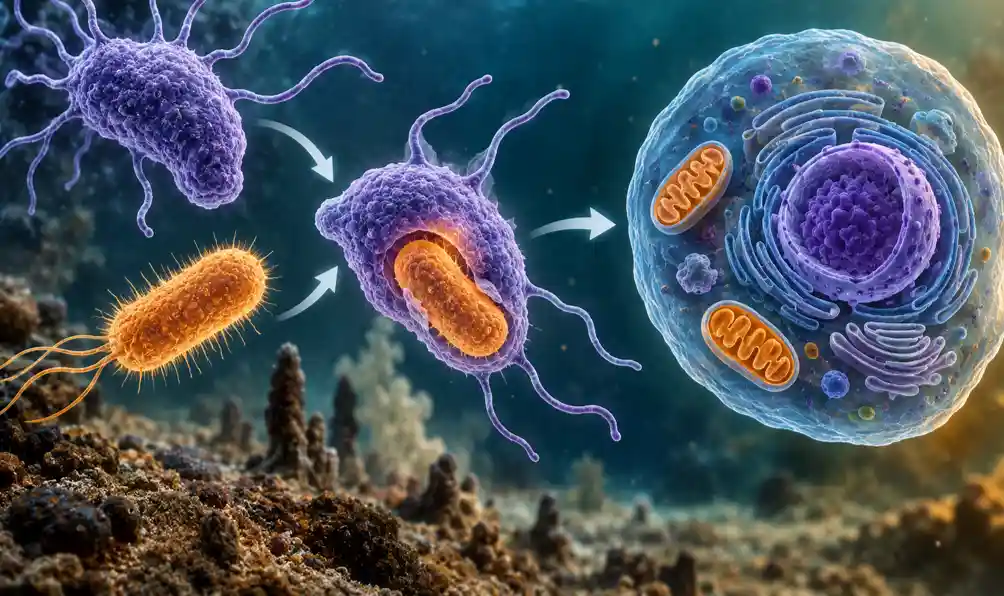
The leading explanation for the origin of eukaryotic cells involves a remarkable biological merger.
Roughly two billion years ago, an archaeal cell is thought to have formed a lasting partnership with an alphaproteobacterium. That bacterium eventually became the mitochondrion the energy-producing organelle found in almost every modern eukaryotic cell.
This process, known as endosymbiosis, may have transformed the biological possibilities available to the host cell.
But scientists still do not know exactly how the two organisms came together.
Recent research provides an intriguing clue. A 2026 study found evidence that some Asgard archaea possess molecular machinery for using oxygen and protecting themselves from its damaging effects. This could help explain how an archaeal lineage and an oxygen-using bacterial partner could have interacted during a period when Earth’s oxygen environment was changing.
What makes the discovery so important?
A 2026 Nature study concluded that Asgard archaea appear to have contributed substantially to many of the core cellular systems found in eukaryotes. The bacterial contribution, meanwhile, appears to have been especially important for energy-related functions associated with mitochondria.
This suggests that complex life may not have appeared through one organism suddenly becoming “complex.”
Instead, it may have emerged through a long evolutionary partnership between different kinds of microbes, followed by the gradual integration of their biology.
We may therefore owe the complexity of every animal, plant and fungus to an ancient microbial collaboration.
And remarkably, scientists are now studying its descendants living cells hidden in ocean sediments to reconstruct how that transformation happened.
Sources: