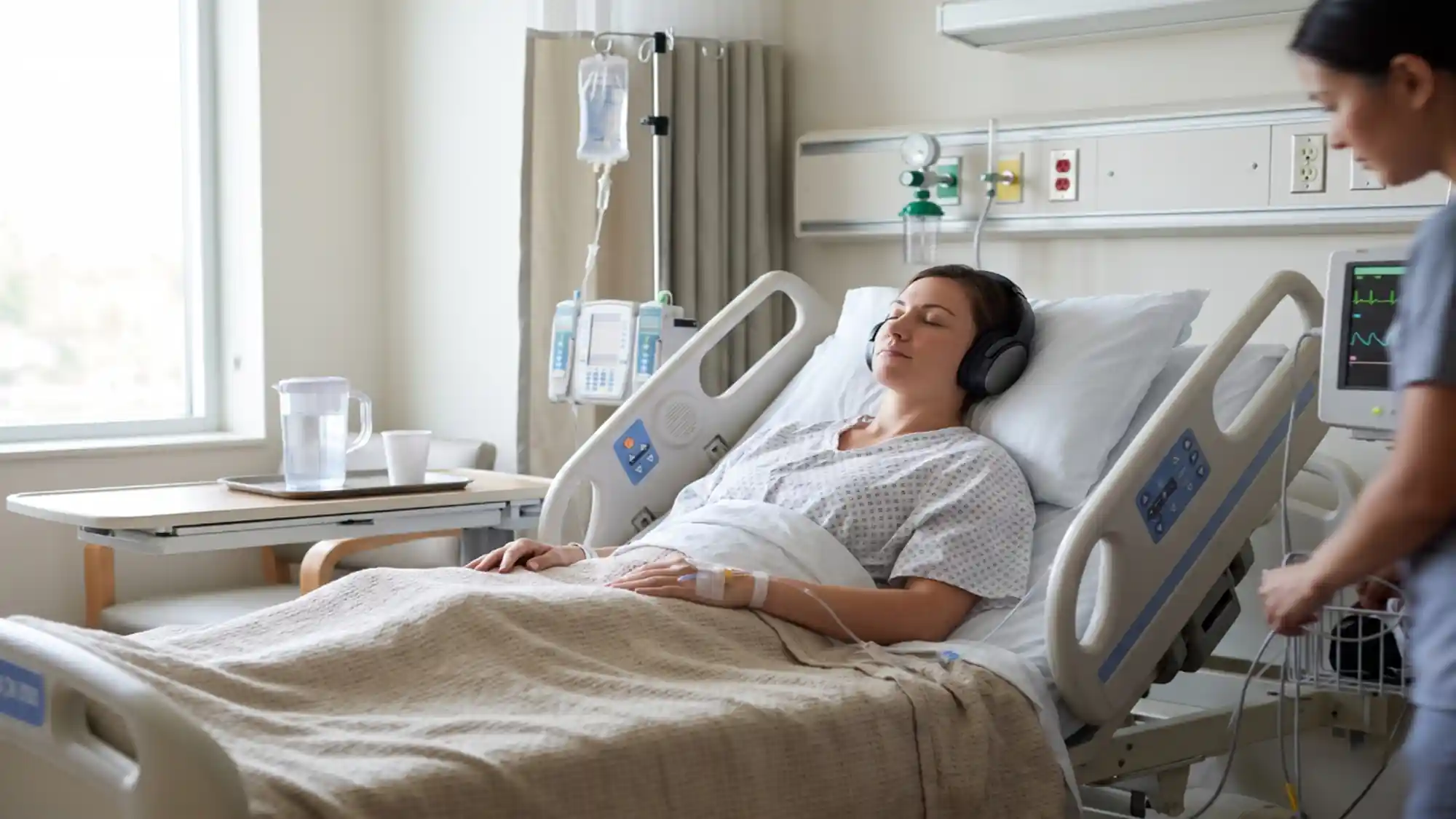
Noise-cancelling headphones are usually associated with peaceful flights, busy offices and uninterrupted music. But what if they could also help patients recover from surgery with less nausea and vomiting? A recent clinical trial suggests that reducing the sounds patients are exposed to while under general anaesthesia may lower the likelihood of one of the most unpleasant side effects of an operation. The study, presented at the American Society of Anesthesiologists’ ANESTHESIOLOGY 2026 annual meeting, involved 192 adults undergoing minimally invasive gynaecological surgery. Researchers found that patients who wore noise-cancelling headphones during their operations experienced less postoperative nausea and vomiting than those who did not.
Postoperative nausea and vomiting (PONV) is a common complication of surgery and anaesthesia. It can cause considerable discomfort, delay recovery, increase the need for additional medication and, in some cases, lead to dehydration or a longer stay in the recovery room. Anaesthetic agents, opioid painkillers and individual susceptibility are recognised contributors. Researchers are now investigating whether the operating-room environment may also influence recovery. In the trial, participants were randomly assigned to one of two groups. One group wore commercially available, over-the-head noise-cancelling headphones from the beginning of anaesthesia until the operation ended. The other group underwent surgery without them. Importantly, both groups received the same anaesthesia and standard medication to prevent nausea and vomiting. This allowed researchers to investigate whether reducing noise could provide an additional benefit alongside existing preventive measures.
What did the researchers find?

Within 48 hours of surgery, 35.4% of patients who wore headphones experienced postoperative nausea or vomiting, compared with 52.1% of patients who did not. That represents a relative reduction of approximately 32%. In practical terms, around 17 fewer patients per 100 experienced these symptoms in the headphone group under the conditions tested. Patients who wore headphones also experienced less severe symptoms during the first 24 hours after surgery. The researchers reported no increase in adverse events associated with headphone use. The operating-room sound levels averaged approximately 66 decibels roughly comparable to a normal conversation in a moderately noisy environment. Although patients under general anaesthesia are not consciously aware of their surroundings, their brains may still respond to some sensory input.
How could blocking noise make a difference?
The exact biological mechanism remains uncertain. The researchers suggest that sound exposure during anaesthesia may influence physiological processes involved in the body’s response to surgery, potentially affecting postoperative symptoms. However, the trial did not establish precisely how noise reduction lowered nausea and vomiting. Further studies measuring sound exposure and the body’s responses during anaesthesia will be needed to explain the connection. There are also important limitations. The trial included a relatively small group of patients undergoing one category of surgery at a single centre. Its results may not apply to other operations or patient populations, and larger studies are needed to confirm the findings.
Could headphones become part of routine surgical care? The approach is attractive because it is simple and does not require another medication. If further research confirms the benefit, noise isolation could become an additional option for reducing postoperative discomfort. For now, headphones should not be considered a replacement for established anti-nausea medication or anaesthetic care. The study offers an intriguing possibility rather than a universal solution. Sometimes, improving recovery may involve more than the drugs patients receive. Paying attention to the environment in which surgery takes place could also reveal practical ways to make the experience safer and more comfortable.
Sources
Fu C, Xia F, Yan Z, Xu HB, Zhao WM, Lei YS, Xu C, Huo WW, Tao DD, Wang J, Shan XS, Peng K, Liu H, Ji FH, Liu HY. Effect of intraoperative noise isolation on postoperative nausea and vomiting in patients undergoing gynecological laparoscopic surgery: protocol for a randomized controlled trial. BMC Anesthesiol. 2025 Jan 30;25(1):48. doi: 10.1186/s12871-025-02924-3. PMID: 39885403; PMCID: PMC11780904.