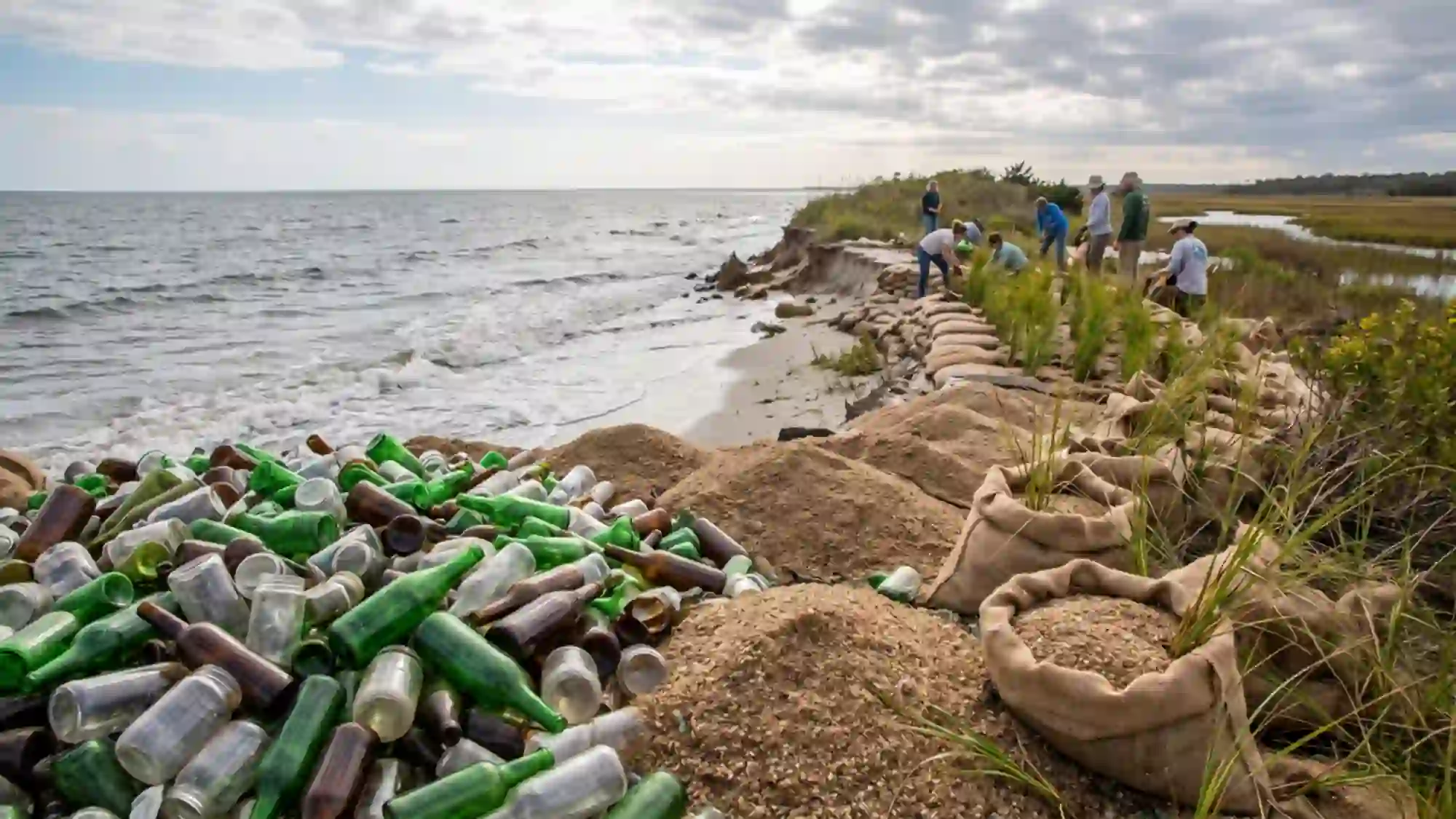
What if discarded glass bottles could help rebuild coastlines? As beaches and wetlands disappear under the pressure of rising seas and coastal erosion, researchers are exploring an unusual alternative to conventional sand: finely processed glass waste. By turning used bottles into sand-like material, scientists hope to create another source of sediment for restoring vulnerable coastal environments while reducing the demand for naturally mined sand.
The challenge is particularly serious in Louisiana, USA, where coastal erosion has caused extensive land loss. The state loses approximately a football field’s worth of land every 100 minutes. Rising sea levels, stronger storms, oil and gas extraction, and changes to the Mississippi River have all contributed to the problem. Coastal restoration projects often rely on sand and sediment dredged from rivers or offshore areas to rebuild shorelines and barrier islands. However, these materials are becoming increasingly difficult to obtain sustainably. Extracting large quantities of natural sand can also damage riverbeds, coastal habitats and marine ecosystems.
A New Orleans-based recycling company, Glass Half Full, has been processing discarded glass bottles into sand and gravel for potential use in coastal restoration. The material is being investigated through Project ReCoast, a five-year research collaboration with Tulane University, supported by the US National Science Foundation. Before recycled glass sand can be used on a larger scale, researchers need to establish whether it affects the organisms living in coastal environments. In a study published in the journal Restoration Ecology, researchers examined five native estuarine species: Atlantic croaker, Gulf killifish, blue crab, white barnacle and eastern oyster. A total of 340 animals were exposed to different sediment types, including fine recycled glass sand and mixtures containing coarser recycled glass. Other groups were exposed to conventional sediments or kept in aquariums without sediment for comparison. The animals were monitored for approximately 30–38 days. Researchers recorded 45 deaths across the experiment, but their analysis found no significant differences in survival between animals exposed to recycled glass sand and those exposed to the other sediment treatments. Most deaths were attributed to factors such as animals attempting to escape their aquariums rather than their interaction with the glass material. The findings suggest that recycled glass sand did not cause additional short-term mortality in the five species examined. However, survival alone cannot establish whether the material is completely safe. It may still affect feeding, respiration, growth or delicate tissues such as the gills and digestive tract. Researchers are investigating some of these possible longer-term effects. There are also practical limitations. The amount of glass available for recycling is limited, and producing enough material for large restoration projects may not be economically feasible everywhere.
Recycled glass is therefore unlikely to replace natural sediment entirely. Instead, it could become one more tool in coastal restoration, particularly in places with a reliable supply of glass waste. Turning discarded bottles into material that may help rebuild threatened habitats offers an interesting example of how recycling can contribute to environmental conservation.
Sources
• Wiley- Gaining ground: survival of native estuarine fauna exposed to recycled glass sand, a potential material for coastal restoration
• Mongabay- Recycled glass offers a potential new tool to restore a vanishing coastline
Can old glass help save a coastline from disappearing?
Researchers in Louisiana are testing recycled glass-bottle sand as a supplement to dredged sediment for coastal restoration, and a study of five estuarine species found no extra short-term deaths, though longer-term safety and limited glass supply mean it can only be one tool among many.