From a simple pregnancy test to sophisticated laboratory analysers, immunoassays have become an important part of how modern medicine detects and monitors disease. They may look like ordinary tests, but behind the small strip or laboratory machine lies a highly organised biological detection system. In many ways, an immunoassay works like a lock and key, where the right antibody recognises the right antigen.
When a doctor orders a blood test, patients may not think about the science happening behind the scenes. Yet, many of the results that help doctors understand what is happening inside the body rely on a powerful biological principle: the specific interaction between an antibody and an antigen. This is the foundation of immunoassays, a group of diagnostic tests that can detect and measure hormones, proteins, antibodies, drugs, infectious agents, and other important biomarkers. The antibody acts like a careful security guard, checking for its particular target among countless other molecules. It does not simply “look around”, it searches for a specific biological signal.
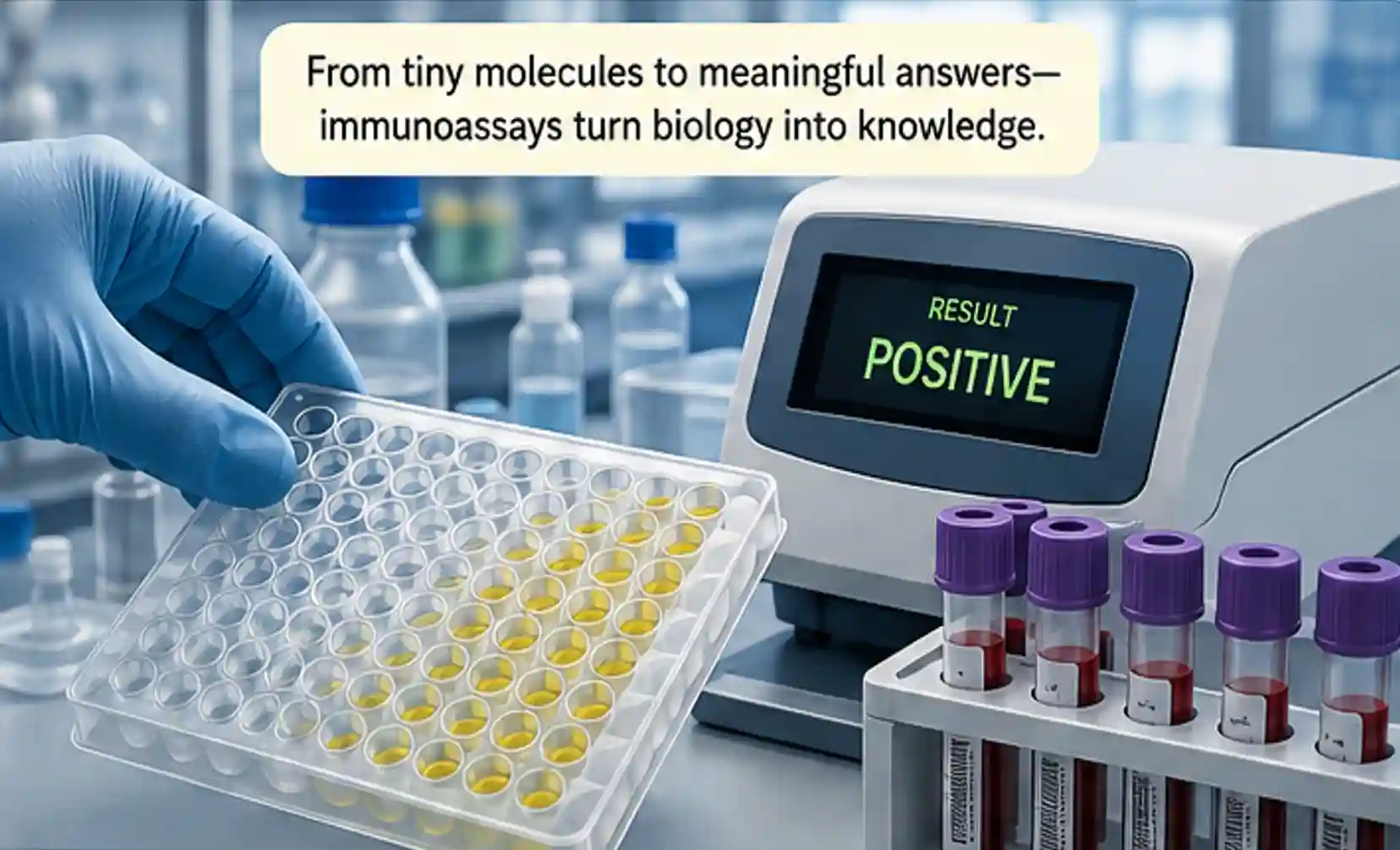
One of the best-known immunoassay techniques is the enzyme-linked immunosorbent assay (ELISA). Because it is reliable, versatile, and relatively easy to perform, ELISA has been widely used in clinical laboratories, research, and disease screening. Depending on the design, it can detect either antigens or antibodies and can be adapted to different testing requirements. The name may sound complicated, but the basic idea is surprisingly simple: find the target and produce a signal that can be measured. It is a little like putting a flag on the molecule that scientists are trying to find.
ELISA has also become a workhorse of immunodiagnostics. Once the target is captured, an enzyme-linked detection system produces a measurable signal, often through a colour-changing reaction. The stronger the appropriate signal, within the test’s working range, the more target may be present. This simple principle has helped turn invisible biological events into visible and measurable information.
As diagnostic technology has advanced, newer immunoassay formats have brought greater speed, sensitivity, and automation. Chemiluminescent immunoassays (CLIA), for example, measure light produced during a chemical reaction. Their excellent sensitivity and ability to work with automated laboratory systems make them particularly useful when thousands of patient samples need to be tested efficiently. Fluorescence immunoassays (FIA) use fluorescent signals to identify target substances and can provide rapid and sensitive results. Here, light becomes the messenger, carrying information from an invisible molecular reaction to a laboratory instrument.
The principle is almost like turning a whisper into a loudspeaker message. A biological interaction that cannot be seen directly is converted into a signal that an instrument can detect and quantify. This is where diagnostic science meets engineering, making tiny molecular events easier to measure at scale.
Not every test needs a large laboratory analyser. Lateral flow immunoassays (LFIA) are designed to be simple, portable, and quick. The familiar home pregnancy test is a classic example. Similar technology is used in a range of point-of-care tests, allowing results to be obtained close to the patient without complex laboratory equipment. These tests bring the laboratory closer to the patient, sometimes literally placing a diagnostic tool in the palm of a person’s hand.
The beauty of lateral flow testing lies in its simplicity. A sample moves across a specially prepared strip, and molecular interactions create a visible signal. In everyday language, the test is doing a small scientific treasure hunt, searching for its target and displaying a clue when it finds it. Sometimes, the simplest-looking technology has a surprisingly sophisticated science underneath.
Older technologies also played an important role in the development of immunodiagnostics. Radioimmunoassay (RIA) offered extremely high sensitivity and was particularly valuable for measuring hormones and other substances present in very small amounts. However, because it uses radioactive materials, many applications have gradually shifted towards safer, non-radioactive technologies. Western blotting is another antibody-based technique that remains valuable for detecting specific proteins, particularly in research and specialised diagnostic applications. Science often moves forward by replacing an older tool with a safer or more convenient one, but the knowledge gained from earlier methods remains part of the foundation.
The history of immunoassays is therefore a story of evolution rather than overnight revolution. What began with highly sensitive but technically demanding approaches gradually expanded into safer, faster, and more automated platforms. As the old saying goes, “Necessity is the mother of invention”, and the need for faster and safer diagnosis has continually pushed immunoassay technology forward.
The impact of immunoassays can be seen across healthcare. They are used to detect infectious diseases, measure thyroid and reproductive hormones, monitor cardiac biomarkers, investigate autoimmune disorders, support cancer assessment, and monitor therapeutic drug levels. They can also help clinicians understand how a disease is progressing and whether a treatment is working. In this way, immunoassays provide more than numbers on a report, they provide clues that help clinicians piece together the biological story of a patient.
What makes immunoassays so valuable is their combination of specificity, sensitivity, flexibility, and speed. They can be adapted for sophisticated automated laboratories as well as simple point-of-care testing. In diagnostic medicine, this combination is powerful because the best test is not always the most complicated one, it is the one that provides reliable information when and where it is needed.
There is also an important lesson hidden in the technology. A test may be small, but the information it produces can have a big impact. A single visible line on a test strip or a signal recorded by an analyser may represent a complex chain of molecular recognition and measurement. In that sense, immunoassays make the invisible visible.
As healthcare continues to move towards earlier diagnosis, personalised treatment, and testing closer to the patient, immunoassays will remain an important part of the diagnostic landscape. What began as a clever use of the body’s immune response has evolved into a sophisticated family of technologies, quietly helping laboratories generate the information clinicians need to make better decisions every day. The science may happen at the molecular level, but its impact reaches all the way to the patient. In diagnostics, seeing the unseen can make all the difference.